
ROMA (ITALPRESS) – Easter holidays in chiaroscuro, the destination Italy keeps but warns the weight of the ongoing conflict in the Middle East. The estimated presences are 14.1 million with a slight decrease of -1.3%, two hundred thousand appearances less than the previous year. Foreign tourists represent 58.9% of the market for a total of 8.3 million overnight stays (-1.4%), while for Italians there are 5.8 million (-1.2%). These are the main results that emerged from the investigation of the Centro Studi Turistici in Florence, for Assoturismo Confesercenti, on a sample of 1,087 Italian companies of hospitality.
The Easter holidays, although historically the flyer for the spring season, this year suffer from the strong climate of geopolitical instability. For all Italian macro-areas a decline is expected, with a decrease more accentuated in the South and Islands (-2.0%) and in the Center (-1.8%). For mountain resorts there is a substantial stability of tourist flows, thanks to foreign markets, while the cities of art are confirmed to be driving destinations despite the estimated bending of -0.8%. They are once again foreign visitors to drive Easter tourism in Belpaese. Revenues from Austria, France, Germany, Netherlands, Poland, Switzerland, Rep. Czech and Hungary; while proceeds from USA, Canada, Australia, Great Britain, China, Japan, India and South Korea are falling. Tourists of Belgium, Brazil, Spain and Scandinavia can be established. “We are in a phase of strong uncertainty.
“The ongoing conflict in the Middle East and the consequent international tensions begin to make their own effects on Italian tourism. Cancellations of intercontinental flights, air fare increases, revocation of reservations and perception of insecurity by travellers discourage”, explains the President of Assoturismo Confesercenti Vittorio Messina.
“The crisis has already produced negative effects for travel agencies and the whole outgoing tourism sector, but the first pickups begin to register also on the incoming front with the slowdown in international flows and a cooling of reservations by some important non-European markets. Yet, in the first three months of the year, the tourism sector had demonstrated a remarkable ability to adapt to market fluctuations, despite the slight decline in attendance. It is necessary a decisive and rapid intervention in support of the enterprises of the entire supply chain that find themselves to suffer a condition of absolute uncertainty”, concludes Messina.
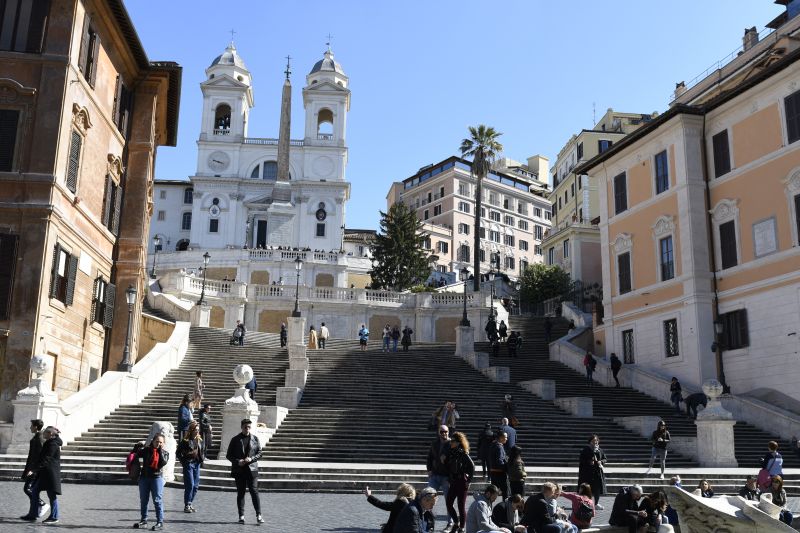
– Photo IPA Agency –
(ITALPRESS).
