
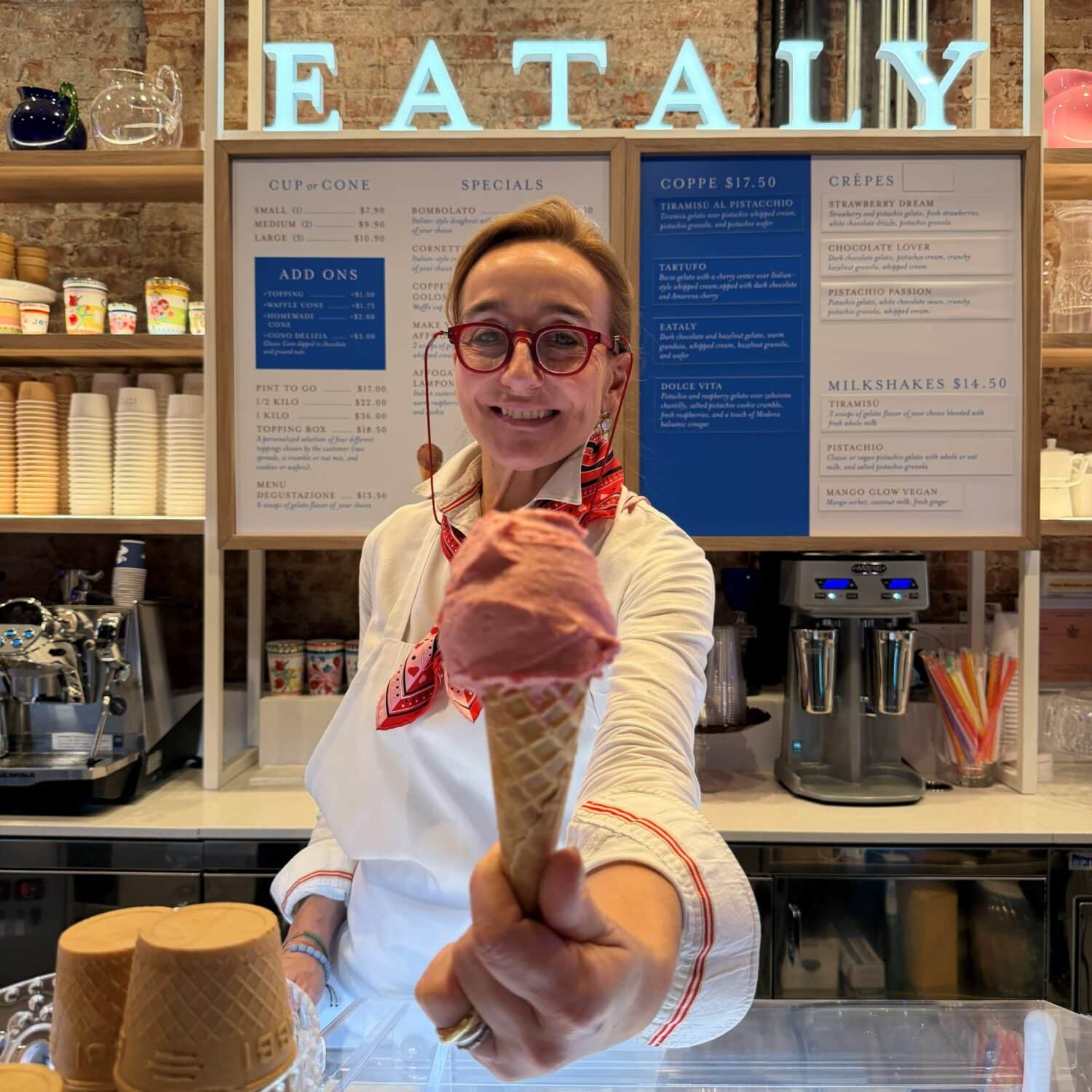
Patrizia Pasqualetti, one of the most widely recognized Italian master gelato makers in the United States, spoke to ilNewyorkese on Claudio Brachino’s podcast Ritratti, recounting a journey that took her from Orvieto to Milan with her family, then to California, and finally to New York, where she now leads “La Gelateria di Eataly by Patrizia Pasqualetti” in the Flatiron district. In her words, gelato is not just a product but a universal language capable of telling the story of Italian culture through simple ingredients, artisanal technique, and a precise idea of everyday happiness.
“Our place is one where the tradition and innovation of Italian gelato coexist,” Pasqualetti explains, describing her gelateria as “a point of happiness, a very interesting project, because it doesn’t just sell a product: it wants to tell a culture, a lifestyle, a way of feeling good, all starting from a cone or a cup of gelato.”
The family story that gave rise to everything begins in Orvieto, though it passed through the industrial Milan of its golden years. There, her father, after a career in the world of engines — “he had an especially keen ear; he also worked for Ferrari” — decided to change direction. “He felt that his life needed to change; he wanted to do something that would brighten people’s everyday lives.” So he opened a gelateria, bringing to the new profession the same rigor and precision he had applied to cars. “That’s where our story in the world of artisanal gelato began.”
The leap from the Apennines to the Pacific came when Patrizia Pasqualetti flew to California for a consultancy. It marked the beginning of a new chapter. “California fascinated me immediately: the climate, the lifestyle, the local products… I realized that I could continue our tradition there.” In Silicon Valley she opened a gelateria that combines zero-mile products with Italian know-how. “Gelato is a universal language,” she says, proving it every day by meeting customers from all over the world, drawn by the purity of the flavors and the strong identity of Made in Italy.
California thus became a natural laboratory where local ingredients and Italian craftsmanship meet and enhance one another. “Our Italian products remain central: pistachios, hazelnuts, excellences that are unparalleled. But to promote artisanal gelato, I also have to protect fresh ingredients: milk, fruit, everything that is part of the heritage of the country that hosts me.”
This combination has created a moment of mutual gratitude: they offer us their fresh raw materials, and we bring Italian tradition and technique. From this also came the pleasure of coming to visit us and truly discovering what a well-made gelato means.”
From the Pacific to the Atlantic the step may seem short, but New York represents a completely different horizon, laden with symbols: “New York represents, in so many ways, the city of the American Dream.”
The opportunity came with Eataly, which invited her to open a gelateria in the heart of Manhattan. “We’re in Flatiron, on 23rd Street, and we want to create not only an indulgent moment, but a cultural one, a moment of learning about ingredients,” she explains. Her sundaes are direct heirs of the gelato cups from Orvieto, while the gelato classes that Patrizia organizes with her staff teach how “simple ingredients — milk, sugar, fresh fruit — can be transformed into an extraordinary product through a process tied to tradition and supported by technological innovation, which makes it extremely pleasing to the palate.”
The result is a welcoming space, “a point of happiness that attracts, every day, a very diverse audience.”
For Patrizia Pasqualetti, happiness passes through gelato as an everyday gesture: “My father used to say that gelato is ‘consoling.’ It’s a small gift that doesn’t last long, but it’s intense. And fortunately it can be repeated: we have customers who come to ‘console themselves’ with our gelato every day. This confirms for us that this simple gesture truly has an emotional, almost therapeutic value.”
And daily experience confirms it: children who stop crying in front of a cone, couples who carve out a romantic moment, people who return every day for a fragment of serenity.
Behind the counter today work 37 people split between the East and West Coasts: “That’s relatively few for the United States, but a lot for Italy. For me they are a great responsibility and at the same time a great source of pride, because they are an integral part of our story of Italian identity in the world.”
The success of “La Gelateria di Eataly by Patrizia Pasqualetti” and the family’s other gelaterie also comes from Italian hospitality and attention to service: “We try to convey this happiness not only through the product, but through what is the tradition of Italian hospitality. My father always said that we must do customer service and provide good service whether we are selling gelato or selling a diamond.”
“Our team has been with us since we opened; they are proud to represent a piece of Italy and of this product. This shows, and the customer perceives it, even when it’s a product that might seem ordinary. But gelato is anything but ordinary: it’s everything except ordinary.”
The topic of ingredients leads Patrizia Pasqualetti to speak about sustainability and a careful balance between Italian excellences and local products.
“To remain faithful to the family tradition, we work seriously with zero-mile products. From California to the East Coast, I immediately did exploratory work with farms that could supply us with raw materials of high flavor profile and great quality, also from an organic standpoint.
We succeeded: here we have excellent fruit, and particularly good milk. About 65–70% of our gelato is made with American raw materials. This allows us to work calmly even with tariffs,” she explains. Pistachios, hazelnuts, and some outstanding chocolates still come from Italy, but milk and fruit come from selected farms in the United States. “It’s a sustainable bridge: they offer us fresh raw materials, and we bring tradition and technique.” A model that enhances the territory in which they operate without betraying the Italian roots of the product.
In the world of gastronomy, Pasqualetti admits, gelato makers were long considered “children of a lesser god” compared to chefs and pastry chefs. But today something is changing. “Gelato is no longer just a comfort food: it’s a comfort healthy food,” she says.
“That’s also where the attention of institutions began. Important working groups were created, in which I participated especially in Los Angeles, where we have another gelateria run by my son Corrado, who represents the third generation of our business.”
It’s an evolution that excites her and confirms a truth that history had already written: “Auguste Escoffier said that the chef is imagination, the pastry chef is precision, but the gelato maker is perfection.” A definition she feels deeply reflects her own path.
Looking ahead, the future for Patrizia Pasqualetti tastes like education and outreach. “My dream is to educate the palate,” she says. Her sensory classes — where taste, smell, sight, and sometimes even music work together — represent the next chapter of her journey: “We explain how a single ingredient becomes a gelato, offering pleasure to all the senses.”
It is a project that brings together past and future, roots and innovation, Italy and America. A journey that, in her words, aims to continue to “educate people in the pleasure of life.”