
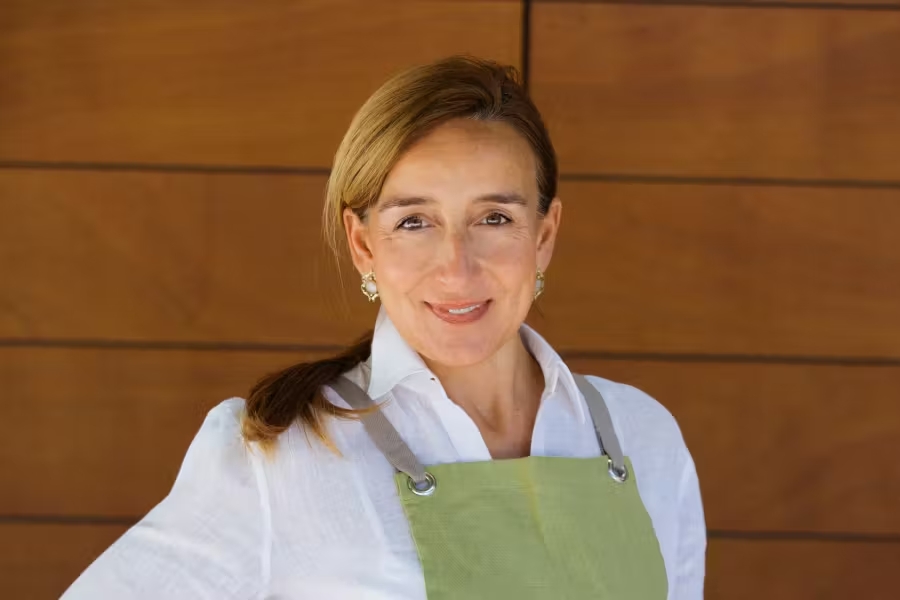
Patrizia Pasqualetti is an Umbrian gelato master and the custodian of a long-standing family tradition in Italian artisanal craftsmanship. Raised in a family devoted to gelato for generations, she combined the expertise inherited from her father with a strong drive for innovation. After refining the craft in the family laboratory, she brought the brand Gelato by Patrizia Pasqualetti to the United States, where she now runs several shops, including a new opening with Eataly in New York. Her work blends fidelity to traditional recipes with attention to sustainable ingredients. We interviewed her.
Which childhood or family memories brought you closer to artisanal gelato and to Italian food culture?
For me, gelato has always been a moment of joy and sharing, ever since I was a child. I remember afternoons in the countryside, at my grandmothers’ homes or by the sea, when the highlight of the day was snack time with gelato. My family did not originally come from the gelato world. My father worked in Milan in the motors sector, far from pastry or desserts. After a sabbatical year spent traveling and discovering new perspectives, he decided to follow a different passion: he wanted to create something “clean and fragrant” that could bring people joy. A great food enthusiast, he often took me, my sister, and my mother to discover interesting restaurants, meeting renowned chefs like Don Alfonso Iaccarino and Gualtiero Marchesi.
As a teenager, I studied Humanities, convinced that I would become a teacher. But, as often happens in Italian families, after some initial teaching experiences I understood that my path would follow the family business founded by my father in Orvieto in 1981: Gelateria Pasqualetti. The beginning was not easy. My father, extremely meticulous and detail-oriented, supervised everything. Only after years did I begin to work with the ingredients, always observing and learning from his precise and rigorous method.
When did you realize that gelato would become not just a passion, but a profession?
Step by step, my path in the world of gelato took shape, intertwining family passion with great care for quality and respect for raw ingredients. I have to say that, in a relatively short time, that initial curiosity turned into genuine passion. For me, gelato is no longer just a job or a dessert: it has become a way of life, a philosophy.
My father always valued the idea that, thanks to him, I could understand the origins of ingredients, study them, and recognize their worth. I learned to respect every fruit, every aroma, turning what seems like a simple task — making gelato — into a cultural act. And that allowed me to reconnect with my academic background: spreading food culture, telling the stories behind each ingredient and each production choice, is something that has always been essential to me.
Gelato has also become a teaching tool: not only to learn techniques, but to understand how to communicate them — how to convey the beauty and complexity of a craft that is often underestimated. Talking about gelato means telling a story of tradition, passion, and the pursuit of quality, and that’s something many people still don’t know how to do.
You often describe gelato as a perfect balance of creativity, technique, and sensitivity. What is your philosophy of gelato?
Behind every artisanal product there is passion, patience, love, and presence: these are the elements that make gelato special. Being Italian naturally gives us a certain credibility — we are perceived as ambassadors of culture, good food, and good wine, and this gives us an advantage from the start.
Gelato is also extremely popular and accessible, without a specific target, which makes it appealing to everyone. Our mission is to offer it in the best way possible, so that an international audience can appreciate it not only for its flavor, but also for its nutritional value. Real Italian gelato is healthy: low in calories, with little sugar, and based on high-quality ingredients. Staying true to this philosophy allows us to maintain the satisfaction of our customers, who increasingly value both the flavor and the lightness of our product.

Were there challenges in preserving the Italian tradition of gelato while innovating and adapting to an international audience like New Yorkers?
Challenges are always present. Every day brings different obstacles, especially when you work with people — something I consider fundamental within our team. You need to be able to manage daily issues, whether it’s trouble sourcing an ingredient or helping the team fully understand the value of our product.
However, the consistency, perseverance, and love that drive my mission allow me to face every day with great positivity. As for the American public, especially New Yorkers, the response has been extremely positive.
To anyone dreaming of bringing a piece of Italy — or of themselves — into the world, I would say: be entirely yourselves. It is essential to nurture your personality and face the world with confidence. Stay true to your identity, to Italian culture, and above all, to who you are.
I often think about the beginning of my story with a particular image: my father dreaming of seeing his daughters beside him in the laboratory. For him it was a romantic image, the desire to share passion and work with us, and that image has accompanied me from the very start.
What is most important for the customer to perceive: the flavor, the tradition, or the personal story?
It must be a perfect balance of all three. None should overpower the others. Our story helps us communicate the product we make, but the customer must feel at ease: they shouldn’t be overwhelmed by our history, but should simply experience the pleasure of what they’re tasting.
If they also remember that this gelato was made by me, Patrizia, and that it represents three generations of our family, that is a great source of joy for us. They become part of our community — but what we want above all is for them to remember the flavor: the emotion and the memory connected to a taste that lingers.
I’ve met people in the United States who, visiting Orvieto, told me: “I tasted your father’s gelato,” and it moved me deeply.