
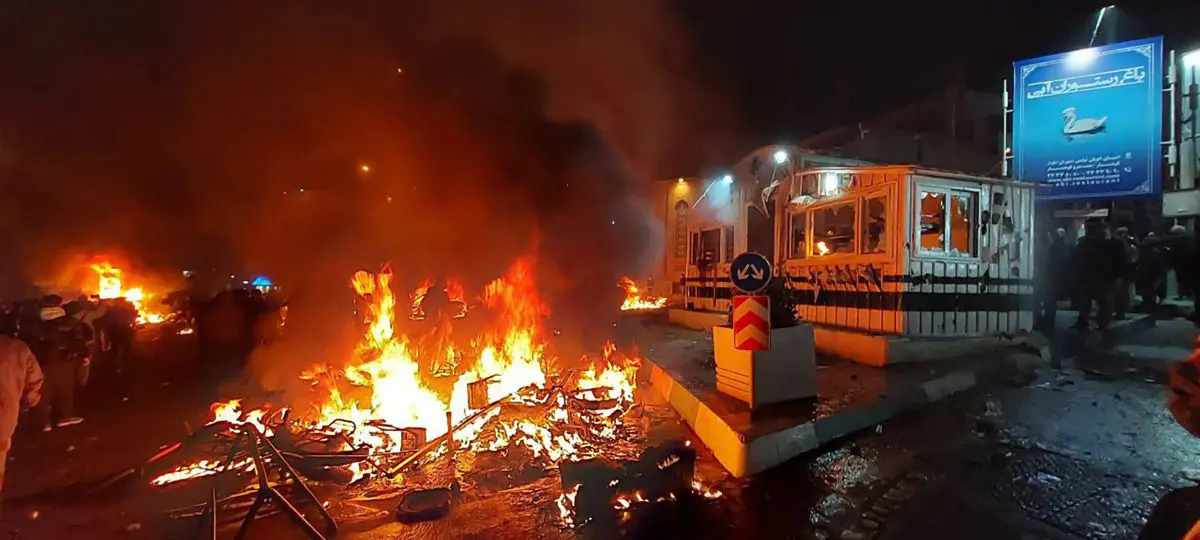
ROMA (ITALPRESS) – The situation in Iran, after 12 days of protests broke out in different cities both for the economic crisis and against the ayatollah regime, is hyperfluid and there are four possible scenarios: a strong repression of protests; the possible development of a shared leadership; an external intervention or the end of the theocracy expelled by the military. Considering the lack of information filtering from Iran after the internet blockade on January 8, however, it is unclear whether there has been an increase in demonstrations and time is a crucial factor to intervene in favor of protesters. This is what the expert of Iran Nicola Pedde, director of the Instituto for Global Studies, said in an interview with the Italpress agency in which he treated the new elements of the protests begun on 28 December 2025, the possible scenarios and the unknown, as well as the real affection of the protesters to the son of the last Sha, Reza Pahlavi.
This stage of protest “was characterized by many new factors. The most important is definitely the welding between three different groups,” said Pedde. Iran’s expert recalled that everything “was born as a protest linked to the economic crisis, corruption, in the mainly economical context of traders, bazaars, but it emerged as a reaction to the latest data of the rial-dollar change“, and the loss of purchasing power “has generated a generalized discontent”. Historically, traders have always remained on the margins of protests and participated only when their interests were affected. The protest of the traders “was almost immediately reached by that always present, in my opinion, in the Iranian social fabric of the youth components, but they have different motivations. Beyond the economic question, for the youth members the true element of discontent is that of the regime, that of the rights”, said Pedde, explaining that this component of the protesters “in fact asks for the fall of the Islamic Republic”.
The third “interest element”, continued Pedde, “was to see formations organized on an ethnic basis in some of the provinces not by a Persian majority of the country, especially those with Kurdish and Arab majority, where we have seen not only quite numerous formations, ready to engage security forces with methods other than those of traditional manifestations.” During the demonstrations in the Kurdish and Arab areas “we were assaulted by police barracks, the army, the participants had weapons, so they were far more structured organizations than the simple protesters.”.
“The welding of these three members of the protest is a huge fact of novelty, there is a mass of protest that on this occasion is really wide, has very diversified motivations between them and, therefore, arises the problem of having to manage what is actually a national emergency for the authorities of regime”, explained the director of the Instituto for Global Studies, which indicated also “different elements of continuity” seen as these three groups have not so much recognition in their internal leadership.
“They test very eclatatingly but there is not exactly a unitary design behind it,” said Pedde. Another element of novelty in this protest is the appearance of the figure of the son of the former Shah Reza Pahlavi who on international media seems to be “the coagulating element of this protest and the element of leadership”. At the moment “it is a little difficult to assess this ability of Reza Pahlavi because on one side it is outside the country since 1979, it has never again set foot and has always been on the margins of political life also because the Iranian diaspora is fractionatissima, the monarchics were now reduced to the minimum number even within the diaspora, the role of Reza Pahlavi was really minimal.”.
Suddenly, however, Pedde continued, “becomes the central element of the narrative of the diaspora, his name is repeatedly scanned also by numerous of the components that are on the road in Iran and that flank the imperial flag, the one with the lion and the sun, and therefore this becomes a bit in the general narrative the element that could constitute the leadership of this protest”.
In recent days, “it urges protesters to stay on the streets, risk their lives and keep the protest alive, probably more in the expectation that Americans could provide or intend to provide in the future a support for demonstrations.” Given this, “the first great unknown is to understand how effectively the figure of Reza Pahlavi is an ideological glue, because for what has been so far the spontaneous participation of Iranians in protests, we have never seen on the occasion of the previous this great interest in monarchy and for the former ruler,” said Pedde.
To melt the doubts about the real support of the protesters in Pahlavi “we should make evaluations that we cannot do today, because we do not have the data to be able to analyze them on the basis of these protesting groups”. The expert recalled that “even during the 78-79 revolution so many people scanned the name of Khomeini without actually wanting it at the top of an Islamic state. Khomeini represented the anti-monarchical element and therefore as such became a banner”, so today “it would be to understand how these are anti-regime or pro-monarchy slogans”.
As regards the reaction of the regime, “the first element was to split the protest, split it into it through a fairly basic strategy which, however, in the perspective of the regime, had to substantially lead to the bazaar component to abandon the roads and to bring back the terrorist activities”, said Pedde, recalling that the regime has said that there is a legitimate part of this protest, a part that has reasons, that is, who complains the economic crisis, the whole other traders.
“In a first phase the regime tried to manage this protest more pragmatically, also because there were threats from US President Trump to intervene in support of protesters – he added. The use of force was massively manifested only from January 8, when something changed. Access to the internet has been switched off, and from there a form of repression has begun that is probably still in place, which is generating a number of very high victims.”.
The expert has clarified that “it is difficult to say how many are, there are numbers ranging from 200 to 2 thousand, but undoubtedly the number of victims has become high, the number of arrested seems to be very high. There has been a mobilization of a military component of the Guardians of the Iranian Revolution (IRGC) and this is also another element of novelty, with the government not asking police or paramilitary forces, Basij, to manage this.”.
From 8 January “repression seems to have entered a dynamic so that it can then generate the usual effects of the application of force in Iran, to prevent these formations from obtaining any kind of result. At present “we are still in a very dynamic phase and we should understand what is actually happening on the level of participation in protests, because this is a fact that it is difficult to assess today, that is, if between 8 and 13 January, tomorrow, there has been a further and so consistent influx to the events”, according to Pedde.
In the interview, Pedde indicated the “4 scenarios in terms of possibilities and none of these can be excluded at the moment”. “The first is that of such a violent repression in which the regime succeeds in repressing all the mechanism of this revolt and therefore slowly through dead and arrested manages to end the protests and Iran returns where it was before, in crisis, increasingly weak, more fragile,” said Pedde. “The second scenario is the one in which this revolt succeeds, as it happened at the time of the revolution, to give itself a shared leadership that becomes the line of reference for the protest, one manages to give a type of movement, therefore a political program and at that point becomes a pre-revolutionary element and therefore has all the chances at that point to be able to catalyze further support between the population and get a result on the plan of the fall of the institutions of regime”, admits.
The third scenario could be that of an “external intervention by the United States or the United States and Israel. I believe it is one of the most dangerous because in the case of a military attack, the institutions of the Islamic Republic would probably evaluate an external intervention as an existential threat and therefore increase exponentially the use of force and the risk at this point of a widespread conflict within the country, of a real civil war,” he continued. Finally, the fourth scenario, “is an acceleration of a process of fact that is already in place, i.e. a substitution within the institutional system of leadership figures, therefore substantially of the second generation of the pasdarans that go to remove all the ornaments of theocracy and revolutionary pillars and turn Iran into a presidential-driven authoritarianism, but with a substantially leadership of military extraction at the top.”.
It would be a model like Egypt or Pakistan “and this could be accompanied, through the removal of the religious leadership that has always rejected the compromise with the United States, by the will instead of reaching a compromise with the United States and therefore substantially legitimize the new leadership that comes from the same environment, but which substantially changed its prerogatives.”.
This fourth scenario is in a certain way superimposed to Syria, where the former leader of the jihadists Ahmad al-Sharaa became the interim president and, Pedde explained, “it could be the transition that also for the United States is preferable from the point of view of stability, because it does not provoke the institutional collapse, the country of 90 million inhabitants remains intact, it manages to be governed by a military leadership that all assured.
While admitting that the scenario remains smooth, Iran’s expert pointed out that the time factor after the watershed on January 8, with the stop to the internet, could play a crucial role in this new protest in Iran that also calls for the fall of the ayatollahs. A possible US attack “if it really helps the protest should hit those that are the centers of repression, then hit the military structures of the IRGC” because “to strike the nuclear bases or missile systems does not give a great help to the protesters”, said Pedde. Or, it is not excluded “an escalation of a lesser nature, therefore having a lesser profile in the military profile and instead limiting itself to a strong action on the cyber plane, for example reestablishing internet communications and giving possibility to Iranians to show what happens”.
The “critical factor is time: this protest if it is not helped today or tomorrow, within 2-3 days, if the repressive capacity is as it appears, the regime will have the best”, said Pedde, concluding that “it is likely that the opportunity for a real intervention in favor of the protesters, and the risk is to be delayed in the ability to support the protests to turn them into a revolutionary process.”.
-Photo IPA Agency-
(ITALPRESS).
