
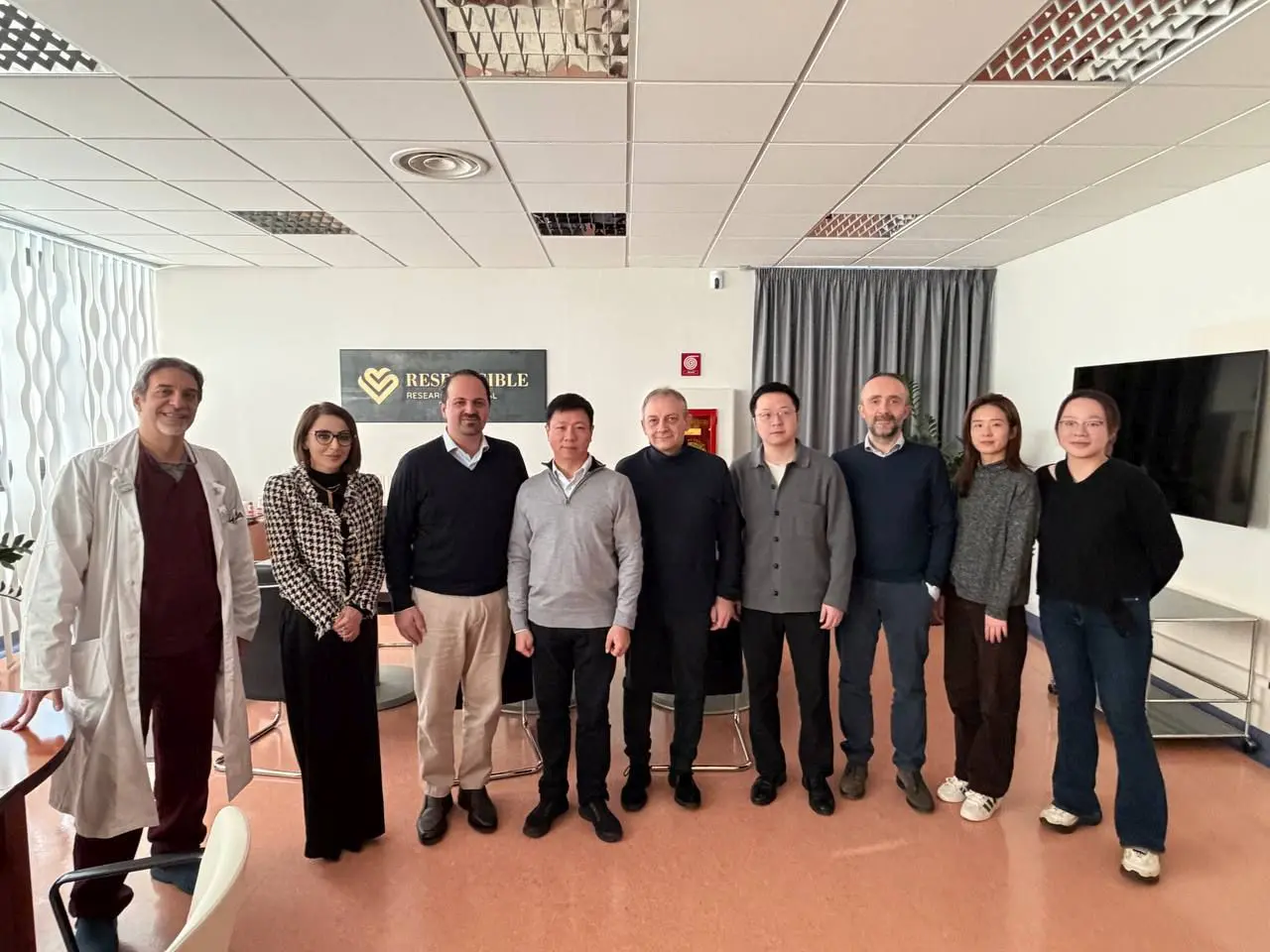
CAMPOBASSO (ITALPRESS) – Responsible Research Hospital accelerates the path towards Radiotherapy 4.0: on 22 and 23 January a technical-scientific meeting was held at the hospital with the international delegation of Manteia, dedicated to the implementation and clinical development of MOZI, a platform for planning the radiotherapy treatment based on Artificial Intelligence and oriented to make the adaptive radiotherapy applicable in daily practice. The initiative is a key step towards oncological innovation: Manteia has identified the Responsible Research Hospital as a European reference centre for the development and clinical introduction of the MOZI system, distributed in Italy by Tema Sinergie and developed within an international project led by Professor Allen Li (Medical College Wisconsin, USA). Adaptive radiotherapy (ART) allows you to adapt the treatment plan after sitting according to the patient’s anatomical variations, with the aim of optimizing effectiveness and reducing side effects. MOZI was born with a strategic approach: bringing the adaptive into the clinical routine by focusing on AI software and algorithms, making it faster and more solid processes such as segmentation and planning and encouraging adoption even on undedicated conventional accelerators. Oncological radiotherapy is a pillar in the treatment of solid tumors and requires maximum precision in hitting the tumor target by saving healthy tissues. Artificial Intelligence is now transforming the whole process, from image analysis to planning, to greater standardization and efficiency of clinical flows. The most significant leap is adaptive radiotherapy (ART), which allows you to update the sitting plan after sitting according to the anatomical variations of the patient, optimizing effectiveness and tolerance: a transition from system precision to a truly dynamic and personalized care. In this framework, the Responsible Research Hospital – where advanced techniques such as IMRT, VMAT, IGRT and radio surgery are already being used – starts a trial to develop and carry in clinical practice the ART through MOZI, a newly introduced advanced planning system on the market, distributed in Italy by Tema Sinergie and developed starting from the search for physicists of the Medical College of Wisconsin (USA) under the guidance of Prof. Allen Li. The goal is to make adaptive more and more feasible thanks to AI algorithm-based software solutions for fast segmentation and planning, reducing technological barriers and promoting clinical application even with undedicated accelerators. Based on the experience in technological innovation, the UOSD of Physics Medica and Sanitaria and the UOC of Oncological Radiotherapy of Responsible Research Hospital were identified by Manteia as a European reference for the development, implementation and clinical introduction of MOZI. On 22 and 23 January, objectives and operational activities were defined: among the first applications, a protocol for hypofractioned treatments of prostate cancer in extracranial stereotax technique, with subsequent extension to other districts, including head-neck and gynecological. In perspective, the path also aims at the integration between ART and radiomics and the development of predictive models (response, prognosis, toxicity) and tools supporting clinical decisions, to increase safety and quality of the treatment process. Among the protagonists of the two days, Dr. Savino Cilla, Director of the UOSD of Medical Physics of the Responsible Research Hospital: “The integration between medical physics, artificial intelligence and oncology is opening new trajectories for oncological therapy and precision medicine – he said –. The challenge is to maintain a virtuous balance between the analytical power of oneselfiA coat of arms and consolidated clinical experience, to develop increasingly targeted, personalized and efficient treatments. In addition to him, Professor Francesco Deodato, Director of the Department of Services and Laboratories and of the UOC of Oncological Radiotherapy ‘Molise ART’, contributed to outline the clinical horizon of implementation: “The artificial intelligence in radiotherapy opens up a clinical horizon in which the protocols evolve from rigidly standardized models to adaptive systems, able to update over time according to the anatomical and clinical evolution of the patient. An approach that allows continuous updating of therapeutic strategies, combining clinical flexibility, safety and reproducibility. In terms of customization, the AI exceeds the concept of ‘meaning patient, supporting increasingly calibrated decisions on the individual risk profile, response and treatment tolerance: protocols such as evolutionary tools and AI as a strategic enabler of quality, appropriateness and sustainability of oncologist care. In the context of the reflections that emerged during the two days, Dr. Gabriella Macchia, Head of the U.O.S. Radiotherapy for External Fascinations, shared some considerations on the subject, stressing that ‘the integration of advanced tools of artificial intelligence allows an increasingly personalized radiotherapy planning, improving dose accuracy and adaptation to the anatomical and biological characteristics of patients. In practice, AI supports definition of target volumes and organs at risk, plan optimization and quality control, reducing inter-operative variability and planning times, for more efficient, safe and sustainable care paths. In oncological gynecology it facilitates the management of high-complexity scenarios ( pelvic treatments and integration with brachytherapy) and adaptive approaches; in breastology promotes more reproducible planning of breast and lymph nodal volumes, saving healthy organs and secure implementation of hypofractioned protocols. The experience gained allows to extend these technologies to different districts, promoting increasingly integrated, adaptive and pazientè-centered radiotherapy. To mark the solidity of the project also on the plan of the organization and health governance, Dr. Giovanni Guglielmucci, Health Director of Responsible Research Hospital: ‘The introduction of technologies based on Artificial Intelligence requires not only scientific innovation, but also a solid clinical government that puts in the center safety, quality and appropriateness of care. Technological innovation, to be sustainable, must be accompanied by clear and controllable organizational processes and a strong multidisciplinary integration: This project fully meets these requirements. This is the approach necessary to transform innovation into a real benefit for patients and the health system. “Being identified as a European reference centre for testing such advanced technology is an important recognition and, together, a responsibility for patients and the territory – said Stefano Petracca, President of Responsible Research Hospital –. MOZI represents a concrete frontier: Artificial Intelligence applied to adaptive planning and radiotherapy means more precision, more customization and more security. This project allows us to transform innovation into clinical practice, strengthening the role of Responsible Research Hospital as a place where research and technology become better, accessible and measurable care.” “The real health innovation is what enters processes with method and governance: standardizes, accelerates, improves quality and makes the results assessable”, added Francesco Bevere, strategic consultant of the President of Responsible ResearchHospital. “AID applied to radiotherapy can generate a significant impact on clinical organization: more efficiency, greater decision-making strength and more rational use of resources, without losing – indeed strengthening – the centrality of the person subjected to radiotherapy. The trial started here is a strong signal: you can do state-of-the-art health by building international alliances and enhancing top-level specialist skills.” With the start of the MOZI trial, the Responsible Research Hospital confirms a clear trajectory: investing in technology, skills and global synergies to bring into clinical practice the future of radiotherapy, with a priority and measurable objective: improve the quality and customization of oncological care.
– photo press office Responsible Research Hospital –(ITALPRESS).
