
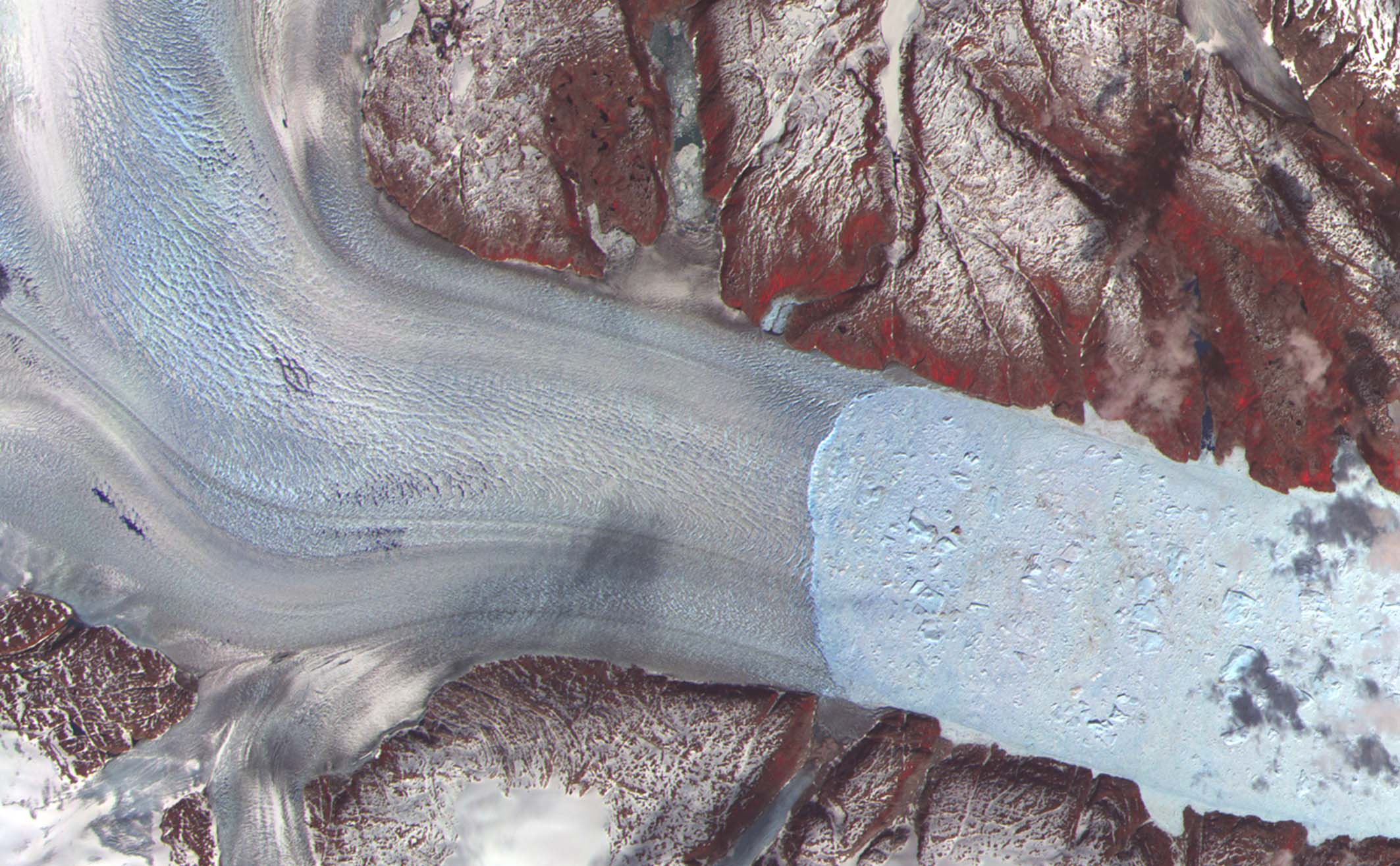
ROMA (ITALPRESS) – Greenland and Antarctica have lost altogether 11,3 trillion tons of ice between 1979 and 2023, contributing to an increase of the global level of the sea of 31,4 mm. This is what emerges from the study “Mass balance of the Greenland and Antarctic ice sheets from the 1970s to 2023”, published in the scientific journal Scientific Data di Nature and produced by an international collaboration led by the Northumbria University of Newcastle-upon-Tyne, with the involvement, among others, of the National Institute of Geophysics and Vulcanology (INGV), of the European Space Agency (ESA) and NASA.
The work has analyzed the longest time interval so far considered for studies of this type, combining 42 independent satellite surveys, based on 27 missions, and going up until 1972 for Greenland and 1979 for Antarctica, also through the archive of the first Landsat images.
The overall loss is quantified in 11,309 billion tons of ice, with Greenland making the greatest contribution to raising the sea level, while Antarctica contributed 13.3 millimeters. The INGV participated in the study by elaborating numerical models of the deformation of the earth surface caused by the variations of the load exercised by the glacial masses.
An element that must be considered in the analysis of satellite data is in fact the slow lifting of the rock bed on which the glaciers of Greenland and Antarctica rest, started after the last deglaciation, about 20 thousand years ago. According to the study, 84% of the total loss of ice is attributable to the acceleration of melting glaciers and to the greater influx of ice in the ocean, while the remaining 16% is due to the superficial fusion of the polar caps.
“The analyzed data shows that the loss of ice has increased dizzyingly since the 1990s,” explains Daniele Melini, researcher of INGV and co-author of the study. “Greenland, which in the 1970s was almost in balance, saw its ice loss rate switching from about 60 billion tons per year lost in the 1980s to 264 billion tons in the first ten years of the 2000s, a decade characterized by repeated episodes of extreme summer fusion.” For Antarctica, adds Melini, “the loss rate has passed from about 48 billion tons per year in the 80s to 202 billion tons in the 2010s”, with the net loss entirely linked to the melting of glaciers. In particular, the outflow of ice from Western Antarctica, led by Pine Island and Thwaites glaciers, has increased in every decade for which data are available. The last years, between 2020 and 2023, have recorded a temporary slowdown in ice loss.
The record snowfalls in the eastern Antarctica have offset partly the losses recorded in other areas of the continent, while a number of mildest summers in Greenland has reduced the surface melting by about half. Researchers, however, point out that these phenomena are not a reverse of the trend, but short-term fluctuations within a long-term trend.
“Our results also underline the central role of the polar caps in the future rising sea level,” Melini notes, according to which the response of climate warmers is the main source of uncertainty in the projections on the future sea level. The highest estimates of the global rise of the sea level by 2150 increase by 2.6 times considering the risk of instability of the ice caps. For this reason, the researcher concludes, a continuous series of data on the behaviour of the polar caps, collected in the span of half a century, is fundamental to anticipate the risks for the populations living in the coastal areas most exposed to floods.
– Photo Ipa Agency –
(ITALPRESS).
