
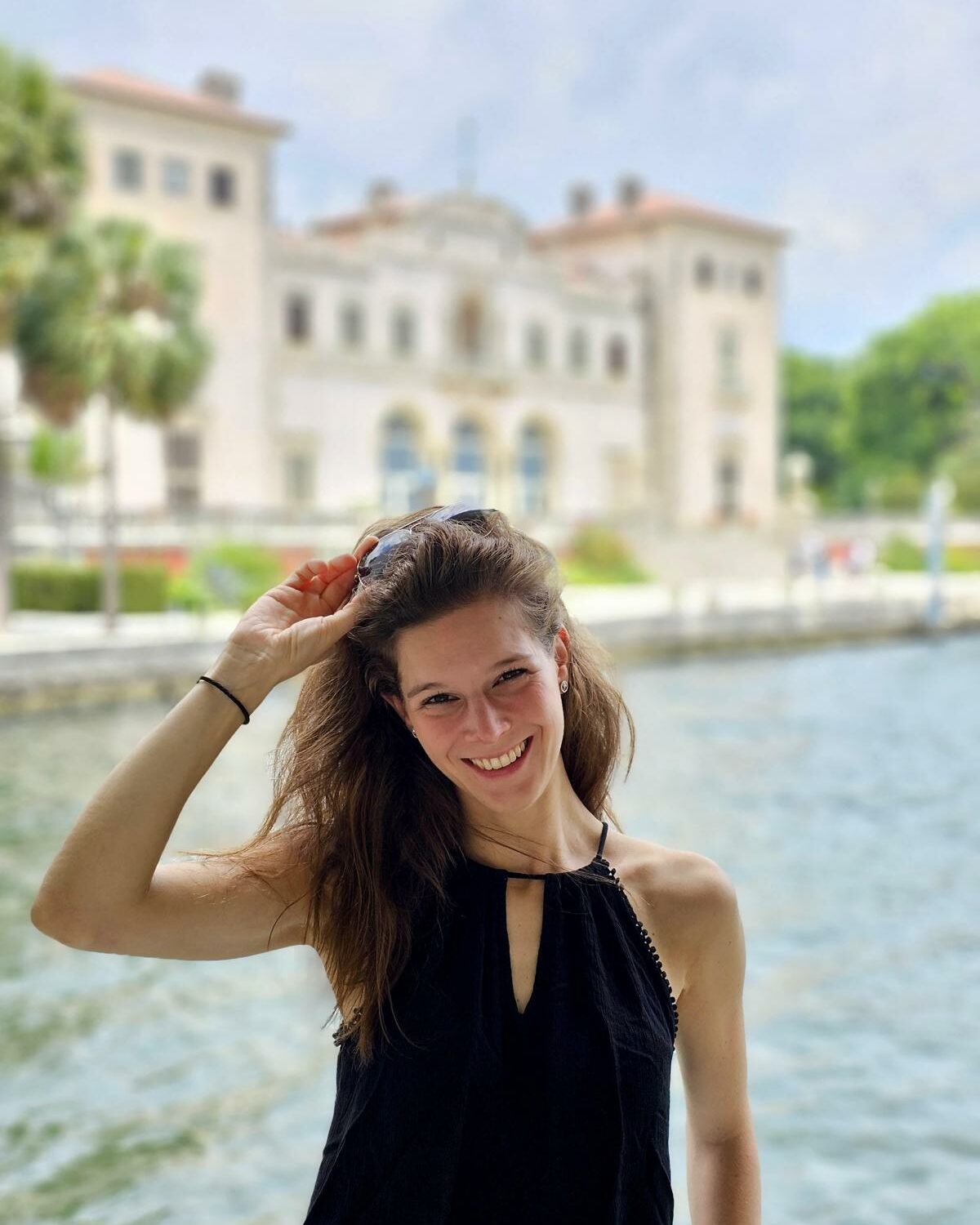
Silvia Sunseri is a young Italian professional who has built her career between Milan and New York, combining academic skills and commitment to educational outreach. She graduated from Bocconi University and continued her studies with an interdisciplinary master’s degree at Columbia University. Today she works in data science, dealing with analysis and optimization of decision-making processes for innovative companies. At the same time, she manages a growing digital community, born from the need to share tools and resources with Italian students interested in international university paths. Her Instagram page has become a reference point for those seeking clear information and concrete support on applications, scholarships and academic guidance. We interviewed her for The New Yorker.
What role has academic training played in your personal and professional development?
I grew up in Milan, in a family where education was always an important value. I did not come from a background related to economics, but I was always very curious: I was interested in understanding what is behind the dynamics that move the world. That’s why, after high school, I chose Bocconi: it was a rational decision, dictated by the solidity of the educational offer. When I was at university in Italy, I realized that I was learning a lot, but not enough about how the world works outside of there. During your three-year degree, you had the opportunity to study in the United States. It was a real watershed. During the exchange program at the University of Texas at Austin I discovered a completely different system, more open, participatory, multidisciplinary. Classes were in smaller classes, professors knew you by name, and there was much more room for discussion and critical thinking. But what impressed me most was everything that happened outside the classroom: you could work on campus, volunteer, join thematic clubs. You were not just a student, but a person with a thousand dimensions. Back in Italy, I already knew I would not stop there – I wanted to continue to grow outside the borders.
After your experience abroad, how were you able to concretely build the transition to an academic path in the United States?
When I returned to Milan to finish my three-year degree, I already had a very clear conviction within me: my future would not be in Italy. I felt that my story had to continue in the United States. But it was late to submit applications, and I remember perfectly the moment when, looking in the mirror, I told my father, “I’m taking a sabbatical.” Then something happened. I talked to my lecturer at Bocconi, who proposed me to collaborate as a research assistant with a professor. Shortly after that I also started working with a Harvard professor. Those experiences were crucial: not only did they give me confidence, but they opened new perspectives for me. They both suggested a master’s program at Columbia University, an interdisciplinary program that combined quantitative methods and social sciences. I sent my application in the midst of the pandemic, with low expectations. Instead, they took me. And in September, I packed my bags for New York. There my new chapter really began: intense, beautiful, but also very challenging. Columbia is a university that constantly challenges you, but gives back a lot in terms of growth. I chose a master’s program in Quantitative Methods in the Social Science. I worked with amazing faculty, did internships, built a strong network. But it was not all easy. Living in New York is very expensive, the academic system is competitive, and there is always no room to make mistakes. That’s why today I’m also trying to tell what often remains hidden: what’s really behind an Ivy League admission, behind a scholarship. The uncertainties, the sacrifices, but also the strategic choices that get you there.
From there also came another path, the one related to your social media activity through the page: Silvia Tips. How did your online community come about?
It all came about somewhat by accident, but mostly out of necessity. When I decided to apply to an American university, I realized I had no idea where to start. I didn’t know what the GRE was, how to write a personal statement, what scholarships to look for or how to choose a university. And the hardest thing was that I had no one to ask: neither family nor university. I felt alone, lost. So I said to myself, if I’m experiencing all this disorientation, surely other kids feel the same way. I opened my Instagram page to share everything I was learning and provide practical advice, for those who, like me, have dreams of studying in the United States-a world that sometimes seems so closed and distant to us. The response was overwhelming. So many wrote to me to say, “Thanks to you I found out that it can be done.” One girl wrote to me, “My parents don’t want me to leave, how do I convince them?” So I involved my mother in a live stream: I asked her to tell her experience, to explain how she was convinced to let me go. That’s the community I wish I had had when I started. That gratitude, that willingness to try – for me that’s the real success. Today we are over 9,000 people, but it’s not the number that matters: it’s the energy, the solidarity, the sense of possibility that we have built together.
You recounted that at first you were afraid of judgment. How did you overcome that barrier?
With so much effort. I still remember my first reel: I felt ridiculous, out of place. Instead, only kind, respectful comments came. My community is really special, and it made me feel safe right from the start. Even the page name didn’t come by accident: it took two weeks of brainstorming with my best friends. It may sound silly, but finding a name that really represents you is not easy. It’s your first business card, your way of saying, “This is who I am, and why I’m doing this.” Exposing yourself takes courage. Telling your story, putting your face to it, even more so. It helped me to have the idea that I was not doing this to “like” or to “get noticed,” but to help those who feel lost. That changes everything. It takes away the burden of judgment and gives you direction.
And how is your life in New York today? Have you found your place in the world?
After my experience at Columbia, the opportunities multiplied. I had the chance to work with several companies, all active in the world of data science. Each experience was a valuable piece: it taught me something new and, most importantly, helped me bridge the gap between theory and practice. This is how I grew, not only as a professional, but also as a person. Today I have embarked on a new chapter in a young and dynamic startup. It is an environment that breathes innovation, where every day I put into practice what I have learned and continue to learn, constantly. New York is at the heart of all this. It is a city that doesn’t let you rest, but it makes you feel alive. What really makes me feel in my place, however, is knowing that I am helping to build something that wasn’t there before: a network, a concrete support, an extra chance for those who, like me a few years ago, have the courage to try.
What would you say to those who dream of studying abroad but are afraid of not making it?
I would say that fear is normal, we all feel it. I too, a thousand times, have said to myself, “I’m not enough,” “I can’t afford it,” “It’s too complicated.” But I realized that the biggest barriers are not out there: they are within us. Studying abroad is not a privilege for the few; it is not reserved for those with unlimited contacts or money. In fact, I had to take a bank loan to finance my studies, but if you really want to do it, you have to at least try.
I say this from experience: you should not wait for the perfect moment, because it will never come. You will never feel completely ready, and that’s okay. The key is to start, even in small steps. Search, read, make mistakes, ask for help. Even I, at first, thought Columbia was an unattainable dream. Yet, here I am. Sometimes that’s all it takes: the courage to believe. And I, today, try every day to keep that door open for someone more.
The article Silvia Sunseri: a journey between education and innovation comes from TheNewyorker.
