
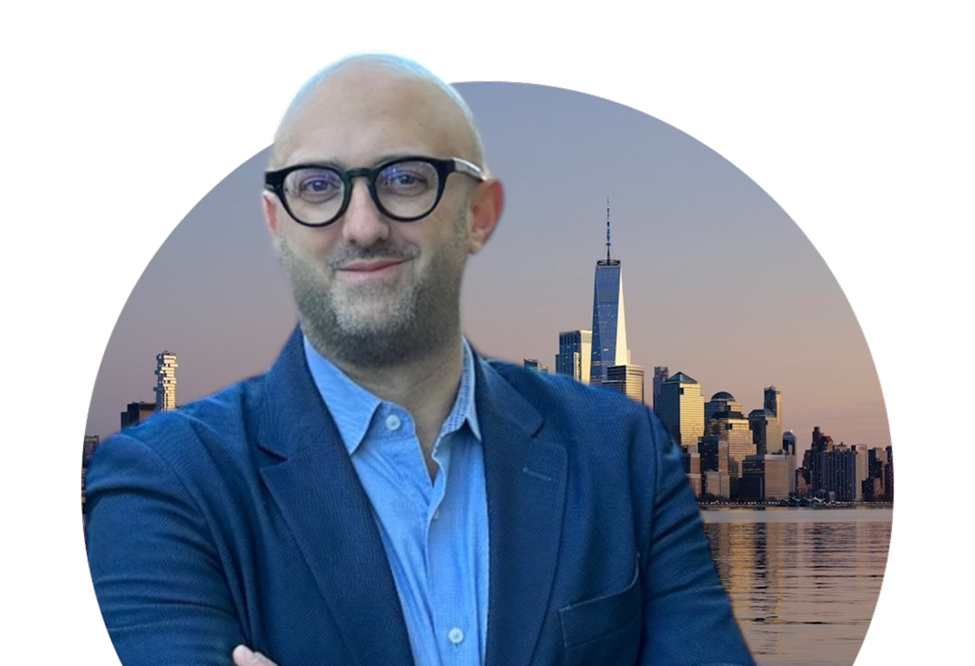
Stefano Luciani is the Vice President Americas for Bisazza, a historic Italian family company recognized internationally for excellence in glass mosaic and interior design. After a career that has taken him between Europe, Asia and the Middle East, he now lives in New York, where he leads the brand’s strategic expansion throughout the Americas, with a particular focus on the United States. International experience has taught me that leading a team means creating the conditions for different skills to emerge, while always keeping strategic goals clear. My task is to combine the vision of the brand with the needs of a complex market like the US. Every decision requires a balance between corporate identity and adaptability.
His work moves between entrepreneurial vision, high-end craftsmanship and continuous innovation.
Your journey started in Viterbo, went through Dubai and now takes you to New York. What has been the common thread?
My path has been guided by a constant openness to the international context and an interest in dialogue between cultures. After graduating in Oriental Languages and Civilizations, and a master’s degree in communication and cultural mediation, I developed the linguistic and relational skills that I still consider fundamental in my work. The transition to the design sector happened almost by chance, but it was decisive: my first experience with Valli&Valli, a historic Italian company of designer handles, led me to follow foreign markets, with assignments that took me first to Asia, then to the Middle East. In Dubai I experienced years of strong professional growth, in a competitive and dynamic context, where I learned to read the different design sensitivities in relation to the cultural specificities of the clients. In 2017 I arrived in New York, where I first coordinated the development of the Valli&Valli brand and recently that of Bisazza for the U.S. market, with the aim of enhancing brand identity in a highly demanding and constantly evolving environment.
Bisazza is one of the historical names in Italian design. How did your meeting with the company come about?
After the conclusion of my previous work project, to which I had devoted a lot of effort, I wanted to continue in a related field of Italian design, capable of combining a solid industrial base with an authentically international vision. It was at that time that I began a dialogue with Bisazza, thanks to the introduction of the far-sighted commercial director Marco Meli. The company was looking for a figure capable of interpreting the American market with a strategic outlook, but also sensitive to the cultural dimension of the historic brand led by President Piero Bisazza and his family. Mosaic, in itself, was not part of my background, but what struck me was the value that the company attaches to each project: it is not just decoration or wall covering, but a form of expression that holds together craftsmanship, stylistic research and contemporary vision. I recognized a strong coherence between my professional approach, matured up to that moment, and the direction the company intended to take with the arrival of a new CEO and a new Commercial Director. From there, a truly inspiring path of collaboration was born.
New York is an often unpredictable city. What is the most significant challenge you have faced during your time in the United States?
The biggest challenge for me was finding a new balance. When I arrived in New York from Dubai, I immediately noticed that everything had accelerated: the dynamics of work, the way relationships are built, even leisure time. It was an important transition on a personal level as well: it prompted me to leverage both my professional skills and my past international experiences, thanks in part to the support of key figures I met in New York, including Bennett, Silvana, and Andy, who have been true mentors to me over the years.It is a market where efficiency is an absolute value. But working with materials like mosaic requires care, precision and time. Each project comes from a supply chain of manual skills, aesthetic sensitivity and attention to detail. Communicating this added value, in a context accustomed to speed, is a cultural challenge before it is a commercial one. It requires the ability to build trust, to educate to the uniqueness of our approach without being rigid or distant.My role, in this sense, is to mediate between two visions of time and work: to maintain the Italian and historical identity while knowing how to adapt it to an extremely competitive and constantly evolving ecosystem like the American one.
What is your vision for design today, even in light of your many collaborations with international designers and artists?
For customers in the United States, when people talk about mosaic, they often think of swimming pools, or the finishing of certain environments such as bathrooms or saunas, and indeed much of our business is in that segment. Bisazza is much more than that. It is a way of narrating space. We work with boutiques, hotels, architectural firms, and designers. In Europe, mosaic is already recognized as an element of applied art; in the United States, however, there is still a way to go to make it known in this capacity. But the response is very positive, especially when we are able to show the variety of languages that this material can express: from classical, to contemporary, to artist projects. Our starting point is a savoir-faire of craftsmanship rooted in nearly seventy years of experience. But what sets us apart is the ability to reinterpret this heritage in a contemporary key, through aesthetic research and dialogue with the world of design and art. Collaborations with designers and artists such as Alessandro Mendini, Ettore Sottsass, Marcel Wanders or Daniel Arsham are an integral part of this vision: it is not just a matter of signing a collection or a decoration, but of building a visual language together, of shaping surfaces that tell a story. Our mosaic is never just a decorative covering: it is an expression of identity, a project that combines material, technique and imagination. Working with creatives of this caliber means, every time, to listen and transform complex ideas into something concrete, without ever losing the soul of the brand.
What motivates you in your work today and what direction do you envision, both for your personal journey and for the evolution of the brand in the United States?
What motivates me today is the possibility of building real connections, between different worlds, cultures and skills. My job is all there: to create a bridge between the Italian tradition and the needs of a market like the American one, which is extremely dynamic and results-oriented. The direction I am working on, both personally and professionally, is to make this dialogue more and more solid. We accompany projects from start to finish: we collaborate with architects, interior designers, creative studios, but also with private clients looking for tailor-made solutions. Each interlocutor has different expectations, and our task is to find a common language. In this sense, the new showroom in New York is not just an exhibition space: it is a place for discussion, a meeting point for the city’s creative network. I would like it to continue to evolve in this direction as a living platform, capable of listening to the transformations of the market.
The article Stefano Luciani: Italian vision, American challenges comes from TheNewyorker.
