
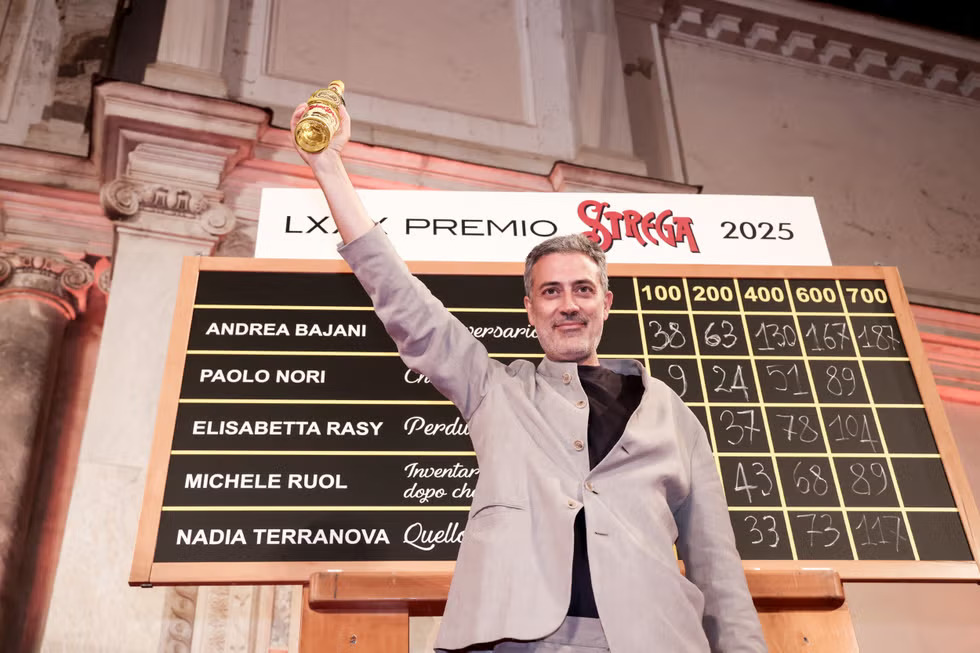
Eighty years of Strega Prize, and an edition that tries to write this goal in a symbolic and spectacular setting. In fact, 79 narrative books will be held in 2026, candidates as from tradition from the “Friends of Sunday”, while the final evening of July 8, for the first time, will be held in Piazza del Campidoglio, adding to the rituality of the award a scenario of strong institutional and visual value, in the heart of Rome.
The number of candidates remains in line with that of the last editions – 81 in 2025, 82 in 2024, 80 in 2023 – confirming the estate of an award that continues to work, at the same time, as an observatory of this editorial and as a legitimation device in the Italian literary field. The first decisive stage will be on 1 April, at the Chamber of Commerce of Rome, in the Sala del Tempio di Vibia Sabina e Adriano, when the Steering Committee will identify the dozen finalists. Pietro Abate, Giuseppe D’Avino, Valeria Della Valle, Alberto Foschini, Paolo Giordano, Dacia Maraini, Melania G. Mazzucco, Gabriele Pedullà, Stefano Petrocchi, Marino Sinibaldi and Giovanni Solimine. From there, the next step will bring the prize on June 3 to the Roman Theatre of Benevento, where the cinquina will be selected.
Already at a preliminary look, the list of candidates returns a stratified literary geography, in which they coexist prestigious names, expected returns, beginnings and a widespread presence of medium-small publishers. Among the authors who circulate with greater insistence in the hypothesis of victory figure Michele Mari with I convitati di pietra (Einaudi), proposed by Vittorio Lingiardi, which emphasizes the nature of “black ronzo” able to irridere the time and together to build a veined corality of comedy, in an ideal filiation that calls in cause Carlo Emilio Gadda.
Much observed also Teresa Ciabatti con Donneregina (Mondadori), backed by Roberto Saviano, in a book that is measured with an emblematic figure of the criminal imagination and power, Giuseppe Misso, called “’o Nasone”, transforming the dialogue in narrative matter and moral tension. Among the strongest titles is Matteo Nucci with Plato. A story of love (Feltrinelli), presented by Giancarlo De Cataldo, who in the motivation insists on the ability of the book to return to the reader the myth Greece, the greatness of the theatre, the violence of war and the birth, anything but linear, of the democratic idea.
In addition to these names, the 2026 edition sets up other authors and authors: Bianca Pitzorno with La sonnambula (Bompiani), Leonardo Colombati with There will be no more night (Mondadori), Edith Bruck with The German friend (The ship of Teseo), Marcello Fois with The immense distraction (Einaudi), Francesco Pecoraro with The end of the world (Ponte alle Grazie) and Mauro Covacich with Lina and the rock (The ship of Teseo). It is a constellation that suggests, once again, how much the Strega Prize remains ground of comparison between very different writings for tone, plant and authorial posture, but united by the ambition to occupy the center of the national literary speech.
No less eloquent is the editorial distribution of applications. The ship of Teseo leads with six titles, followed by Einaudi and Mondadori with five each. It is a fact that reiterates the weight of large and medium-sized acronyms in the award mechanism, even within a framework in which a wider editorial plurality continues to take place. In this sense it is significant the presence, for the first time, of some minor or independent realities: Rai Libri participates with No grace. Gramsci and Pertini, a story of imprisonment and resistance of Cosimo Damiano Damato, while Gramma Feltrinelli presents two titles, including The Powerful Life of the Exotant White Lavinia. The brands like Felice Edizioni, Vanda Edizioni, Other Voci Edizioni, Maschietto Editore, Graus Edizioni, Serradifalco Editore, Love Edizioni, Fuis Edizioni, Effigi, Giraldi Editore and Alpes Italia complete the panorama.
Just on the side of the beginning one of the most interesting elements of this long list is recorded. Giuliana Vitali with Nata in the dirty water (Perrone), Cecilia Rita con Mantide (Nn Editore), Isabella Delle Monache con La compagna (Serradifalco Editore) and Saverio Gangemi con Calùra (Rubbettino): new voices that try to cut out space in a context traditionally dominated by already established names. But perhaps the most competitive area is the intermediate one, where recognized authors but not necessarily data in advantage could take place in the race to the dozen: Vanni Santoni with Il detective sonnambulo, Marco Vichi with Eyes of Child, Christian Raimo with The Invention of Color, Laura Pariani with Primamà, Gaja Cenciarelli with The revolutionary and the teacher, Ilaria Bernardini with Amata and Maria Attanasio with The Rose overthrows.
As often happens, the Strega Prize comes to design not only a competition, but also a photograph of the state of the Italian narrative: its hierarchies, its expectations, its persistence and its openings. The eighteenth edition, also for the symbolic value of the anniversary, seems to be read in this double key: celebration of a long tradition and verification, once again, of its ability to tell the present
L’articolo Premio Strega, eighty years and 79 racing titles, Roma welcomes a new finale proviene da IlNewyorkese.
