
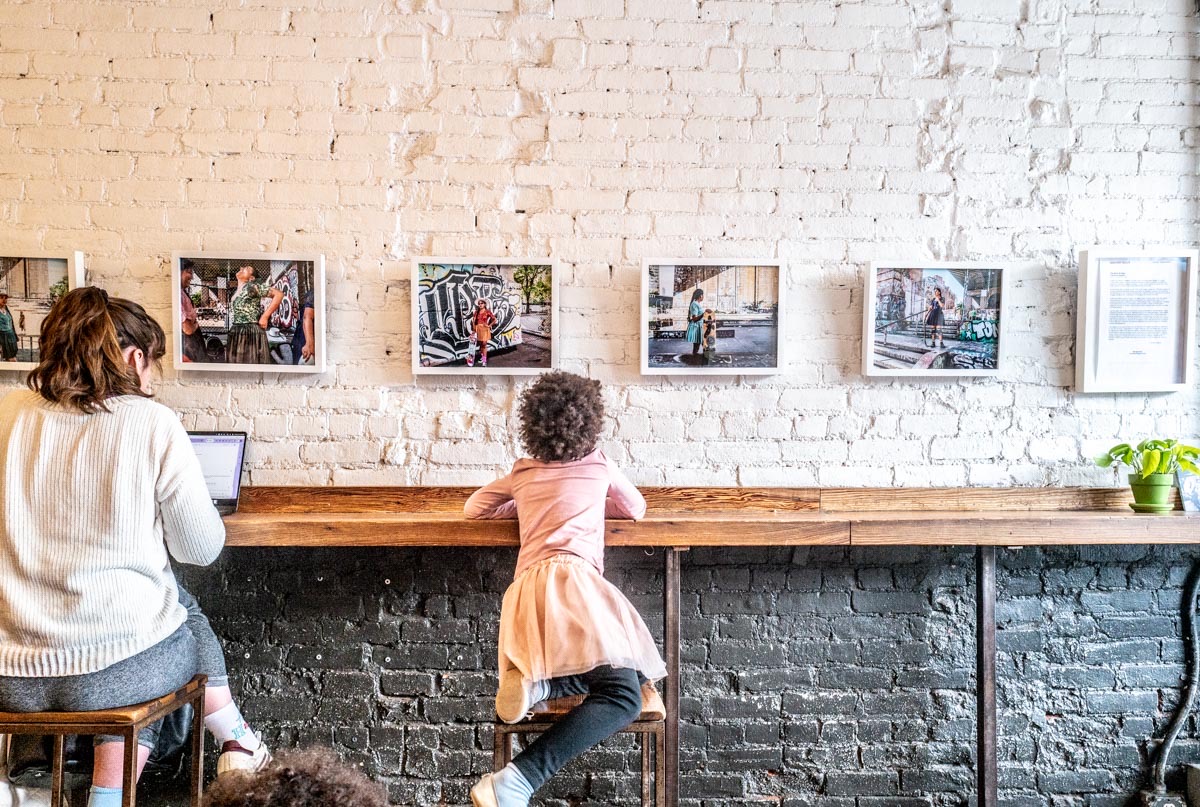
In the heart of East Village the Blue Bridge takes shape, the exhibition with which Francesca Magnani returns an unexpected fragment of New York. More than just a sequence of portraits, the project is configured as a visual survey born from the meeting and developed through a look that favours intuition, time and relationship. In the center, ten images and a conversation that illuminate the process of the artist, where photography becomes experience lived before even than formal construction.
Within the Ninth Street Espresso, East Village, from 7 March to 10 April, Magnani presented The Blue Bridge, a selection of ten portraits made on the Lower East Side. The photographs depict the components of the collective ImillaSkate under the arches of Manhattan Bridge: young women who practice skateboards wearing chicken, the traditional balze skirt of Bolivian culture. A long head associated with marginality and discrimination, today reappropriated as a symbol of identity and pride.
The project was born, as often happens in the work of the artist, from a coincidence. «I photographer during my day», he says, «I am not looking for a photo in a planned way». Its method is based on a daily practice, without predetermined itineraries: «I let myself be guided by the light of the day, from time and from situations».
In this dimension, the case plays a central role. “For me the case is fundamental: it has almost a sacred dimension”. After years of experience, he explains, the images emerge suddenly, as “apparitions”. This is precisely how the meeting with the ImillaSkate, in the skate park under the bridge, a place that frequented habitually.
The relationship with Manhattan Bridge, however, precedes this episode. Magnani says he started to cross it regularly after moving from Williamsburg, where he often photographed the other great bridge in the neighborhood. Only later recognized a continuity between the images collected, building a coherent narrative.
Within this story, ImillaSkate introduces an additional symbolic level. Their way of being together recalls, according to the artist, iconography of classical tradition: “It struck me their way of laughing and playing”, he observed, evoking a scene of the Odyssey, “a group of young people who joke and throw a ball”.
The visual aspect of the photographs is not the result of artificial construction. The protagonists choose independently to wear the chicken as an identity statement. “I didn’t have to build anything,” he said, “they were themselves wearing these clothes with great pride.” The contrast between vibrant fabrics and urban background, made of graffiti and industrial structures, thus emerges spontaneously, becoming one of the distinctive elements of the series.
The artist’s intervention remains minimal: “I suggested to the maximum small elements related to light or position”, while the rest is defined at the moment of the shot. A practice refined over the years, in which light management becomes intuitive, until it evokes the precision of the portrait built while remaining rooted in street photography.
The exhibition context also plays a significant role. The Ninth Street Espresso is not a traditional gallery, but a space crossed by everyday life. “I am very interested in this dimension,” Magnani emphasised, “where art fits into everyday life”. Visitors enter for a coffee and are immersed in the images, without a clear separation between artistic experience and routine.
The proximity to a skate park further strengthens this relationship, creating an overlap between audiences and subjects: who practice skateboard can recognize the protagonists not only visually, but also through a shared experience.
Magnani’s work continues to develop along this line, based on walking and observation. «It is a continuous practice», he says, «a form of investigation». Among the most recent projects is a series dedicated to figures immersed in urban architecture, entitled with a verse by Dante Alighieri, I was among color that are suspended, already selected for a festival in Kyoto from 18 April. Born in Padua and resident in New York since 1997, Francesca Magnani has been carrying out for over twenty years a research that interweaves autobiographical dimension and urban narrative. His work, exhibited in Europe and North America, was published in volumes such as Here is New York, Trespass: A History of Uncommissioned Urban Art and All the Time in the World by E. L. Doctorow, and is now preserved in collections such as the Museum of the City of New York and the International Center of Photography.
L’articolo <i>The Blue Bridge</i> in ten portraits proviene da IlNewyorkese.
