
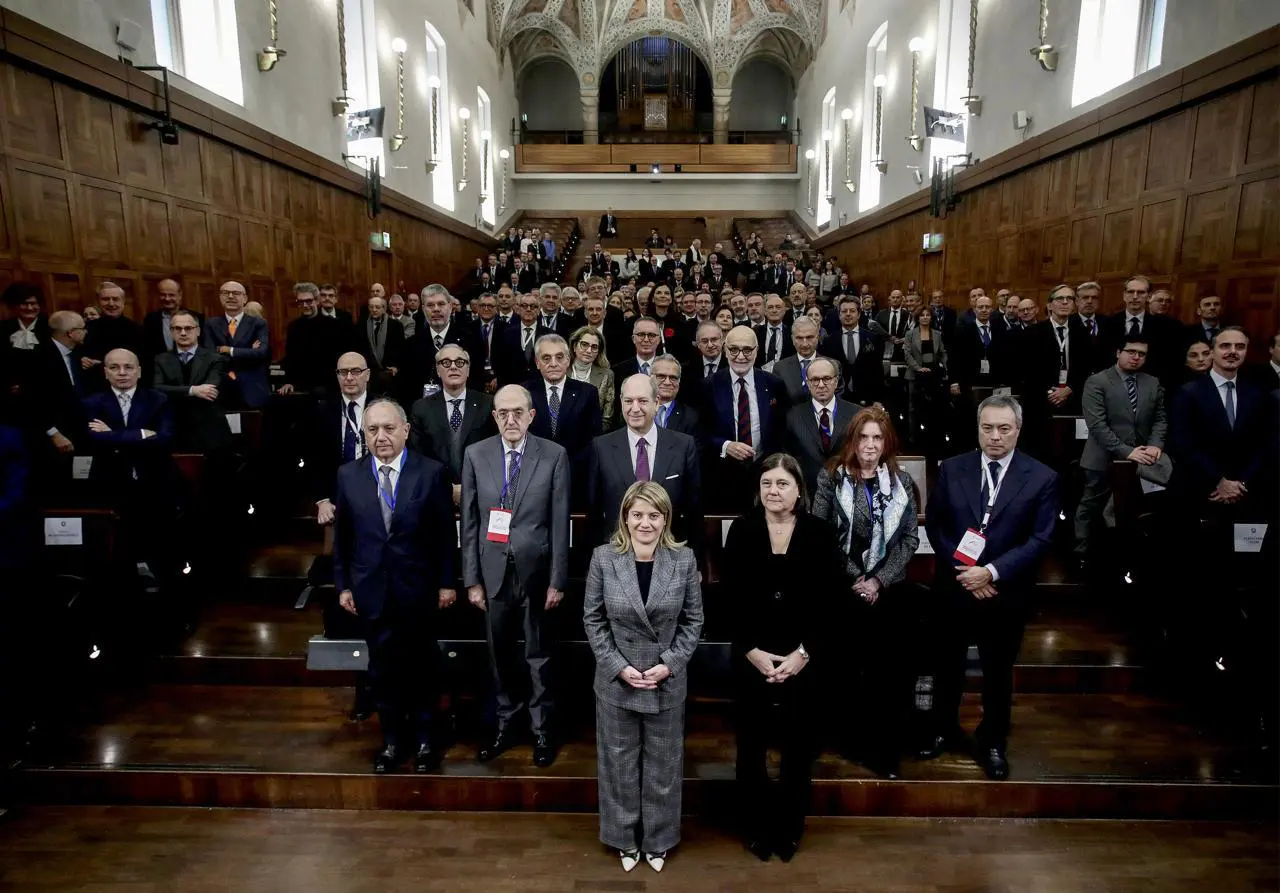
MILAN (ITALPRESS) – Not only places of formation and research, but also areas of dialogue between different cultures and visions. In other words, true geopolitical arenas, capable of building bridges, cultivating global diplomacy and orienting comparison between countries and societies. This is the mission that will have to fulfill more and more Italian universities in the world, as it was outlined during the conference “Italian universities abroad: the internationalization of the Italian university system”, hosted in Milan on Thursday 18 December in the Magna Hall of the Catholic University of the Sacred Heart.
The meeting is part of the program of the 18th Conference of Embassies and Ambassadors of Italy in the world, opened in Rome on 15 December by the greetings of the President of the Republic Sergio Mattarella. “For the first time in the history of the Conference we wanted to foresee a session dedicated to universities: is the sign of a new awareness and a new will. If we want to talk about the future of Italy, we must discuss universities with universities and universities,” said Maria Tripodi, State Secretary for Foreign Affairs and International Cooperation, welcoming the over 200 holders of the Italian diplomatic offices and leaders of the Ministry of Foreign Affairs meeting in Milan on 17 and 18 December. “The universities are models and laboratories of innovation, natural bridges between Italy and the rest of the world. They attract international students and investments, strengthen the territories. In the vision we are carrying out, they are a fundamental reference for the diplomacy of growth.”.
Elena Beccalli, Rector of the Catholic University of the Sacred Heart, reaffirmed the role of universities as strategic actors in the construction of international relations. “The international projection of a university does not only result in the activation of courses in English, in welcoming students and students from abroad, in promoting their courses in the circuits of global education, in obtaining accreditations of study courses, in activating double titles or in pursuing advances in international rankings. They are all essential and essential goals. But it should be remembered that it is instruments, not the end in itself of the internationalization of an Athens. They are in fact functional tools for a higher mission: real and responsible impact on society, starting from the awareness that the universities are called to act as authentic geopolitical arenas.”.
The initiative hosted in Cattolica has taken on a dual value: an opportunity to reflect on the dynamics of the internationalization of the Italian university system, but also a moment to question the role that the universities must cover in a constantly evolving geopolitical scenario and future strategies to address new global challenges.
“I think that the heated debate in progress on the future of universities is not enough about the importance that can cover the mission of Athens as places of dialogue between cultures and visions even very distant from each other. In short, as public subjects able to decline their educational mission in a broad sense,” said Rector Beccalli. “In fact, to form tomorrow’s leading classes with a long and integral look, it is not enough to provide students with cutting-edge study methods; it is necessary to get used to confront the world, in the world. It is precisely the world scenario to suggest a change, embracing logic of coopetition for the construction of an ecosystem of knowledge that exceeds national borders. To do so concretely we must reiterate the criterion that universities operate not for profit – to quote the title of the famous book of Martha Nussbaum – but to strengthen democracies, representing epistemical communities able to educate responsible citizens and citizens”.
To focus more specifically on the presence of the Italian university system abroad was Tiziana Lippiello, Delegata CRUI for International Relations and Rector of Ca’ Foscari University of Venice. “Our system is an excellence and a flyer for the social and economic growth of the country,” he said, recalling how the funding of the PNRR was fundamental.
“We have strengthened relations with the territory and with European partners. I think it is important to continue working according to a logic of alliances to build ecosystems in higher education, strengthen the transnational dimension of scientific research and innovation, promote joint investments to create lasting effects over time. Networking is essential to attract and retain talent.” In addition, “embassies can help us both to understand criticality and opportunities in different contexts and to identify which countries to guide our efforts. International students are always welcome, but must be accompanied and oriented not only in the understanding of the country system and its services but also in language learning.”.
The Italian language, in fact, represents a “privileged instrument” for the pursuit of internationalization as a true “cultural issue” and “training project of contemporary university”. Mariateresa Zanola, President of the University Quality Presidium of the Catholic University of the Sacred Heart, highlighted this. It is thanks to Italian, “international language”, that “the university becomes the space where internationalization is lived, not only is organized: a place that generates international experience”. But being an international and open university in the world means also working in areas of the low income world to promote sustainable development.
The Plan Africa of the Catholic University, illustrated by the director Mario Molteni and has already promoted over 130 projects in 40 countries. “The goal is to be the most active European University in Africa and Africa in terms of research, training and third mission by working in partnership with African universities and institutions with a view to mutual enrichment for the integral formation of people, socio-economic development.” A tangible sign, in short, to resume the words of the Rector Beccalli, to “act as a geopolitical arena by placing us, moreover, as an institution of peace, a place where teaching, research and social impact find a common denominator in promoting a culture of peace”.
The event ended with the testimonies of the Italian Ambassador in Azerbaijan Luca Di Gianfrancesco and the Italian Ambassador in Ghana Laura Ranalli. For both Italian universities, they are an exceptional model of soft power that, contributing to the exchange of knowledge, collaboration between countries, are crucial for the pursuit of peace and dialogue among peoples.
– Catholic University photos –
(ITALPRESS).
