
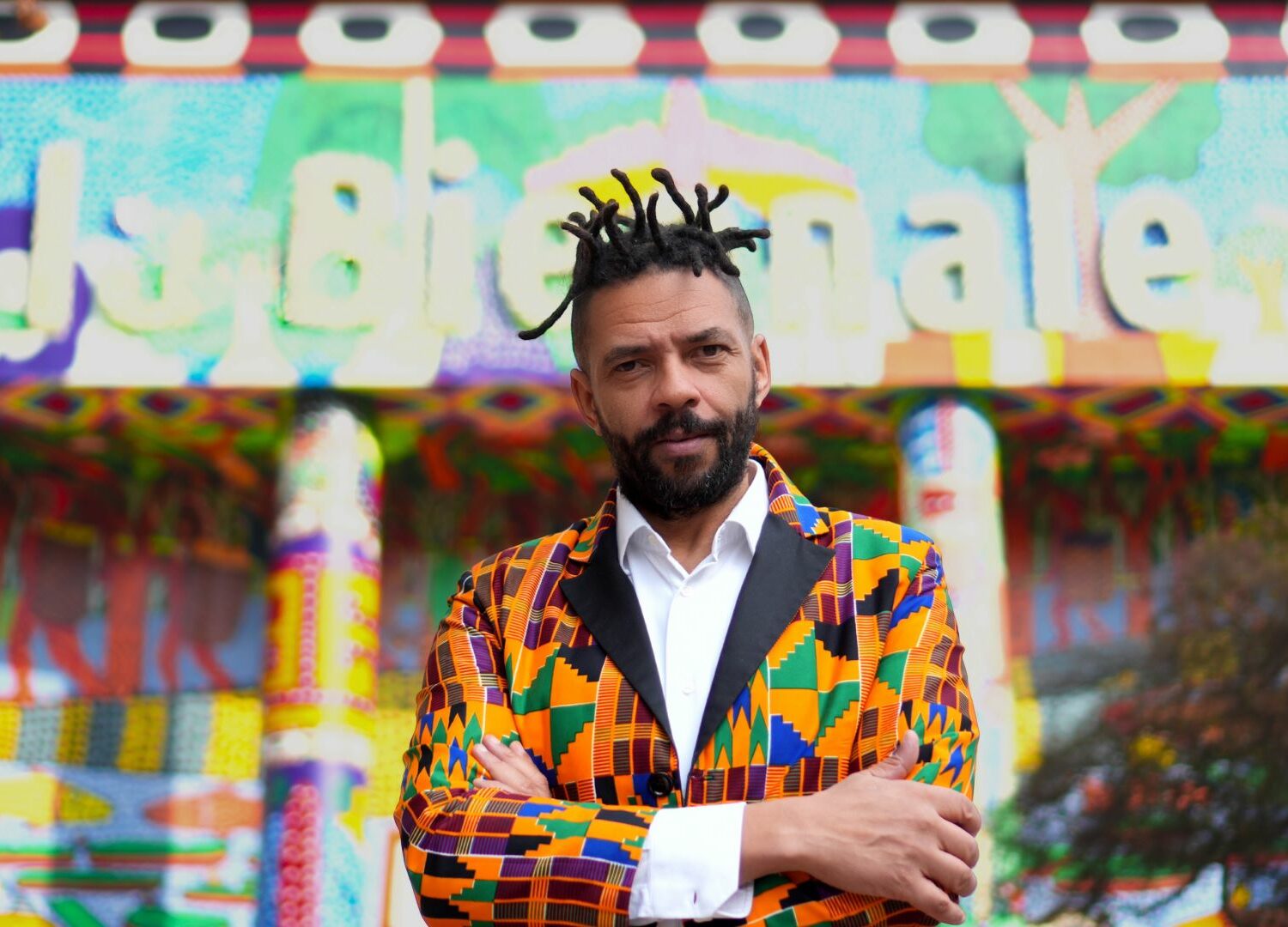
Fred Kudjo Kuwornu is an aphrodiscendent director and activist born in Bologna and living in New York for years. At the Venice Biennale of 2024 he was one of the very few Italians selected for the Central Pavilion with his film We Were Here, a documentary that reconstructs the presence of Africans and aphrodiscendents in Renaissance Europe, bringing to light figures of artists, nobles, saints and intellectuals forgotten. After over 45 screenings in the United States, the film is now running for the Oscars 2026 in the Best Documentary category. In this conversation, Kuwornu tells the genesis of the project, the reactions of the public, and a broader reflection on how European history has removed its aphrodiscendent roots.
Hello Fred, and thank you for accepting the interview. In our first exchange, we talked above all about your experience at the Venice Biennale, where you were one of the few Italians – and New Yorkers – selected for the Central Pavilion. How was this opportunity born and what was it for you?
True, I was one of the very few Italians – and also among the New Yorkers of adoption – present in the Central Pavilion. At that edition we were only five Italians. It was significant because I am a documentary filmmaker, and the Art Biennale is certainly not the typical space for a linear documentary. Usually there are video installations or works of video art five minutes long. I brought a 45-minute film with a dedicated screening room. And I was amazed to see many people stay even half an hour: usually, when I visit a Biennale, I remain three minutes by work.
The project arrived very quickly: I had to finish the film and I had no time for press offices or communication, a shame because there were so many journalists who could talk about it. So we started the tour in North America: the first screening was at the Minneapolis Institute of Art, then many universities in the United States. For ten years I have been making 50-60 dates a year, because here universities have facilities, departments and resources to promote cinema. They often become cultural spaces open to the community.
Then I brought the film to Europe too: Madrid, Germany, Zurich. In September I resumed the tour in the United States and we also had a cinema release in New York for a week. After this we have written the film in the Documentary category at the Oscars. It is a long process, full of materials and verifications, but ten days ago we received confirmation of admission. Now we wait for the first selection in early December, when the members of the Academy will choose the first 15 titles.
Then I’d say we start talking about the movie, We We Were Here. The thing that strikes is the perspective: instead of starting from the history of the Atlantic treatise of slaves or the consequent African diaspora, tell a well-integrated aphrodite presence in Renaissance society. Why this narrative choice?
Born from my personal experience: I am Italian of African origin, raised in Italy, and at school the only moments when black people appeared were the slave trade and Martin Luther King. Two moments away from each other. So black presence was always associated with slavery or civil rights.
Living in the United States and working in universities I immersed myself in aphrodiscensing literature, also European. There are many publications on the African presence in Europe, not only in the Renaissance but also in ancient Rome, Greece, in the Middle Ages. At some point I realized that it was possible to make a documentary about the Renaissance because there is a very solid visual base: famous and less famous paintings showing this presence. It is not a contemporary interpretation: there was indeed. The point is that we read the past with the prejudices of the present. I myself went in front of buildings full of African representations, especially in Florence, without asking questions. Why are they there? What do they mean? Nobody educates us to question what we see.
An interesting reflection that emerges from the film is that European aphrodite is practically absent in the mainstream debate. The word “afroitaliano”, for example, has entered the common language only very little. Your film fills a narrative void?
I think so, and perhaps it is the first to do so in a European dimension. There are beautiful projects in England, the Netherlands, Switzerland, and something in Italy, but almost always limited to the national context. I wanted a continental perspective, even to avoid the game of “we do not center” that every country does on others. In Italy it is said: “We had no colonies like the French.” In reality there are shared responsibilities and stories on a European scale.
Do you think the absence of aphrodistant history in school books is a simple editorial lack or a symptom of a deeper problem?
It’s a structural problem. It’s not just about minorities: in general the history we study is made of dates and names, not of people. As for aphrodiscendent stories, they suffered further cancellation between the late nineteenth and early twentieth century, during European colonialism.
One example: we all know of Arab domination in Spain, lasting almost 700 years. But at school we devote ourselves very little. If they really explained that period, many Spaniards would understand that their history – and perhaps their genes – are also Arab or African. The same in South Italy. If you really knew, more interest would arise, more studies, more awareness. But the story is told superficially, and this limits everything.
In part we are victims of the cultural canons imposed in the last centuries, often more Nordic than Mediterranean.
That’s right. Since the 18th century, Northern Europe has set up cultural canons to separate South from Africa and the Middle East. England, in particular, played a huge role, even in the process of Italian unification – today there are documents that prove it. It was a way to reduce the Mediterranean influence on the Suez Canal and the entire basin.
Obviously, it is hard not to deal with the subject without hearing the presence of that sort of political clava, or sword of Damocle, of the label “woke”. Especially when we face the detail in the general, such as the aphrodistant presence in Europe. Do you think that once you publicly recognize this story, will someone still call it “woke”?
It will happen, it is inevitable. First it denies history, then when the data becomes uncontrollable it is said that they are “woke” representations. But the curious thing is that these controversies do not burst when, for example, Cleopatra is interpreted by a white actress, or when making a film about Jesus and the protagonist is a Nordic actor. Nobody says anything. I do not agree with some forcings in recent years, but they are often inflated to saturate the public, so then they no longer believe in historical truths.
Is there a character in the film that, according to you, could rewrite the European collective imagination on the Black presence?
Yes, and that’s what I’d like to set up the next project: Saint Benedict the Moro, patron saint of the city of Palermo. He is a friar, born of slave parents – but he was born free, in the province of Messina. He became Franciscan friar in a convent of Palermo, but was already pursued by the people who asked for miracles. He was beatified almost immediately, but sanctified almost two centuries after death: Despite this, already after the beatification, it was begun to be venerated by all European black Catholics, especially in Spain and Portugal. That cult finally exploded in South America, around 1600, especially among the Afro-Afrovenezuelani slaves. Working a documentary on him would be a great challenge, it would touch more than seven countries and give a much more global breath, as I wanted to do with We Were Here.
If we compare racial integration in the United States with the European one, do you think Europe is back?
It’s complicated. From the legislative point of view and opportunities, yes: Italy and Europe are not meritocratic societies and often protect a part of the population, creating huge bureaucratic barriers. I don’t see a simple solution.
On the level of daily relations, however, I would say the opposite. The unconscious Mediterranean has always had to do with diversity, so in human relations there is more empathy. You see it in mixed couples: in Italy and Spain there are many more than in the United States. In America there is still a strong separation between black and white: different neighborhoods, different churches, different habits. On Sunday, in the USA, the church is one of the most segregated places there are: If a black man does not enter the church of his own neighborhood, but in one of the white communities, he often receives glimpses. In Italy this does not happen.
I have the feeling that in Italy many people assume that the black community is mainly Muslim, while the idea of a black Catholic person seems almost “out of category”. Is he coming back?
I didn’t think about it, but it can be. In Italy, many communities, such as Senegaleses, are Muslims, but there are many Christian or Catholic aphrodiscendents. It’s a distorted perception. And this is linked to the fact that, on some aspects, Italy is ahead of the USA and on others further back: it is as if rationally you wanted to take away, but in the unconscious remained an ancient familiarity.
In Italy there is a form of “Mediterranean” solidarity towards the other, sometimes also linked to colonial history. How much does this legacy weigh?
I think it weighs a lot, but not just for colonialism: Italy has always been an area of Mediterranean mix. The European identity “Nordic” was set from the 18th century onwards, but never really waited. Even today, when an Italian lives abroad in very “nordic” places, he often feels closer to Middle Eastern or African people than to the north-European. It’s cultural, unconscious.
There is, according to you, a “cultural checkpoint” that will make us say: Okay, from here on, is the story about the aphrodistant presence in Europe finally changing?
Yes: when the school begins to use the original names of people, places, cultures. Names are key to breaking stereotypes. And when you tell the real origins of historical figures – like Jesus, who in European paintings becomes blond and Nordic – you will change the way the boys perceive the world. Alterity becomes less scary if you really know where things come from.
In the dozens of screenings of the film in the United States, did you notice differences in reactions between American and European audiences?
In Europe I did not have a chance to show a lot in films like in America, but a difference is there. Americans welcome it with enthusiasm, perhaps because they have a great passion for Renaissance art, which for them is something exotic. They remain fascinated by the link between painting and history. In Europe, on the other hand, the real history of slavery is often missing: Many think that it all begins with the Atlantic Treaty towards the Americas, without knowing that Spain and Portugal already practiced forms of domestic slavery 60 years earlier. And that in Europe, for centuries, Europeans were also enslaved.
Among other things, in the slave trade a fundamental role played by the same African elites of the time, who sold the prisoners of African wars to Europeans. I don’t say that to justify anyone, but for intellectual honesty: This would also help to disassemble the idea that Africans have always been victims. And it would have a huge cultural impact. Today I read presidents of African states asking for economic repairs to the United States for the slave trade. But these economic repairs, as they are discussed today, do not work: who should pay them? In the United States, many citizens have no connection with the history of slavery. I think of an Italian American who comes to know that the money of their taxes went to Africa for these repairs: their descendants did not live in slavery. And then, even if money came to African countries, they wouldn’t solve structural problems. They would be absorbed by governments without real benefits.
There is to say, then, that the wealth of many European states was born precisely thanks to the exploitation of slavery.
That’s right. Countries such as Holland, Spain and Portugal have accumulated enormous wealth through that system. It is the basis on which capitalism, infrastructure, economic power have been built. If Italy had done the same – uncomfortable but historical paradox – today would be a very different country. Instead in the eighteenth and nineteenth century it was a land “to conquer”, not a commercial empire.
We close with Alessandro de’ Medici and Benedetto il Moro, two central figures in the film. Why do you feel closer to Benedict?
Because Benedict represents a meritocratic, human path. Alessandro de’ Medici became Duke for birth and for political interests: was supported by the Habsburgs, probably put there for convenience and then eliminated for equally political reasons. Benedict, however, embodies a story of spirituality, recognition and personal redemption. It is a figure that speaks very much to the present.
Article The European story we have forgotten: interview with Fred Kuwornu comes from IlNewyorkese.
