
ROMA (ITALPRESS) – The future of Italy will be renewable for 80% of Italians. The offshore wind is a positive technology for 92% of the sample (42% believe it positive in any case while, for 30%, provided it respects the marine fauna *drm). For 69% it is to be encouraged, because safe (67%) and environmentally friendly (67%). Climate change concerns 84% of respondents – convinced that the PNRR resources destined for the EcoDigital transition are an opportunity to grasp (for 49% helping businesses and families, for 26% speeding up time, for 9% slowing them down a bit) – but they are confident that Italy will be able to reach the European goal of reduction of 55% of CO2 emissions established with the ‘Fit for only 60%’ package. Absolutely priority (62%) the containment of temperatures within 1,5°C / 2°C. Since it rises to 91% if we also consider who considers it important, although not priority.
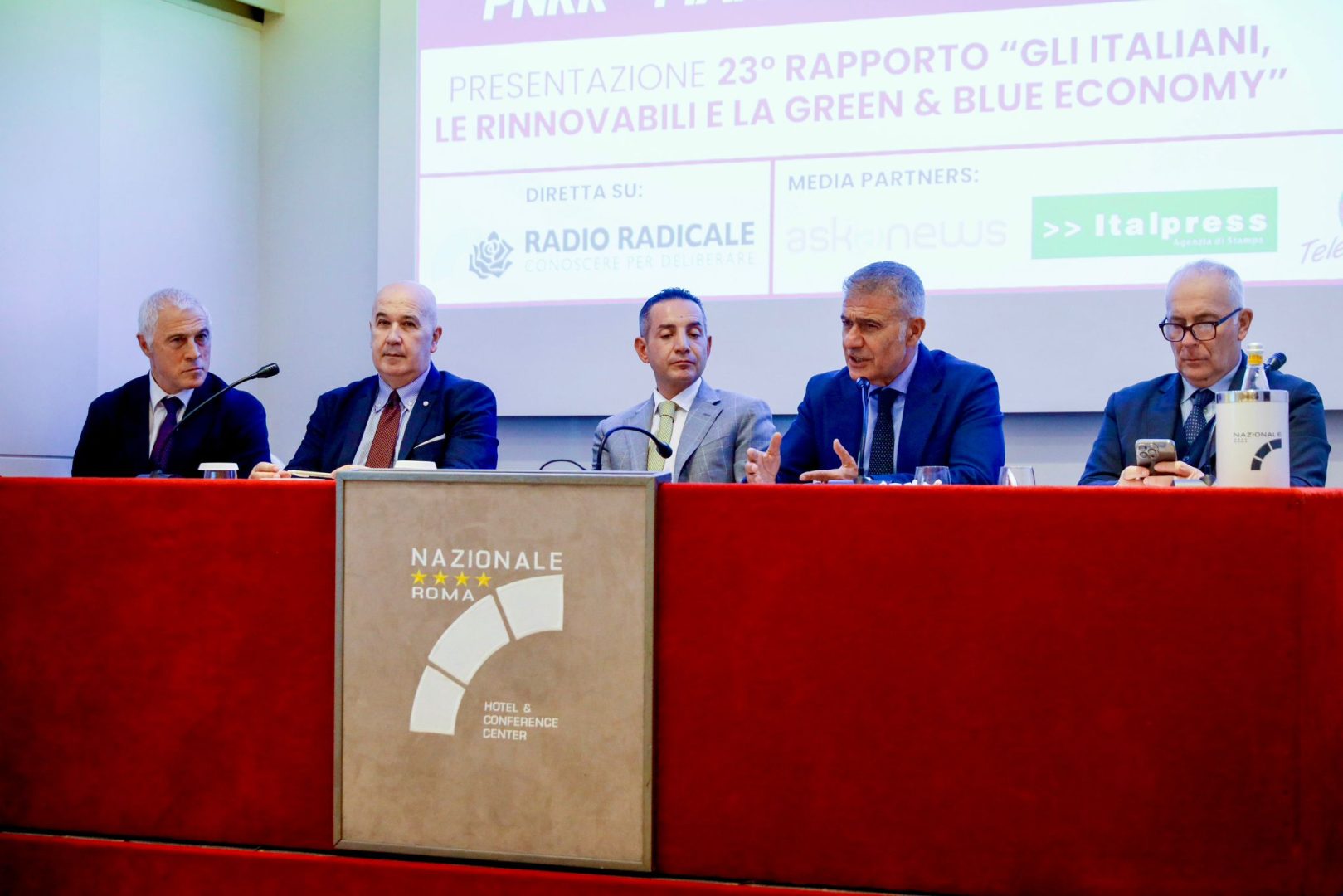
These are some of the major evidences of the 23rd Report ‘Italians, renewables and the green & blue economy’, created by the UniVerde Foundation and Noto Sondaggi, whose data were disclosed yesterday, by Antonio Noto (Director Noto Sondaggi), to the conference ‘Energy Transition and Innovation between opportunities and obstacles. PNRR – Transition Plan 5.0 and PNIEC 2030’ promoted with Renexia’s main partnership and with event partners Almaviva, broadcast live on Radio Radicale from the Sala Capranichetta in Rome. The meeting was held in connection with the special envoy for the climate of the Italian Government at COP30 in Belém and was opened by the video message of greeting and address of Minister Tommaso Foti.
Alfonso Pecoraro Scanio, President of the UniVerde Foundation, sums up clearly: ‘The data emerging from the 23rd Report leave no room for doubt: the country is ready for a rapid energy transition in the sign of sustainability, EcoDigital innovation and respect for local communities. Chiara is the road to follow: wind farm to the sea away from the coast, stop to land consumption also with the increased use of the agrivoltaic, photovoltaic on the roofs of large buildings, investments in energy efficiency and digitization. The protection of biodiversity, habitats, landscape and communities and local economies must be the absolute priority of all projects.’.
Fabio Tancredi (Vice Chief of Cabinet of the Ministry of Environment and Energy Security) said: ‘The report confirms that it is necessary to continue in the implementation of the decarbonization process by resorting to a plurality of technologies that ensure security of supply of energy and reduction of costs for citizens and businesses. All technologies must be properly balanced according to their maturity, cost-effectiveness and effectiveness in reducing emissions. Due to the very positive evaluation of Italians on the offshore wind, it is necessary to accelerate the development and programming tools of the sector. Among the most challenging challenges is the need to simplify and speed up procedures to authorize new renewable plants.’.
Live from the 30th Conference of Parties (COP30) of the Convention United Nations Framework on Climate Change (UNFCCC), Francesco Corvaro (Special Envoy for the Climate of the Italian Government), pointed out that ‘three are the issues that struck me in this COP. The first concerns China’s new posture in climate diplomacy: compared to last year is growing awareness of the role of leaders that can take on in the energy transition. The second concerns the visit here to Belém of the Governor of California. He had great echo and highlighted the strong support of the private sector in the US to continue the transition path. There may be slowdowns, but you won’t come back. The third aspect, in my opinion, concerns our country closely. It clearly emerges the possibility for Italy to play a key role as a bridge between Global South and Global North in climate decisions and policies. A Mediterranean forum led by Italy, involving all the countries of the area on these issues, would demonstrate how it is possible to build consensus and overcome the division, now completely anachronistic, between South and North global.
The conference, moderated by Gianni Todini (Director of Askanews), has allowed to open a window of confrontation between institutions, companies and stakeholders on the planning tools that favor the energy, ecological and digital transitions but also on the bureaucratic and authoritative criticalities to overcome to favor the installation of renewable, sustainable and well integrated plants with environment and landscape, and thus, with decision, to counter climate change. In the same way as renewable plants, the primary objective of raising the efficiency level of Italian companies cannot ignore sustainable digital innovation or fueled exclusively by clean energies, especially considering the increasingly significant and safe application of artificial intelligence and highly energetic technologies.
Chiara Braga (Capogroup PD and Component of the Commission Environment, Territory and Public Works, Chamber of Deputies), in a video message recorded in Belèm, where it is for COP30, said: ‘The theme of the event is of great relevance and central even in the debate of COP30, where we are trying to find the synthesis of a sustainable development model that, through an integrated system of energy production and efficiency, concretely address the climate emergency. Italy and Europe can be protagonists, but it is a priority to intervene on the permitting and the regulatory framework. In order to avoid delays such as those on suitable areas, regulatory changes are required and, at the same time, promote the reduction of energy costs for the benefit of families and enterprises. The good use of PNRR resources can also allow us to achieve the objectives of the PNIEC by creating new renewable energy plants such as offshore ones. It is certainly transversal, among the political forces, the desire to develop a system of industries that can favour the transformation of our energy model to make Italy increasingly independent from supplying from foreign fossil sources.’.
For Gianluca Loffredo (Sub Extraordinary Government Commissioner): ‘The rate of increase of carbon dioxide in the atmosphere as evidenced by measurements in the NOAA in the Hawaiian Islands does not show any signs of reduction and even the period connected with the Covid lockdown in the 2020 period and in part 2021 has resulted in effects, demonstrating that the hydro-geo- atmosphere in terms of carbon dioxide cycle, and not only, is very complex. Without prejudice to the fact that the decrease in emissions is not recorded and that the countries which contribute more to the introduction of air-conditioning gases do not show attention to the Paris Agreement, the role of Italy and Europe is transformed into a driving role for the protection of the environment and the prevention of significant damage to the environment according to the principle of precaution, protection of the rights of the person to live in a healthy environment in conditions of environment. The EU and Italy show an exceptional maturity as can be seen, for example, by a careful reading of the PNIEC published in 2024: an in-depth analysis of all possible solutions, in key to maximising the beneficial-cost relationship, aimed at the energy sovereignty of Italy, the minimisation of climate emissions, the relaunching of industrial policies aimed at renewables.
The report still shows a lack of knowledge of some innovative technologies. Only 51% heard of offshore wind and, once listed the main characteristics of this type of plants, the initial percentages (68% wanted the large wind farms on the hills and in the areas devoted with attention to the landscape and 24% at sea, far away and invisible from the coast) somehow reverse. 69% called for the promotion of offshore wind and promoting development by increasing the available funds (40%), speeding up authorization times (35%) and building a local and national supply chain (30%).
Data in line with the new trends for displacement of wind farms and preference for offshore, in particular in floating configuration: a cutting-edge engineering solution that will allow Italy to achieve the objectives of decarbonization and energy transition of the country (59%). Floating technology, moreover, allows the installation of turbines in open sea, where the wind is stronger, without trivelling the backdrop but using a system of mooring, thus maximizing the production of clean energy. A project solution that combines well with the main priorities of the survey: mitigation of impacts on marine biodiversity (45%), do not interfere with areas of environmental interest (44%) or with migratory routes of birds (35%). Instances that are structural part of the projects of the new floating plants that become, indeed, potential areas of natural repopulation for different species of marine flora and fauna. The main pillar of this innovation and the main Italian project on offshore wind is Med Wind by Renexia.
Riccardo Toto (Director General of Renexia): ‘The floating sea wind represents an energy revolution for Italy: invisible from the coasts, it can produce large amounts of clean energy thanks to large plants that exploit strong and constant winds in the high sea. These plants will not only guarantee renewable energy, but will also play a key role in stabilizing the national electricity grid, representing a fundamental transition technology in the development of the next generation fusion nuclear. Investing in 15 GW of floating sea wind power, as provided by the PNIEC, would mean a minimum fee for users – less than 1euro/MWh – and would create an added value of almost 60 billion euros for the Italian economy, generating thousands of jobs. For this reason, we strongly ask: the confirmation of the objective of the 15 GW of sea wind floating at 2040; a quick decision on the incentive tariffs that enhance the floating wind away from the coasts; removal of bureaucratic and ideological obstacles to guarantee clean and affordable energy to Italian families and businesses. Italy cannot miss this opportunity: developing the floating wind means countering deindustrialization, ensuring energy independence, lowering bills and ensuring the energy necessary for the future of the country.
In the realization of the pioneering project Med Wind, which previews a total investment of approximately 9,9 billion euros, Renexia has decidedly focused on the need to start a new national industrial chain of the floating marine wind for the production of the essential components, indispensable to build the great offshore and onshore wind parks in Italy and in the Mediterranean countries. In accordance with the Abruzzo Region is putting to the ground InVento Italia, the factory of wind turbines that will rise in an area in the immediateness of the port of Vasto. It is a totally private investment of approximately 500 million euros capable of generating 3000 jobs. At full capacity, Med Wind will ensure an annual production of clean energy estimated at 9 TWh, sufficient to meet the energy needs of approximately 3.4 million households and reduce CO2 emissions by approximately 2.7 million tonnes per year.
In this scenario, if the energy transition appears clearly not deferable, it is equally clear from the debate that it is necessary to make it march in synergy with ecological and digital transformation. Fulvio Conti (Market Director Water, Agricolture, Environment & Space in Almaviva): ‘Digital is a powerful enabler of energy transition and sustainability. It offers innovative tools to manage and optimize resources. Almaviva Group’s approach is multi-level, integrated and ecosystem: put together satellite data with sensors on the ground. The fusion of these information sources gives us a 360° view of the territorial and environmental dynamics, offering managers effective and simple solutions and systems to use that allow them to achieve the objectives set.
– photo print office Univerde Foundation –
(ITALPRESS).
