
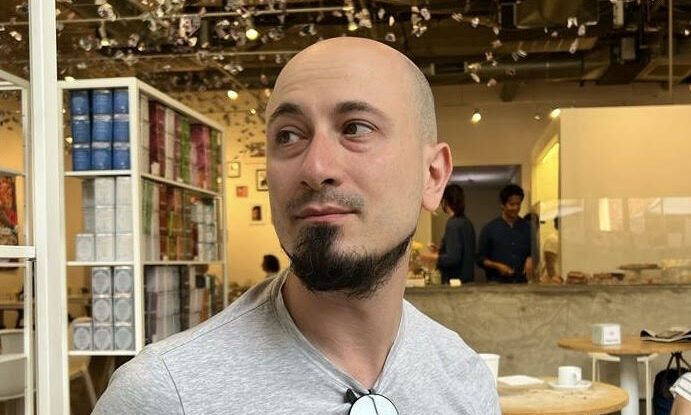
Alessandro Giammei was born in 1988 in Rome and is Assistant Professor of Italian Studies at Yale University. After graduating from Rome’s Wisdom and perfecting at the Normale of Pisa he taught at Princeton University as Cotsen Fellow, at Bryn Mawr College as Assistant Professor, and in the prison system of New Jersey as a volunteer. In addition to numerous articles and essays on the art and literature of the Renaissance and the twentieth century, he is author of several books, including Talking between males (Einaudi 2025), Ariosto in the Machine Age (Toronto 2024), Youth of Ancestors (Einaudi 2024) and Heretical Aesthetics (with Ara Merjian, Verso 2023). He collaborates with Tomorrow, the manifesto and Esquire, on which he holds the monthly column “Itaca”.
Three Ciotole is taken from the homonymous novel by Michela Murgia, and she has curated the inheritance. What were the main challenges in transposing such a complex literary work on the big screen, and how did he collaborate with Isabel Coixet to maintain the authenticity and original voice of the text?
As a curator of Michela’s literary heritage, I had, in fact, a single, very small role in the transposition of Three bowls: To choose, in the end, if the film would be officially “tracted by” or “inspired by” that book, the last that Michela published in life before leaving me the task of collecting his writings in posthumous books. I was very worried before reading the script and seeing the film: how do you turn a collection of stories into a single story? how do you instill, in that story, the thousand political, poetic and deeply personal issues that Michela has catalysed in the last work that has fired herself? But then I read, I saw, and immediately it was clear that the film by Isabel Coixet, in his respectful love for a source that does not fetish, was the antidote to my fears. I immediately said, I’m off!
As curator of the legacy of Michela Murgia, what role does it feel to have in the dialogue between literature, cinema and international audience? How do events like Italy On Screen Today in New York help preserve and promote the work of contemporary Italian authors?
I feel a strong responsibility for the readers and readers of Michela Murgia, but above all for those who do not yet know it. Since Michela died, I constantly receive messages from strangers, people of all ages and from all over the world (the last, for example, from Thailand!), who tell me how his books have had a strong impact on their lives. My role, I think, is to ensure that Michela’s spell continues to reach those who need it. Events like Italy On Screen Today are crucial, because cinema is a crucial medium to cross borders: it is enough to think about the poetry and the novels of Pasolini, which would not be so alive in the American imagination if they had not been preceded by his films.
When an Italian opera comes to an international audience, what cultural or linguistic aspects do you think is more delicate to convey without losing the original intensity? Are there narrative or symbolic strategies that believes fundamental to create empathy with non-Italian viewers?
I don’t believe much in the mythology of the “original”. Just when movies, like novels (like people, at the bottom), migrate into other languages and cultures become more fully themselves. I think we have to trust spectators: to leave to them the joyful work of empathizing with what is strange, foreign. This film is full of strange and foreign things and people, even for those in Italy and in Italian who were born and live there—perhaps because Michela Murgia and Isabel Coixet come from two nations, Sardinia and Catalonia, whose languages and cultures are foreign to the same states where they are administratively located.
The narrative of Michela Murgia addresses themes strongly linked to identity, community and memory. What tools or approaches would it suggest to those who work in cinema and literature to ensure that these issues continue to be perceived as relevant by the new generations?
I think the new generations are thirsty for these themes. Michela never underestimated the intelligence of young people, even of the very young: in his novels and stories are always children and adolescents to understand before and more than others. Those who work in cinema and literature should, in my opinion, avoid infantilizing those who were born after, believing that they have to simplify.
Italy On Screen Today aims to create a bridge between Italian cinema and international audience, including members of the Academy and Golden Globe voters. From its point of view, how can the projection of works like Tre Ciotole influence the global perception of contemporary Italian cinema, and what cultural values do you think most important to convey?
The work of deconstruction of the mythology of the so-called “traditional” family that Michela has worked in his books, and which is expressed in the film Tre Ciotole, prevents from reducing the imagination on Italianity to mythical nostalgies for an order of values that has never existed. Who goes to see an Italian film and finds such unusual ties, people with different accents and ethnicities, current themes of the Queer theory such as failure and unproductive joy, will begin to think of Italy not as an ominous postcard, but as a question still alive, whose thousand different answers are worth exploring. The Rome of Michela Murgia and Isabel Coixet is a different place than the equally beautiful one, to say, of Raffaele La Capria and Paolo Sorrentino, who dispopulated at the Academy and the Golden Globe ten years ago: as Michela wrote in his last posthumous book that I have edited, Anna of the rain, “History needs many, many, not to become slaves of one point of view”.
L’articolo The live legacy of Michela Murgia, Alessandro Giammei between literature and cinema with Italy on Screen Today proviene da IlNewyorkese.
