
by Vincenzo Petrone (*)
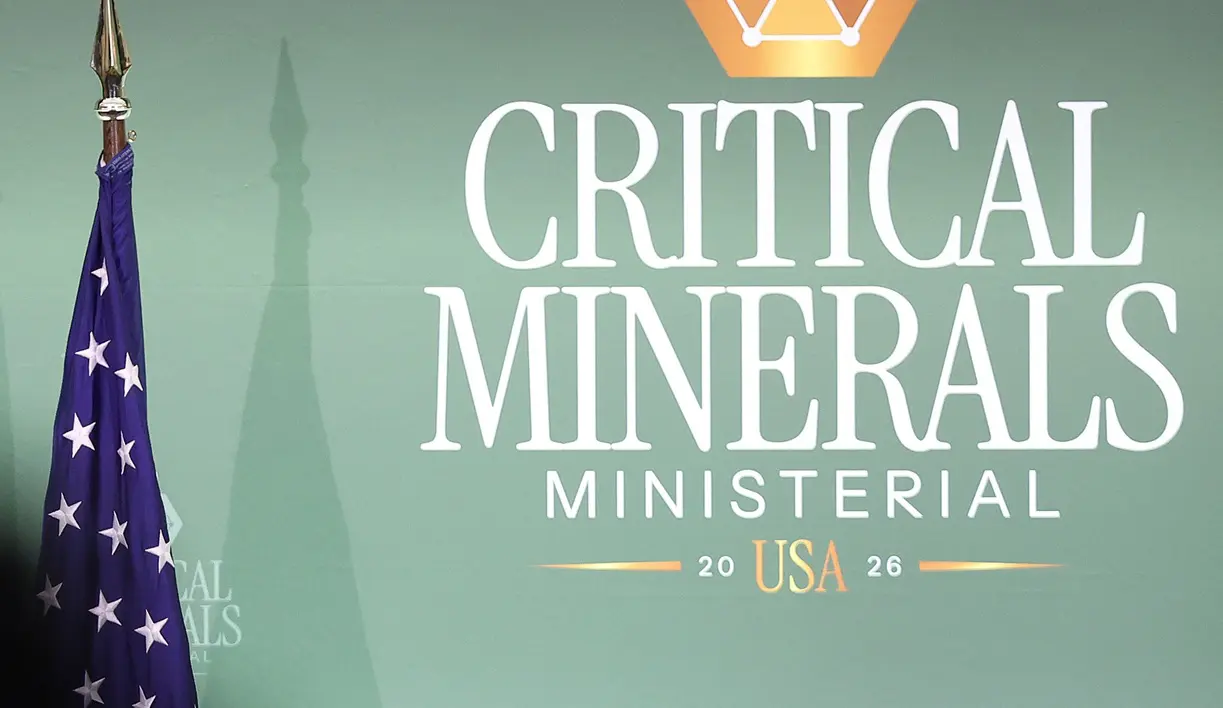
ROMA (ITALPRESS) – The President of the United States, with its intemperance, almost unknowingly affects often in the sign, because it bare the vulnerabilities that America and its allies, including Italy, have accumulated for decades for unpublished, political laziness and not incompetence. A macroscopic example is the overflow that China today has on Earth Rare, the 17 critical minerals for the global economy and for civil and military high tech. The ministerial meeting in Washington today, attended by the Foreign Minister Antonio Tajani, could launch a major strategic concerted operation between Western allies, to try to remedy guilty inadmissibility. It may be too late, but Washington will have to offer the countries convened around the table, a concrete program, well-funded collectively, that includes the great European, Canadian and American mining companies. These are times of industrial policy not of laissez faire. But let us ask ourselves: how did we get to the point of being hostages of the Communist Party of China and its supreme leader Xi Jin Ping, who today control 90 percent of the production and global refining of rare Terre? The Pulitzer Prize Keith Bradsher of the New York Times, a few months ago reconstructed masterfully and in detail the chronicle of US strategic blindness. Secret Service, State Department, Major States, for 50 years have ignored the development policies that China was carrying out in this area. And we have not done better in Europe. On April 4, last year, in response to the prohibitive fares announced two days before by Trump on the Chinese export, a strong trumpet ring has arrived that awakened the west from the torpore: China’s customs blocked the export of rare lands to the United States. Unlike Trump and his triumphal TV ads, Xi Jin Ping did not speak and did not need it as they spoke to American companies that produced critical materials for high tech and defense. And those companies were informed that the Rare Lands they had already purchased were firm in Chinese customs warehouses. Among those minerals was disprose, an irreplaceable component of high-powered magnets for nuclear reactors, laser equipment, optical fibres and finally medical devices for cancer treatment. A few days later, Trump marched back on Chinese fares, suspending them. China, while recovering the shipments of rare earth, instead put a gun on the table. In October the government adopted by decree a regulation that provides for the granting of a licence for each exported cargo of Terre Rare, of manufactured products containing Terre Rare and of technologies and machinery for their extraction and refinement. According to indiscretions taken from the British press, Beijing would withdraw passports to scientists and technicians working in the development of new advanced technologies for refining, which then is the most complex part in the production process of these minerals, available in many countries but very difficult to separate to produce individually the single mineral required for a specific product. In essence, with the licensing system, Beijing has provided a formidable tool, more permanent and completely discretionary, to be able to ban from today to tomorrow any supply to anyone, not only the United States. And can do it selectively, enterprise by enterprise, product by product, country by country. Moreover, by acquiring with every license precious data on the use of Rare Lands worldwide, in individual companies and in individual production processes.
In such a context we Westerners, the United States in the head, for once we should apply reverse engineering to China. Obsia learn how it is done, retrace the individual stages of Chinese development in this field, the tools and strategy that China has used not so much on the technological level that it is now accessible but above all on that of the acquisition in the West of technologies for the refining of these minerals. We would discover that the United States was avant-garde in the 80s and early 90s, thanks to the General Motors that in Indiana, had refined for years Terre Rare with which then produced very powerful magnets for electric motors for both civil and military use. GM had specially created a Magnet Production Society, the Magnequench. Only Japan, with Sumitomo Special Metals, had comparable technologies for the production of those magnets. China in return, although it was already a world leader in the production of rare land in industrial applications, was a decade behind GM and Sumitomo. And then intelligently decided to buy this technology without violating any rules and without politically and militarily affecting the sensitivity of the United States. In the 1990s, GM as the majority of the big companies competing in the automotive industry decided not to produce their own components but to assemble those of others, produced in outsourcing. It was cheaper and gave more flexibility in production chains in response to market cycles of vehicles produced. And so GM sold Magnequench to a group of American investors, with a small share of stock that was purchased by a Chinese company whose two owners had married the two daughters of Chinese leader Deng Xiao Ping. The Clinton Administration did not object to the sale by GM of Magnequench, because the majority of company control remained in the hands of American citizens. After several years, in 2001, the two Chinese members proposed the sale of machinery considered obsolete to a Tianjin company.The machine tools were dismantled and shipped by ship. In 2005, the majority of Magnequench’s capital moved to a Canadian company, even this time without raising objections to Washington. Soon after the Chinese shareholders acquire control and the company begins to provide technical and technological assistance to Chinese companies that refine rare lands. So far, the story can even be considered trivial because it was one of the many examples of transfers of important technologies to China that then developed them to create monopoly positions. Has it not already happened for example for renewable, wind and solar energy, and for cars? It is not so because the Rare Lands are strategically crucial. And the United States, Europe and Japan should have understood 15 years ago that China was ready to use the monopoly on Rare Lands as a strategic weapon, not only commercial and economic, but also political and military. The opportunity to understand the assumption was China itself to offer us. The writer followed her directly from Tokyo, as Italian ambassador in Japan. We are in September 2010, when a moment of particular tension comes between China and Japan, this time for the new maritime incident in the waters of the Senkaku Islands.
These uninhabited rocks are part of the Japanese Archipelago, but China considers them proper and calls them Diaoyu. The Japanese Coast Guard had arrested and taken to Tokyo to process it and allegedly expel it, the commander of a Chinese flag fishing vessel found fishing in the Senkaku waters. Everyone knows that this is a typical tactic cited: to send commercial boats in disputed waters and then to protect them first with his own Coast Guard and then with the Navy, gradually imposing a state of fact of Chinese sovereignty in support of the corresponding sovereignty of law that is then claimed on the international level. A script that China also follows in the South China Sea and elsewhere. After the arrest of the Chinese sailor, they followed a couple of days of invectives that we diplomats in Tokyo considered part of the Chinese repertoire in the crisis with the Japanese. After a very short time, however, the voice was spread that important reprisals were being prepared by China. Without notice or political announcements, officials of the Beijing Ministry of Commerce had arranged for the interruption of all customs practices of exporting rare land to Japan and to Japanese companies wherever they operated. The Japanese government in a few hours was forced to close the incident without trial by restarting the Chinese commander. The pressure of advanced Japanese industries had become very strong. The Italian Embassy sent a long report to Rome in the following days to report in all details what had happened in the Japanese industrial system just a few days after the Chinese embargo. And this in order to facilitate each useful parallel with a possible crisis of supply of those minerals for the corresponding Italian industrial sectors. The diplomats from other European countries and the United States are equally apparent.
Almost 15 years later, on April 4, 2025, President Trump’s unwise unwillingness to accept duties from Beijing was a similar treatment, almost identical in reality, to the one immediately from Japan during the Senkaku crisis without the U.S. and its alliedies drawing any teaching. The perhaps most worrying aspect of this political and military unpublished is that the West as a whole is now even more exposed to the external blackmail than it was for example in the 70s, after the Yom Kippur War, when oil-producing countries members of the Opec decreed against us the oil embargo. And it is more exposed than then for the simple reason that the 1973 oil embargo concerned only one third of the global oil production and, nevertheless, paralyzed entire industrial sectors, imposed forms of energy rationalization and excavated a global inflation wave. That cataclysm was caused by interruptions of supplies only for a third of global production. On the other hand, today, China controls 90 percent of Terre Rare supplies. What would happen for example to military supplies if before or during a crisis on Taiwan China stopped the flow of rare Earths to the West? Who in Europe would risk accepting an industrial paralysis to help Taiwan? The stake with the Rare Lands is strategic, existential. It should be hoped that at today’s ministerial meeting in Washington, the United States hopes to put shelter quickly and together, to the impoverishment of decades.
It will soon be necessary to immediately create common financial vehicles for mining development, technologies and refining plants that offer important incentives to the richest countries of raw materials. America has already begun to do so in Congo. We’ll all have to cooperate in Africa and elsewhere. If we operate together, we have all the financial, scientific and technological resources that are needed, especially if governments can involve large companies in the project. The real obstacle could also be the negative prejudice of President Trump and his faithful for everything that binds American development and security paths to Europe, Canada, Australia and Japan. The reaction to this strategic threat will tell us if Washington understood that he is unable to face the Chinese challenge alone without his historical allies. And the Rare Lands are an example and an occasion of alliance with America that we Europeans cannot let go. But to dance the tango you have to be in two.
(*) ambassador a.r.
(ITALPRESS).
