
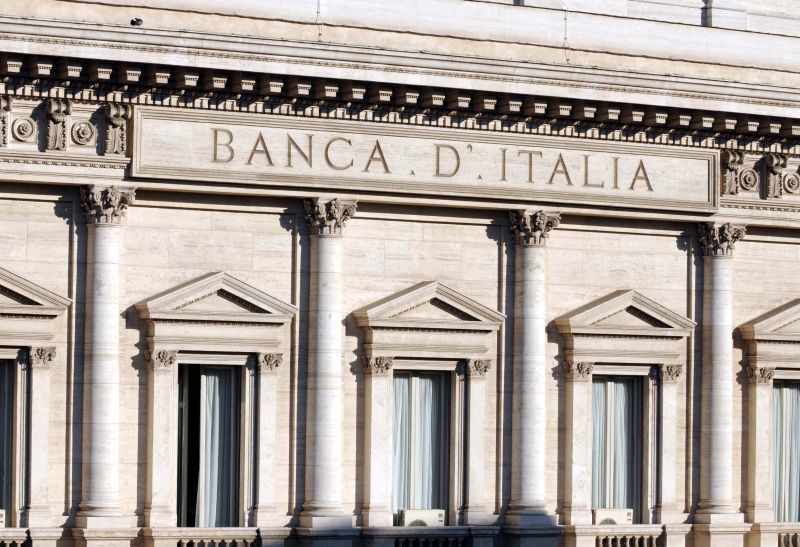
ROMA (ITALPRESS) – The macroeconomic projections for the three-year period 2026-2028 elaborated by the Bank of Italy predict that GDP increases by 0.5% in 2026 and 2027 and by 0.8% in 2028. In the basic scenario the prices of oil are placed at 103 dollars per barrel and those of natural gas to 55 euros per megawattora in the average of the second trimester of this year, and then gradually descend into the rest of the forecast period, in line with the recent trends of the markets to term of energy.
International trade expands to a limited extent this year, in a framework characterized by greater uncertainty and high energy costs, and then gradually recovers in the next two years. Financing conditions worsen along the forecast horizon. The economic activity, especially this year of the weakening of domestic demand, slowed down by the sudden rise in energy, the further increase in uncertainty and the deterioration of trust; it would gradually become stronger in the next two years. The outbreak of the conflict and the sudden rise in energy prices negatively affect the short-term prospects, compressing domestic demand in the current quarter and the next two.
The activity would be strengthened from the beginning of 2027, in conjunction with the attenuation of inflationary pressures. Compared to the projections published in December, the growth of the product is revised in the three-year period altogether by about half a percentage point, substantially due to the rise of energy goods. The trend of economic activity will depend crucially on the duration of the conflict in the Middle East and the consequences on the production and transport flows of raw materials.
A protracting of hostilities and the possibility of significant damage to energy infrastructure in the Middle East area is likely to affect the prices of raw materials, to further weaken international trade and to weigh on the trust of families and enterprises. For purely indicative purposes, in a particularly adverse scenario the Bank of Italy assumes that the growth of the product may be less than half a percentage point in the current year and for about one point in the next.
STIMA INFLAZIONE AL 2,6% NEL 2026 E POCO SOTTO 2% NEL 2027-2028
According to the macroeconomic projections for the three-year period 2026-2028 elaborated by the Bank of Italy, inflation, measured with the harmonised index of consumer prices, is averaged 2.6% in 2026, an increase of a percentage point compared to the past year, and then slightly below 2%. The increase in inflation in the current year is largely attributable to the energy component, which is affected by the sharp rise in commodity quotations. The transmission of energy revenue to the wages and prices of other goods and services is gradual, also because of the reduced share of employment contracts waiting for renewal: net of the food and energy components, inflation increases only slightly in the average of the current year, to 2%, to return to 1.8% in the two-year period 2027-28. Compared to the forecasts published in December, inflation is revised to rise, more significantly this year. The uncertainty about projections is exceptionally high. The trend of inflation will depend crucially on the duration of the Middle East conflict and the consequences on the production and transport flows of raw materials.
A protracting of hostilities and the possibility of significant damage to energy infrastructure in the Middle East area is likely to affect the prices of raw materials, to further weaken international trade and to weigh on the trust of families and enterprises. This would result in a rise in higher and more persistent inflation, with significant counterbalances on economic activity, especially if such developments were accompanied by turbulence on financial markets. For purely indicative purposes, in a particularly adverse scenario, the Bank of Italy assumes that consumer inflation would be higher than the central projection for more than 1.5 percentage points per year in 2026 and 2027 and 0.3 points in 2028, compared to the basic projection. This increase would be determined in the short term by the direct effect of the highest energy prices. In the next two years it would also contribute to the gradual transmission to the wages and prices of other goods and services, which would lead to indirect effects and wage reversal equal to 1,5 percentage points.
– Photo IPA Agency –
(ITALPRESS).
