
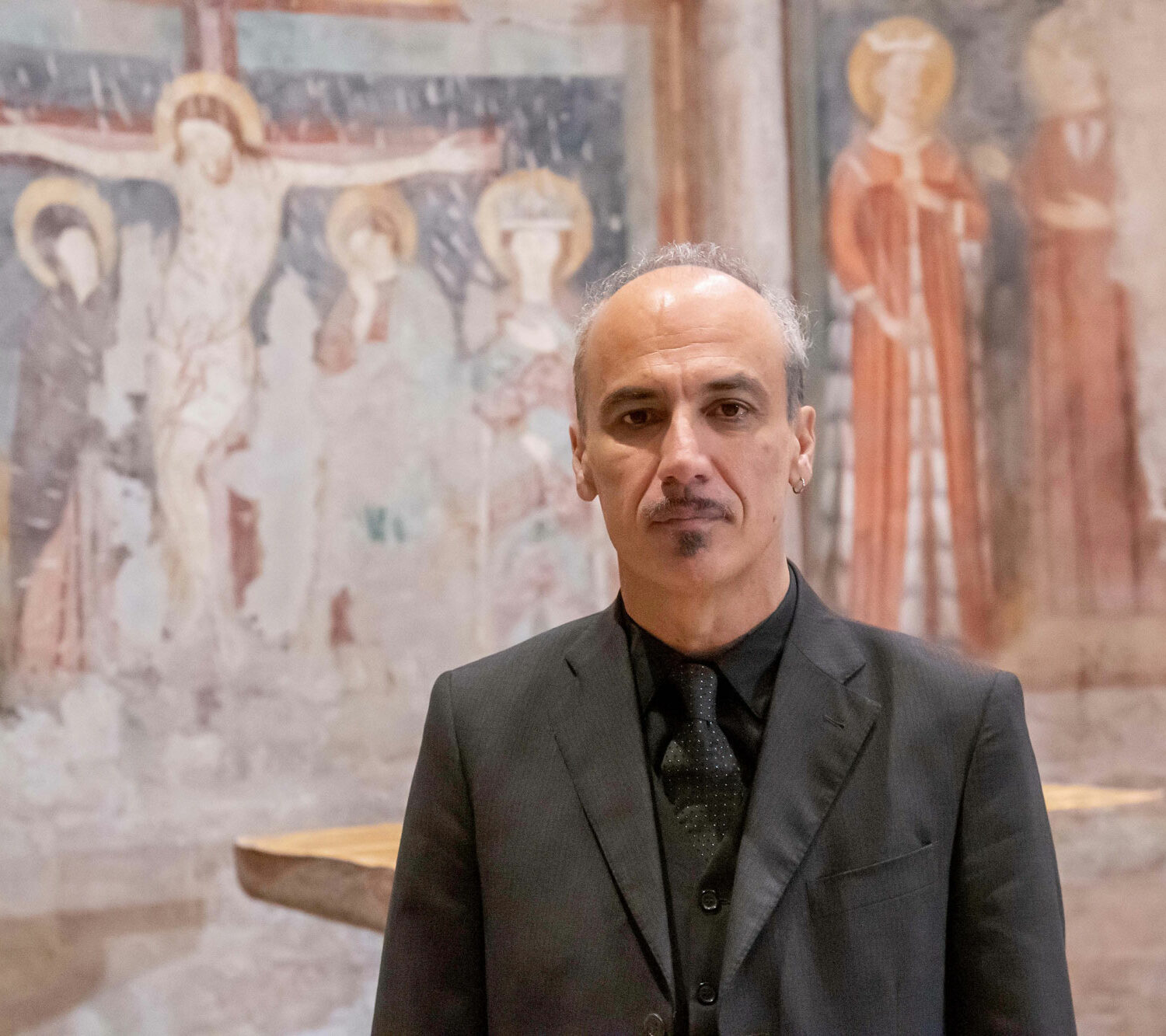
Some stories come back from afar. And even if they speak of the distant past – of a woman who lived in the 1800s in a small town in Trentino, never leaving her room – sometimes they manage to be surprisingly contemporary. This is what happened to Pino Loperfido, a writer and journalist, who decided to tell the story of Maria Domenica Lazzeri in his latest book, The Gift, published by Edizioni del Faro.
“The figure of Lazzeri came into my life in 1998,” he says, “when I was at a conference in Rimini. A speaker was talking about her, and I had never heard of her. It was love at first sight. There were two main reasons: first, that it was a very well-documented story, with an incredible amount of sources, including secular ones; second, that it was a story with a European dimension. Witnesses came from all over, commented on it, observed it. A story that circulated all over the continent.”
But what prompted an author of today, accustomed to moving between chronicles and investigations, to recount a mystical figure of the 19th century?
“The charm is all there,” he says. “It’s a story that has the structure almost of an investigation. There are documents, letters, testimonies. But there is also something beyond that. And then it was in my region, and I didn’t know anything about it. That struck me very much.”
A contemporary character also appears in the book: Giulio, an Italian American who embarks on a journey in search of his spiritual roots. “It was he who acted as a bridge between Italy and the United States. We don’t talk about miracles, because that’s not our job. But the fact is that since he came into contact with this, his life has changed. He has come out of a very serious health crisis. And today he is one of the main promoters of this American adventure, with a foundation and an association of philanthropists that raises funds to raise awareness about Lazzeri.”
Loperfido is less interested in sensationalism, more in the dynamic that is triggered between the seeker and the finder. And this is also clear from the tone of the book, which alternates between doubt and faith, irony and detachment, without ever seeming poised. Is this a book even for those who do not believe?
“Certainly. In fact, I jokingly say it’s a book that displeases a little bit of everybody. Those who believe, and those who don’t believe. That is precisely why it attracts both. I tried to maintain a detached, almost journalistic point of view. As I have also done in my other works. It is, in my opinion, the best perspective to tell things objectively. My background is Christian, but in this case I put myself at a distance, just enough to tell this story without coloring it.”
Ritratto della Lazzeri, opera di un pittore di Caldaro, tale Pfeifer, 1838
There is, however, a part of the narrative that moves outside Lazzeri’s room, outside her life and even after her death. It is the part about the silence of the Church, a long, and heavy silence. “We are talking about a century and a half,” he explains. “After Lazzeri’s death, there was a phase of great caution. But sometimes it was really censorship. Even blatant, toward those who tried to document themselves. The mysteries are many, and they followed one another. Almost more interesting, from a journalistic point of view, is the period after his death. That’s where you realize that something doesn’t add up. That is what prompted me to investigate. The fact, for example, that even today, despite the fact that in 2023 Pope Francis declared Maria Domenica Lazzeri venerable, in Trentino – where she lived – very few people know her. Something I still cannot explain.”
And so one wonders if this history, which spans centuries and oceans, still has something to say, especially to those far away, to Italians around the world.
“It is a figure that recalls one’s roots,” says Loperfido. “But not only spiritual. I’m really talking about cultural belonging. In the 1800s, people came from all over-even Australia-to visit this woman. Today that movement seems to have reversed. It is as if she is coming back to visit them.” As is often the case with certain stories, you never really know where they begin and end. But if they continue to pass from mouth to mouth, it is because they are still saying something.
The article The story of Maria Domenica Lazzeri, told by those who have studied her for decades comes from TheNewyorker.
