
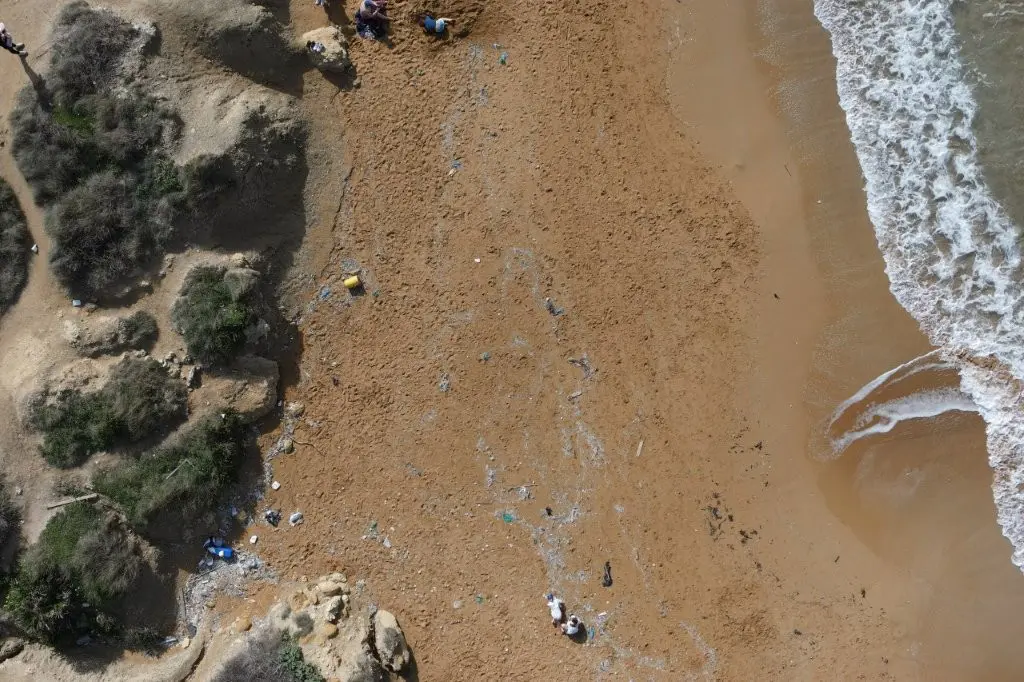
PALERMO (ITALPRESS) – The Mediterranean contains just 1% of the world’s marine water, but it concentrates about 7% of the microplastics (MP) in it. This is because it is a semi-closed basin where the plastic that enters (every year over 100,000 tons) struggles to get out, accumulating along the coasts and in the seabeds. They concern the long time of degradation of plastics, but also the damage that MPs cause to marine organisms and, indirectly, to human health.
In fact, MPs can release toxic additives, transport pollutants, pathogens and antibiotic resistance genes, and, once ingested by marine fauna and also by humans through the food chain, are difficult to eliminate. Although the presence of plastics in the sea and marine organisms is now widely documented, the knowledge of the mechanisms that regulate transport and distribution in the marine environment is still limited.
In particular, it is not clear what the routes run by plastic particles or how marine currents, winds and coastal circulation processes affect the movement and accumulation in specific marine areas. To address this complex problem, as a systemic nature, MAESTRI was born, an acronym of “Previsional models of accumulation of microplastics in coastal marine areas, effects on biodiversity and strategies to reduce pollution”, project conceived and coordinated by the University of Palermo that will develop the first forecast model of accumulation of MP in the central Mediterranean.
The model will be able to describe, simulate and predict the distribution of MPs in the next ten years in this area, identifying the most vulnerable coastal areas to accumulation and clarifying the dynamics that determine its concentration. MAESTRI is funded with €1.5 million under the INTERREG Italia-Malta Programme. Launched in May 2025, it will end in 2027.
Professors Fabrizio Pepe and Gianluca Sara and Marta Corradino from the Department of Earth Sciences and the Sea of the Athenaeus of Palermo, promoters of the study, in collaboration with the Universities of Messina (Medical Department), Catania (Department of Biological, Geological and Environment Sciences) and also the CNR of Messina, the Department of Geosciences of the University of Malta and the Ministry of Public Works.
“The Mediterranean Sea is today one of the world’s hotspots for microplastic pollution. With MAESTRI, thanks to the multidisciplinary nature that integrates competences of geology, marine biology, engineering and chemistry, we want to provide concrete scientific tools to predict where microplastics will accumulate. Understanding the dynamics of transport and concentration of plastics is essential for identifying the most vulnerable areas, estimating the time of permanence of plastics at sea and anticipating its entry into the trophic networks, so as to be able to assess and mitigate ecological and health risks,” explains project coordinators.
-Photos press office
(ITALPRESS).
