
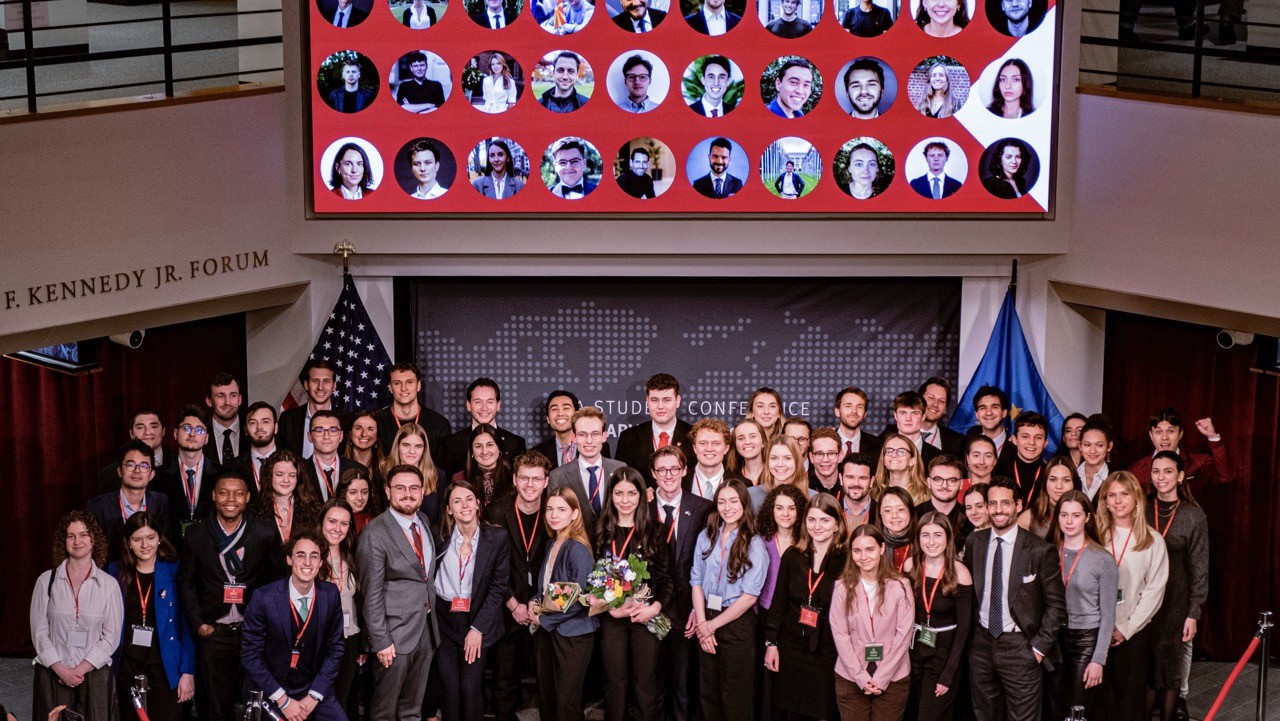
Student at Harvard Kennedy School and co-president of the European Conference at Harvard, Carlo Giannone is one of the emerging voices of the European debate in the United States. Born and raised in Sicily, with a path of study and work that brought him from Milan to Boston, passing through Belgium and the Arab Emirates, Giannone tells his training, the early passion for politics and vision that animates the conference scheduled on 6 and 7 February.
What path did she take to study at Harvard and how did she experience this choice?
It all starts from a small Sicilian town, Ragusa, where I grew up. I come from a humble family, a family that has always transmitted to me the value of education, the importance of study and commitment to fill the gap with those who might start from a more favorable background. Thanks to this boost and to this love I moved to Milan, where I studied Economics at Bocconi University. After graduation I moved to Belgium first and then to the Arab Emirates, where I worked for three years. Here my company, after reaching certain indicators of performance and excellence, gave me the opportunity to realize a dream: studying for two years at Harvard Kennedy School thanks to the support of three scholarships, doing a master’s degree in what is my great passion, public policies and public affairs. This is how I came here, where I am living these two years trying to carry out my passions, especially for Italian and European politics.
When does his passion for politics arise?
She was born very early when I was five or six. There were children who wanted to become footballers, doctors or astronauts. I always had very clear ideas: My goal was to help the community, to be able to say one day to have left a positive sign in the people around me. I have always felt the need to fight for those who have nothing, for those who do not have the chance to move forward or simply enjoy dignity and happiness. From there was born this passion, which I tried to carry out through the activism at regional and national level, the dissemination with a podcast that I founded, articles in the newspapers and associations that I created or to which I participated, including a association of social promotion in Sicily, called Sicily, which aims to promote the economic and social development of the region by uniting the energies of the Sicilians in the Island, Italy and the World.
Do you recognize in that pride, typical of who departs from the South, of wanting to return something to his homeland?
Absolutely. Sicily is a beautiful region, with a community full of desire to do and not to resign. It is a community that, however, was left alone by the state and often by those who, within the region, should lead it towards a more prosperous future. That’s why many Sicilians abroad are looking to give themselves something to do and return something. You do not want to resign to a future in which you have to run away from your land, see your parents crying so that you will not see them for months, or accept that 50% of the young under 35 years have no work, can not build a family, can not dream of a dignified and happy life.
How did he become co-president of the European Conference at Harvard?
It is a role for which I feel privileged and honored. In my first year at Harvard I participated actively in the conference, supporting it and working continuously. The presidents of the previous edition decided to designate me and Slavina Alsova, a Bulgarian girl with whom we work in great harmony, as new co-presidents because they thought we had a solid vision for this edition. I think we’re succeeding in implementing it: We will have three former prime ministers, a prime minister currently in office, the Vice-President of the European Parliament and more than 50 protagonists of think tank, NGOs, international companies and European and national political institutions.
At a time when Europe is often told as a marginal viewer, do you think it can still play a central role in the world?
I think this is especially a narrative. If we look at the indicators of human happiness and dignity, Europe is constantly at its first places for decades. The problem is that in recent years he has lost his soul a little, the awareness of his strength. In just twenty or thirty years we have created a unique currency among the most important in the world, scientific programs, an area where people can move, work, create a family, make cultural and intellectual experiences. We must be proud of this. At the same time, however, we cannot continue to depend energetically on Russia, militarily on the United States or economically on China. We must not follow someone, but dictate the line, defending our values without resigning to a world where the strongest imposes his vision. It serves a “realism of values”: face global competition without abandoning what has made our society thrive.
How much does this debate on European postage matter in the United States, at Harvard?
This is the real leitmotiv of our conference. We want to be more than a place where someone keeps a speech: We want to be a space where people exchange opinions and change their beliefs. From abroad it is difficult to influence the public scene, often those who live outside are only marginally involved. We don’t respect this. We believe that even abroad can create spaces for discussion capable of generating change and positively affect European institutions and governments.
What role can Europe play in managing global crises, from wars to economic and social difficulties?
Today Europe seeks above all to contain, eluding that certain crises are only brackets destined to close. It’s a wrong vision. I think, for example, Ukraine: we waited for others to take the initiative. We can’t always wait for someone to solve our problems. The knot is structural: With 27 Member States pulling everyone on their side is difficult to act. As Mario Draghi also said, it serves a path towards European federalism, in which fundamental decisions are taken by a single guide with the consent of citizens. Otherwise we risk being crushed by giants like China, the United States and Russia.
Can the Federalism and sovereignty of the various democratic countries live in Europe?
Democracy must never fail, indeed it must be defended. We must be proud of our national identities: I will always feel Italian. Change does not mean renouncing this, but coordinating itself better, thinking about what suits everyone. The United States was also not born in a day. Europe is not a museum destined to remain immovable, as it was defined here in America: can be a forge of ideas, innovation and future hopes.
Is Europe really seen as a “museum” in the United States?
It is a definition that has long been circulating. Someone said that in the United States it is innovated, in China it is copied and in Europe it is regulated. Others spoke of economic giant but political nano. This story has to be changed. Europe spends more than Russia in defense, is the third global economy and a great commercial power. What is missing is not the resources, but the coordination and trust in ourselves.
Any number on this year’s conference?
We will have over 700 participants and more than 70 speakers, including representatives of consulates and European embassies in the United States. There will also be people who will arrive directly from Europe, from London, Paris, Milan, facing logistic costs and difficulties. I really hope to be up to expectations and I am convinced that the debate will help to advance the priorities of the European agenda.
Article Today the European Conference at Harvard. The vision of the co-president Carlo Giannone comes from IlNewyorkese.
