
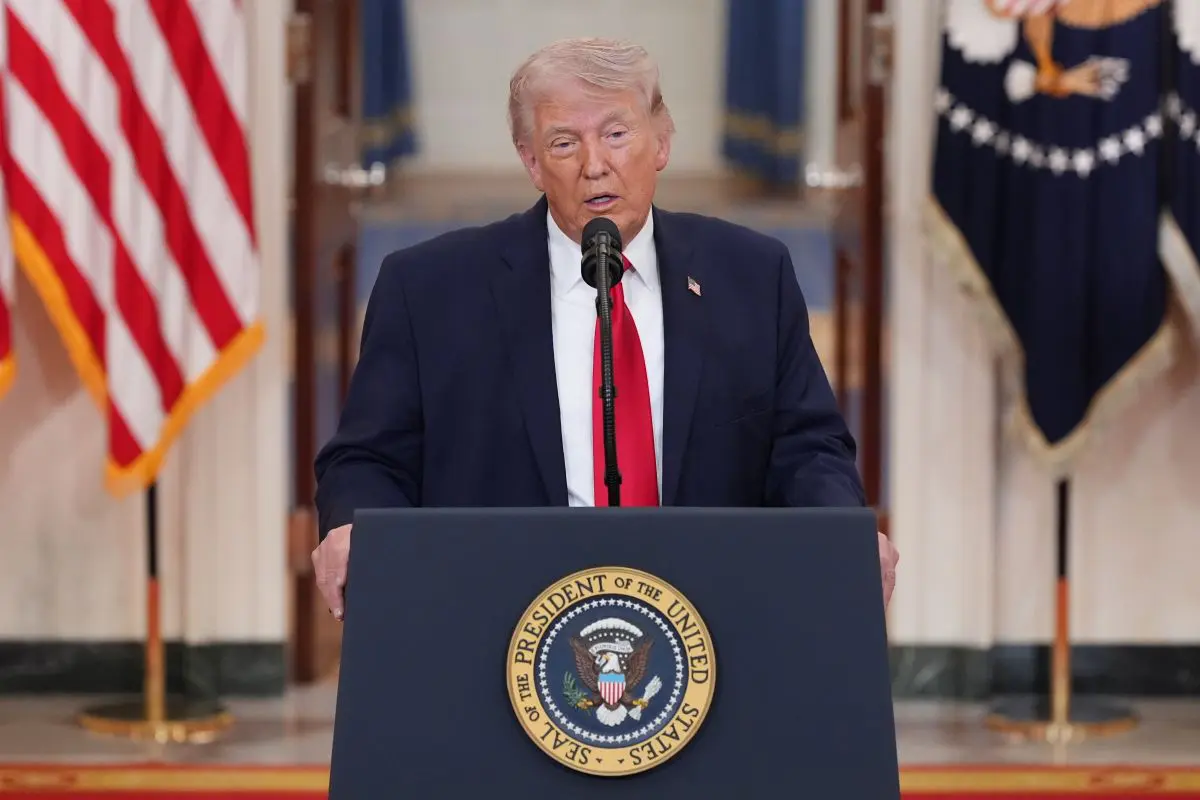
WASHINGTON (UNITED STATES) (ITALPRESS) – The President of the United States, Donald Trump, has claimed “fast, decisive and overwhelming alleys” in the war against Iran, pointing out on the military operation “Epic Fury” in a speech to the nation pronounced by the White House, in Cross Hall, 32 days from the beginning of the conflict alongside Israel. In his television intervention, which lasted less than 20 minutes, Trump outlined a strongly positive balance of military action, claiming that Tehran’s operational capabilities were drastically reduced. “The capacity of Iran to launch missiles and drones is dramatically diminished, their weapons factories are destroyed, their navy is gone and their air force is ruined,” he said, adding that the leadership of the country “are now dead” and that the Islamic Revolutionary Guard Corps “was decimated.”.
The president defined the military operations “fast, deadly and respected all over the world”, claiming that “in the history of war an enemy suffered such clear and devastating losses in a few weeks.” According to Trump, the United States is “very close” to achieving strategic goals and “on the good road to complete all military goals shortly.” Despite not providing a precise timing for the conclusion of the conflict, Trump indicated in the “next two or three weeks” a decisive phase, threatening new attacks: “We will hit them very hard. We will bring them back to the Stone Age.” At the same time, he made it clear that diplomatic contacts would be in progress, while Tehran continues to deny the existence of negotiations.
The head of the White House reiterated that the intervention is not motivated by economic or energy interests, underlining American energy independence: “We don’t need their oil, we don’t need anything they have. We are there to help our allies.” In this context, he invited the countries most dependent on oil that transits in the Strait of Hormuz to “take responsibility” of the safety of the route, from which it passes about a fifth of the world offer of crude oil. Trump also attributed Iran to the responsibility of the surge in energy prices, defining it as a consequence of the attacks of the regime against oil tankers and neighbouring countries. From the beginning of the war, on February 28, the prices of gasoline in the United States rose from an average of 2,46 dollars per gallon to more than 4 dollars, while the oil recorded a strong rise: the American crude has passed from about 98 to almost 104 dollars per barrel, and the Brent from 99 to 106 dollars.
At the same time, the financial markets reacted negatively to the presidential speech: the futures on the S&P 500 lost 0.75%, those on the Nasdaq about 1% and futures on the Dow Jones over 300 points. The trend of the lists reflects investors’ concerns for a possible extension of the conflict and the impact on the global economy, particularly on the energy and inflation front. In his speech, Trump also retraced the main conflicts of the past to invite Americans to patience, recalling the duration of World War I and World War II, as well as commitments in Korea, Vietnam and Iraq. In comparison, he stressed, the operation in Iran “lasted just 32 days” and was “so powerful and brilliant” to neutralize one of the main global threats.
The president then renewed his criticism of the Iran nuclear agreement of the Obama administration, claiming that he would allow Tehran to develop a vast atomic arsenal. He reiterated his hard line: “I will never allow Iran to obtain a nuclear weapon”, defining the Iranian regime “the most violent and thug of the Earth”. He also recalled that, according to the U.S. intelligence assessments prior to the conflict, Tehran had not yet started a real military nuclear program, despite having made significant progress in enriching uranium.
In the speech there were no details about a possible use of land troops or operational references to NATO, while the international tension on the geopolitical and energetic level remained high. Trump, however, pointed out indirectly to the role of allies, complaining previously of poor European participation in the management of the crisis, in particular regarding the safety of maritime routes.
The president also underlined the strength of American energy production, claiming record levels and stating that the US produces more oil and gas than Saudi Arabia and Russia put together. An element, according to Trump, that allows Washington to face with greater resilience the economic consequences of the conflict and to propose itself as an alternative provider for the countries in difficulty.
Finally, Trump also touched on other international scenarios, citing Venezuela as an example of “rapid and effective” military operations and talking about a new phase of energy cooperation with Caracas. The president described the South American country as a partner with which the United States is collaborating for the production and sale of oil and gas, with a view to strengthening global energy security. The framework outlined by the President thus highlights a strategy combining military pressure, nuclear deterrence and energy lever, while the effective duration of the conflict remains uncertain and its long-term impact on international balances.
– Photo IPA Agency –
(ITALPRESS).
