
by Stefano Vaccara
NEW YORK (UNITED STATES) (ITALPRESS) – In less than twelve hours Donald Trump brought the United States to the brink of an act that many jurists consider already, in itself, a serious violation of international law. And then he marched back. First openly threatens Iran: reopen the Strait of Hormuz by 20:00 or witness the destruction of “an entire civilization”.
It is a formulation that directly collides with Article 51 of the first Additional Protocol to the Geneva Conventions, which prohibits not only attacks against civilians and infrastructures, but also threats against the population used as a negotiating lever. Then, the turn. In the late afternoon, after a mediation in extremis of Pakistan, less than 80 minutes after the ultimatum expires, Trump accepts a truce of two weeks and reports the negotiation on the ten points proposed by Tehran, the same ones he had previously rejected. Attacks stop at least temporarily.
But the result marks a strategic retraction: Iran maintains the operational control of the Strait of Hormuz and can condition the naval traffic, transforming a vital hub of the global economy into a political and economic lever: now it can also charge the passage.
Trump, on Truth, explains that “on the basis of the conversations with Prime Minister Shehbaz Sharif and the Asim Munir Field Marshal of Pakistan, in which I was asked to suspend the sending of destructive forces in Iran planned for this evening, and provided that the Islamic Republic of Iran consents to the complete, immediate and secure opening of the Strait of Hormuz, I consent to suspend the bombings for two weeks. It will be a bilateral ceasefire. The reason for this decision – Trump points out – is that we have already achieved and exceeded all military objectives and are well-defined with a definitive agreement on long-term peace with Iran and peace in the Middle East. We received a proposal in 10 points from Iran and we believe it is a practicable basis on which to negotiate. Almost all past disputes were agreed between the United States and Iran, but a two-week period will allow to finalize and implement the agreement.”.
The New York Post editorial board speaks of negotiating success, but this reading ignores two fundamental elements: one cannot negotiate threatening the destruction of civilians and then accept the conditions of the opponent after an apocalyptic ultimatum. It’s not a force signal. Even at the United Nations, Trump’s language provoked alarm. First, to the Security Council the resolution presented by Bahrain to force the blockade of Hormuz is rejected by the veto of Russia and China which, as the Chinese ambassador Fu Cong admits, were also influenced by the threats from Trump’s “end civilization”.
Then, the Secretary-General’s spokesman, Stéphane Dujarric, reiterated that the destruction of civil infrastructure and threats against the population constitute violations of international humanitarian law, underlining that “there is no military objective that can justify the total destruction of a society”.
To the question whether Guterres thought that the American president was now “out of the head”, insisted on the urgent need for a return to a “sobrio” dialogue. A diplomatic way to signal the unprecedented gravity of the words spoken. At Congress, the reaction from the early hours of Tuesday was explosive. Democratic MP Alexandria Ocasio-Cortez, speaks openly of “genocide threat” and invites officials and military officials to refuse illegal orders. Californian MP Ro Khanna calls for the activation of the 25th amendment, claiming that the president is no longer able to exercise his duties.
Massachusetts Senator Ed Markey asked for Trump’s impeachment and removal, calling it “completely unstable and dangerous” and accusing him of potential “war crimes”. Mr. Elizabeth Warren denounced the threat of “war crimes of terrifying proportions” and asked for the return of Congress in session.
The crisis is not only international, but also constitutional. The most significant voice on the Republican front is that of Alaskan senator Lisa Murkowski, who denounces Trump’s words, incompatible with American values. But the rest of the Republican Party, with speaker Mike Johnson in the head, remains still. Only a few isolated voices, such as the Texas Congressman Nathaniel Moran, distanced themselves from the threat of “destroying a civilization.”.
Meanwhile, regional balances are more fragile and the United States allies observe with increasing concern a perceived leadership as unpredictable and ready to use the threat of total destruction as a negotiating lever. What will happen in two weeks cannot be expected, but what has happened will remain indelible in the history of the United States.
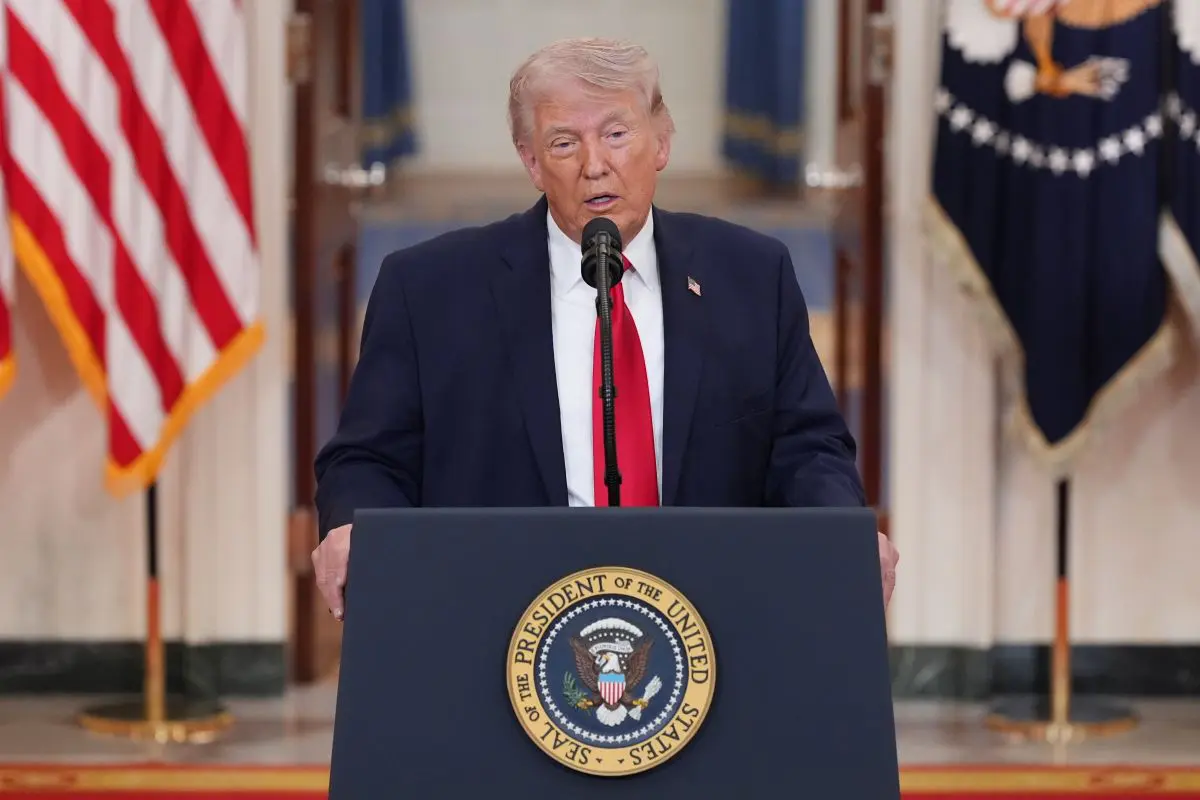
-Photo IPA Agency-
(ITALPRESS).
