
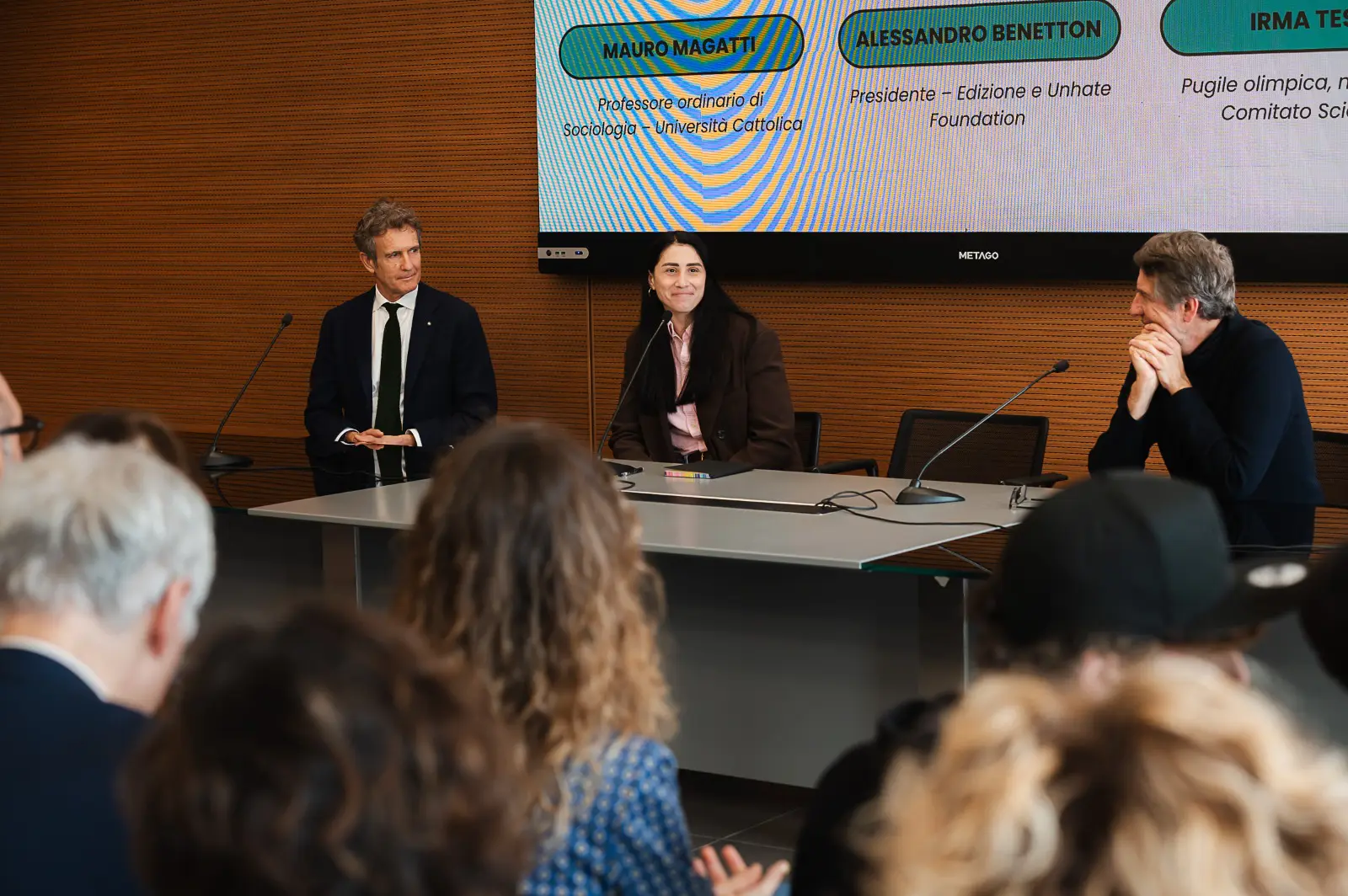
ROMA (ITALPRESS) – 24% of the Italian boys are “strusted under pressure”: they are young people who live the world as scary, feel overwhelmed and little capable of acting, struggle in relationships, internalize the discomfort without asking for help and feel strong fatigue and inadequacy, while recognizing the value of psychological support. At the same time, however, 17% of young people in our country are “propositive trusts”: open and active, with a good emotional and relational balance, little anxiety and no sense of inadequacy. They see the world as full of opportunities and face complexity without fear. These are some of the most significant data of the first initiative of the permanent Observatory on the condition of youth in Italy promoted by Fondazione Unhate, a reality of the Third Sector created by Alessandro Benetton and supported by Edition SpA, Mundys and airports of Rome.
The research, led by Professor Mauro Magatti and entitled “FRAGILE – map and mundi of a new generation”, analyzes how young Italians – between the ages of 13 and 24 – react to a context characterized by opportunities and unprecedented freedom. This extreme “opening” (more access to information, greater mobility, global horizons, cultural and expression possibilities), if not supported by educational networks, often turns into a factor of pressure and disorientation, into a real “block”. However, research shows how more than two-thirds of young people have a positive vision of themselves, their lives and the future (e.g. they look confidently towards Europe and towards science and technology), although, at the same time, widespread signs of fatigue, pressure and inadequacy emerge, especially in the 17-19 years.
The study maps the boys according to their ability to open up to the world and to act actively, and identifies altogether 4 generational profiles: in addition to the Propositional Trusts, the only ones to successfully manage complexity, and the Trusted under pressure, who perceive the world as scary, tending to social retreat and blocking, are also identified: the Moderates in transition (34%), the broadest group, characterized by a fragile and no crisis.
The latter, driven by performance anxiety, oscillate between great activism and risk of overload collapse. In this context, discriminating factors are for all the availability of cultural, relational and economic resources, while the school emerges as a decisive step in the path of fragility and activation. Many young people live it mainly as a place of evaluation and pressure. Strengthening the educational and guidance component – especially between 16 and 20 years – helps make sense of experiences and build a clearer vision of the future. A continuous orientation, linked to real experiences and the territory, can support more aware choices. Another key element is participation in extracurricular activities (sport, art, volunteering) which has a very strong protective effect on mental health. Only through solid relationships and institutions that “accept desire”, the openness of the world and the future can become an opportunity instead of a threat.
The focus of the research is on the basis of the action programme that Fondazione UnHate has set itself since its birth a year ago. With the aim of strengthening the systemic ability to accompany young people towards adulthood, the UnHate Foundation Observatory therefore proposes five lines of action/intervention, not as a closed program but as a shared basis of work between institutions, third sector, schools, companies and educational communities: Suggests of 1) reconstruct stable educational relations and places of belonging; 2) transforming orientation into a continuous path that helps make sense of choices; 3) better manage school and work transitions; 4) integrate psychological well-being in educational contexts with accessible and non-stimulating preconditions; 5) enhance the protagonism of young people through real spaces of participation and co-responsibility.
The juvenile condition is therefore built within a broad educational ecosystem that includes family, school and extracurricular experiences (sport in primis): it is in the integration between these subjects that play the possibility of transforming the openness of the world into sustainable growth paths. The evidence shows that the quality of adult posture, based on authentic listening, recognition and guidance, is a structural condition to support growth and activation paths even in those cases where the signs of discomfort become rougher (69% of young people consider bullying, food disorders and depression as structural fragility, 64% report abuse of alcohol and panic attacks as internal and external sufferings, 63% declare social withdrawal/insulation as a real phenomenon among peers).
“With this Permanent Observatory we wanted to equip ourselves with a tool consistent with the mission of Unhate Foundation: to counter hatred and violence by intervening on their deep causes and generating concrete opportunities for young generations – says Alessandro Benetton, President of Edition and the UnHate Foundation. A data-based working mode, designed to offer a timely photograph of the condition in which they live, understand their needs, inconveniences and real needs, and put these evidences available to institutions, educational services, enterprises and territories. The goal is to build contexts that can activate their potential through conscious plans and projects that meet their needs in a concrete way.”.
“I have always believed that young people are present, as well as the future, of our country and the planet – Benetton concludes. As an entrepreneur, but first of all as a man, a citizen and a father, I want to continue to do my part so that they are listened, involved and accompanied to discover and express their talent. In a global context so complex and marked by demographic winter, investing in relationships, orientation and educational continuity is not only a social responsibility: it is a strategic choice. Every energy that remains unexpressed is value that Italy fails to transform growth, innovation and positive impact. I thank the girls and boys who have made this study possible, which we make available to the institutions as a contribution to increasing the awareness of adults on the difficulties, the potential and aspirations of our young people”.
“Every generation inherits a world and has the task of regenerating it, creating new forms of freedom, responsibility and relationship – says the Magatti, President of the Poetic Foundation – in the current demographic frame, recognizing the difference between generations opens the space for the encounter between different looks, languages and codes. This generational laboratory arises from the need to overcome fragmented analysis and return a dynamic map that combines quantitative data, qualitative looks and, above all, the direct voices of girls and boys.” “Youth fragility – concludes Magatti – is the result of a complex relationship between individuals, educational contexts, institutions and social world. The research is not limited to describing the discomfort, but questions the systems that help to generate it or to counter it, with particular attention to the crucial role of the school.”.
– Photo of Mundys Press Office –
(ITALPRESS).
