
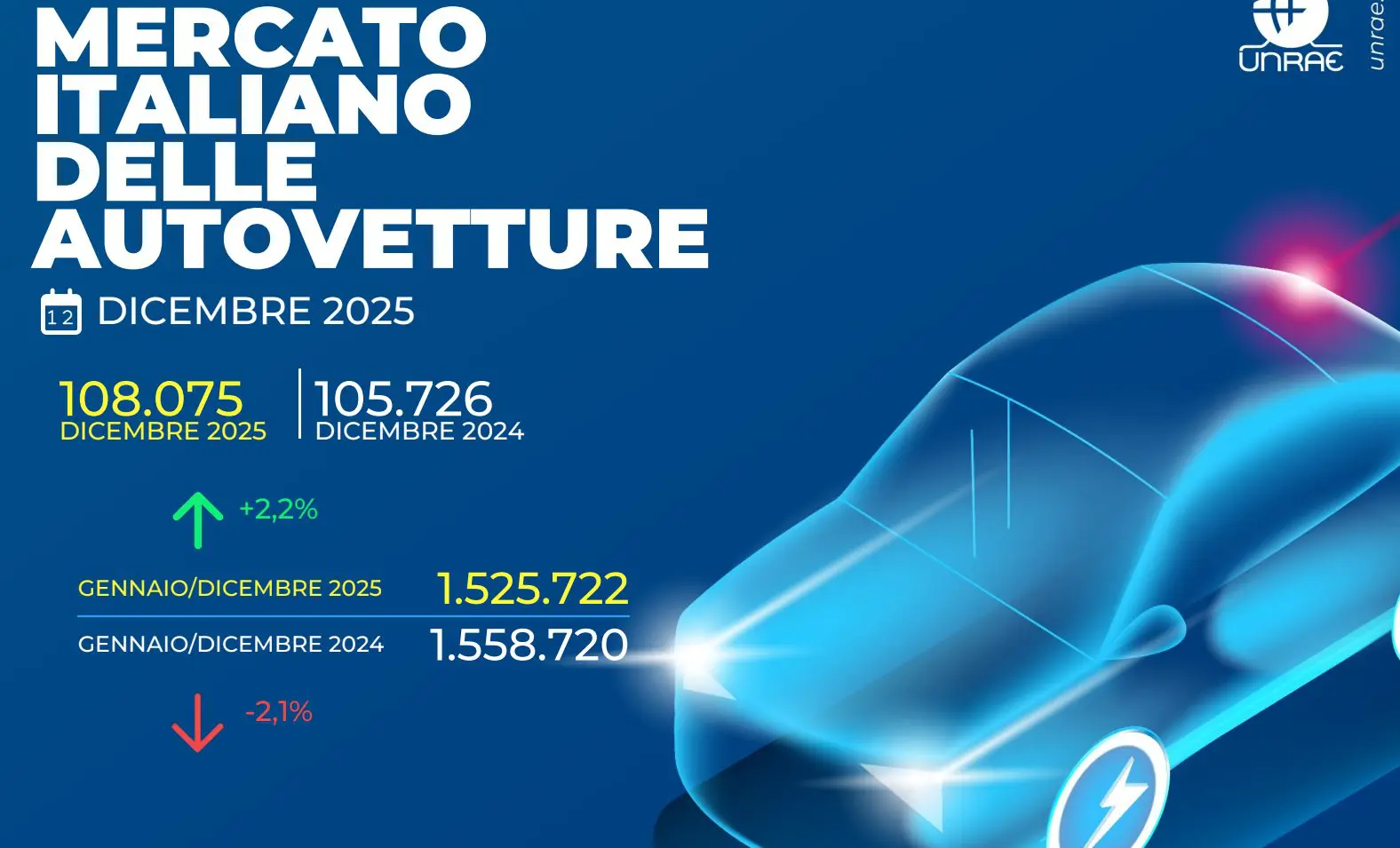
ROMA (ITALPRESS) – The motor vehicle market in Italy closes 2025 in line with the forecasts formulated by UNRAE, attesting to 1,525,722 overall registrations, down 2.1% compared to the 1,558.720 units of the previous year, and confirming a gap of 20.4% compared to the levels of 2019. The last month of the year contributes with a slight positive sign: with 108,075 registered cars, December marks an increase of 2.2% compared to 105,726 recorded in the same period of 2024.
The MASE government support program aimed at electric propulsion cars generated a total of about 55,700 vouchers, almost entirely validated within the deadlines set by the first two available fund booking windows. Following the same, there were 1.881 vouchers, whose funds were available on December 23 and sold out within a few hours. The MASE incentives have significantly influenced the market share of electric cars as well, which in the last month reached 11.0% of the total with 12.078 overall units: a doubling compared to 5.4% of December 2024, but a slight decrease compared to 12.2% of November, also already influenced by incentives on cars “in prompt delivery”. This phenomenon has obviously influenced CO2 emissions, decreased in December by 13.8 g/Km (-11.7%). The impact of the incentives will continue for a few months, but there is a concrete risk that the application will stop as soon as this effect is finished. The plug-in hybrid vehicles (PHEV) in December reach a share of 9.3%, increasing compared to 3.4% of the same month of 2024 and 7.2% of November 2025, benefiting both of the progressive extension of the offer of models available both of the new tax rates on the company cars under fringe benefits.
The total share of rechargeable cars reaches 20.3% in December, but in 12 months it stops at 12.7%, divided into almost equal parts between BEV (6.2%) and PHEV (6.5%). The 2025, a crucial year, thus confirms another year lost for the energy transition. While remaining far from the rest of Europe, BEV cars have shown a high reactivity to incentives, in a market that remains in a state of structural suffering. However, despite some rumours potentially only harmful, there is no concrete indication of incentive measures for 2026.
On the European front, on 16 December the Commission published the long-awaited “Automatic Package”, whose central element is the revision of the objectives on CO2 emissions: the reduction of CO2 emissions from 2035 on 2021 will not be more than 100% but 90%. In the remaining 10% they will be able to return different technologies, but the emissions will be compensated by credits obtained through the use of green steel “Made in EU” and sustainable renewable fuels (e-fuels, biofuels and biogas). The objective of the package, while introducing some flexibility, reiterates the ambition towards zero-emission mobility, with a primary role for the electric car (especially on corporate fleets and lower segment cars).
UNRAE stresses that the Commission’s proposal is a starting point, but not yet satisfactory: “There remain critical issues and aspects to be clarified and improved to prevent negative effects on the market, consumers and industrial competitiveness. However, we welcome the reopening of the dialogue with the sector, a necessary signal, and we are ready as UNRAE to an active confrontation in order to affect concretely the final decisions”, says UNRAE President, Roberto Pietrantonio.
“The transition must be effective and practicable, not only ambitious, and to become it needs realism and listening. We need appropriate tools, such as a revision of corporate car taxation, a widespread development of electric charging infrastructure and affordable charging rates. Italy must also play its part. With a fiscality of corporate cars aligned with European best practices in “green” key, green car purchases would grow, it would increase the spread of virtuous vehicles and accelerate the replacement of the circulating park, resulting in a state-of-the-art use for poorer social classes. They would benefit not only environment, road safety and enterprises, but also the herb that would obtain better results with less investments,” concludes Roberto Pietrantonio.
According to the analysis carried out by the Association, through limited adjustments to the tax parameters relative to the deducibility of the corporate cars, in fact it would be sufficient a commitment to the herb of only 85 million euros (net of the extrajettito) to stimulate more than 100,000 green cars in the range 0-60 g/km. The Fiscale delegation, recently extended to 31 December 2026, is an unmissable opportunity to intervene in this regard.
– Photo screenshot UNRAE –
(ITALPRESS).
