
by Stefano Vaccara
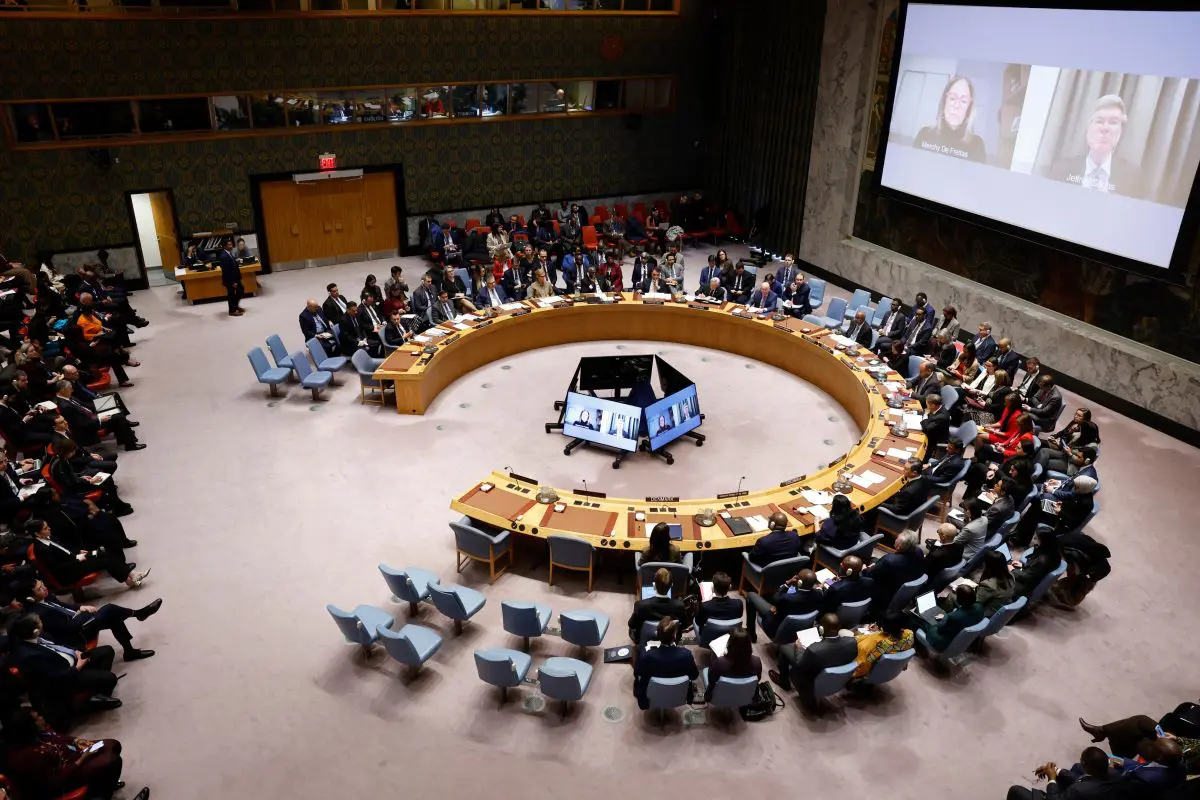
NEW YORK (UNITED STATES) (ITALPRESS) – The UN Security Council emergency meeting on the Venezuelan crisis clearly showed the UN limits in the new global disorder. A very hard confrontation between the United States and Russia, a clear majority of countries contrary to the use of force, deep divisions in Latin America and a politically absent Europe. The result: no decision, no concrete initiative, no way out.
Rosemary DiCarlo, Secretary-General of the United Nations for Political Affairs, has opened the debate, which has sent to the Council the evaluations of Secretary-General Guterres. Di-Carlo warned that the capture of Venezuelan President Nicolás Maduro risks aggravating internal and regional instability and raised explicit questions about respect for international law and the former that such an operation could create in relations between States. A prudent but net call, remained unsuccessful. The American line was defended by US ambassador to UN Mike Waltz, who rejected the idea of a war act, describing the operation as a measure of “law enforcement” against a defined illegitimate leader. According to Washington, there would be no occupation or violation of the UN Charter, recalling Article 51 on the right to self-defense. A position openly supported by Argentina and, more cautiously and ambiguously, by Panama.
But the Council has shown a front largely contrary to the use of force. Brazil, under the voice of Ambassador Sérgio França Danese, has rejected without hesitation the armed intervention, reasserting that “South America is a zone of peace” and that the bombings on Venezuelan territory and the capture of the head of the State “beyond an unacceptable line”, constituting an extremely dangerous precedent for the entire international community. On the same line Colombia. Ambassador Leonor Zalabata Torres condemned American action as a violation of sovereignty, political independence and territorial integrity of Venezuela, underlining that democracy cannot be defended or promoted by violence or coercion, or subordinated to economic interests. Mexico and Cuba have strengthened the critical front. Mexico, with Ambassador Hector Vasconcelos, recalled the Council’s responsibility to act without double standards, warning against regime change policies from outside. Cuba, with Ambassador Ernesto Soberón Guzmán, spoke openly about imperialist aggression and goals of domination and control of Venezuelan natural resources.
Among the hardest attacks that of Russia. Ambassador Vassily Nebenzia has defined the American operation a “armed aggression” without any legal justification, asking for the immediate release of President Maduro and his wife. In his intervention, Nebenzia widened his gaze, accusing Washington of wanting to restore a logic of unilateral domination, disguised as “international order based on rules”, and warned that the case Venezuela represents a direct threat not only for Latin America, but for the future itself of the United Nations. China has supported a similar position, rejecting the idea that a single country can arrogate the role of judge and policeman of the world, and calling for a return to political and negotiated solutions, respecting the principle of state sovereignty.
To bring the direct voice of Caracas was the ambassador of Venezuela Samuel Moncada, who defined the American action an illegitimate armed attack and a seizure of the constitutional president of the Republic. Moncada has openly denounced the attempt to impose from the outside a regime change, claiming that Venezuela is targeted for its natural resources and for its political independence. Also significant are the divisions within Latin America.
Argentina sided with Washington, breaking a regional consensus historically anchored to the principle of non-intervention. Chile, although led today by a conservative government, did not follow the Milei government, instead aligning itself with Brazil and Colombia. A fracture that is not ideological, but strategic, and that isolates Argentina in the South American context. Panama – who in 1989, at the time of Noriega, underwent an invasion by the US – under the voice of Ambassador Eloy Alfaro De Alba, adopted a very prudent profile, avoiding to openly stand against Washington and instead pointing on a call to the peaceful resolution of the crisis and to respect for democratic institutions, but without legitimizing the use of force as an instrument of foreign policy.
The absence of Europe appeared even more evident. No common position, no visible coordination. France and Spain intervened separately, while the EU ambassador did not present himself in the Council, a sign of the lack of a shared line. Italy has not intervened. A choice of diplomatic prudence in the light of hundreds of thousands of Italian citizens resident in Venezuela? A silence that, however, also in diplomacy could be interpreted with a “who silent consents”.
During the meeting, Professor Jeffrey Sachs of Columbia University also spoke on video linking, which warned how the use of force outside the UN framework risks to normalize a practice that empties multilateralism and accelerates the crisis of international order. According to Sachs, the Venezuelan case shows how the Security Council is increasingly hostage to the great powers, unable to play the role for which it was created. The final budget is needed. No resolution, no concrete initiative, no mechanism activated. As with Ukraine, the Security Council remains paralyzed: yesterday from the Russian veto, today from the direct action of the United States. Venezuela thus becomes the yet another symbol of a UN that discusses, records divisions, but can no longer affect events. An Organization that, eighty years after the Charter, appears increasingly deprived of the political tools to govern the crisis of the present.
– Photo IPA Agency –
(ITALPRESS).
