
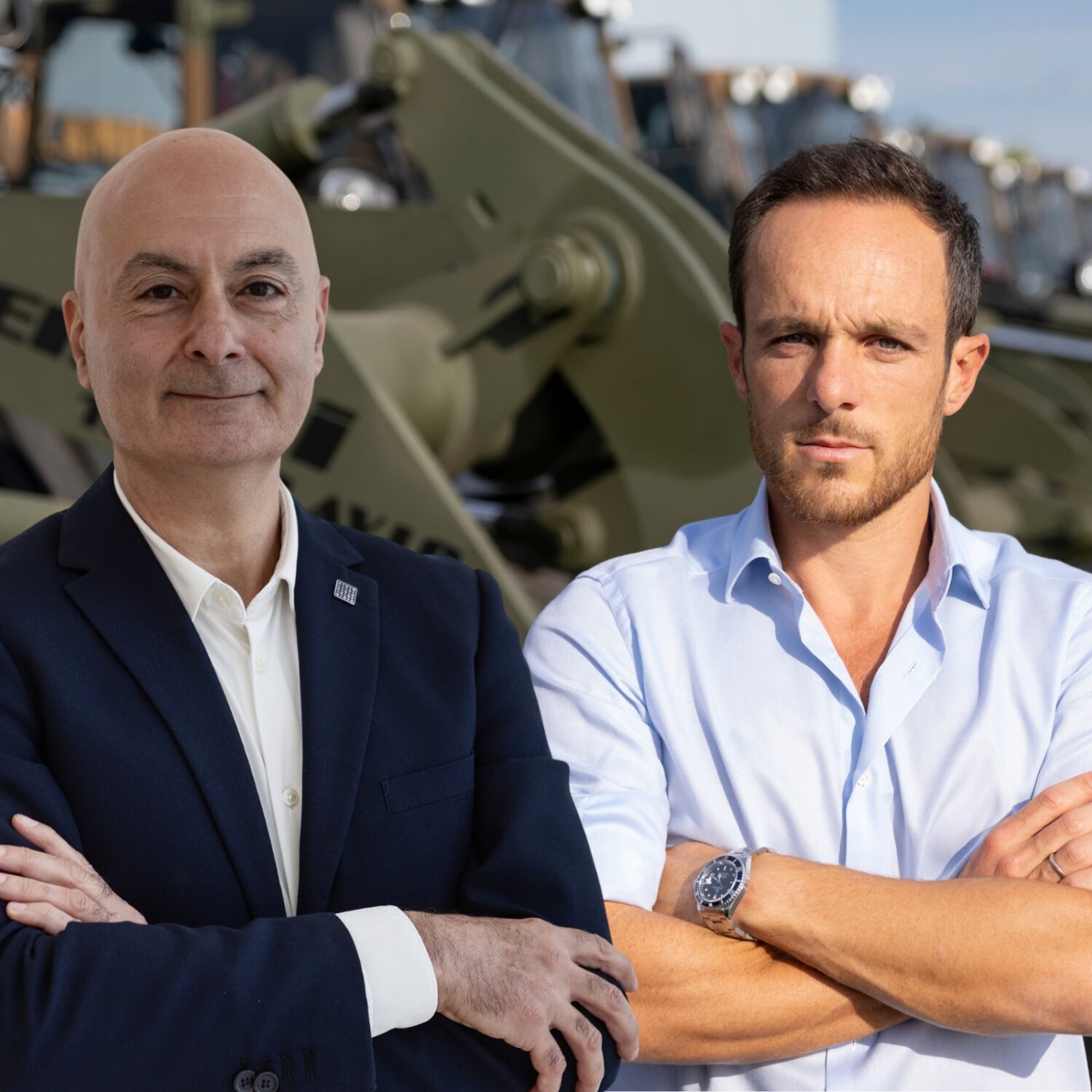
The new episode of the Portraits podcast, hosted by Claudio Brachino for ilNewyorkese, featured two authoritative voices from the world of Italian construction machinery: Filippo Muccinelli Venieri, an entrepreneur at the helm of the historic company Venieri S.p.A. in Lugo di Romagna, and Luca Nutarelli, director of UNACEA, the Italian Construction Machinery Union. Together they recounted a less celebrated but highly competitive Italy: that of precision mechanics, of industrial culture rooted in the postwar period, of quality as an identity and strategic figure. A dialogue that runs through family histories, international trade fairs, customs challenges, and a clear desire to be protagonists in global markets, especially in North America.
“We are the company Venieri S.p.A. of Lugo di Romagna, founded in 1948, and represented in the association sphere by UNACEA, of which I am a member of the Board of Directors,” told Filippo Muccinelli Venieri.
“We are in the third generation of a family company that manufactures construction equipment. The interesting thing is that this industry was born in Italy, but today we remain the only company with entirely Italian capital that builds this type of machinery. We work in Europe and outside, particularly in the United States and Canada, markets that we started exploring back in 2018 as a natural outlet for our products.” A deep-rooted identity, that of Venieri, which projects itself abroad with determination and vision.
On the membership side, Luca Nutarelli explained the role of UNACEA: “It is the association of Italian manufacturers and importers of construction machinery. We count about 90 member companies. It is a fundamental sector for building infrastructure: houses, bridges, roads, foundations, but also for recycling construction waste. An interesting curiosity is that the first earthmoving machine was conceived, at least at the design level, by Leonardo da Vinci. Although it was probably never built, the design exists.”
And it is to foreign countries that many energies are directed: “The United States is the second largest destination for our machines, right after the European Union, with about 655 million euros a year. So yes, we feel a little bit at home in the United States.”
These are not, however, episodic exports. Internationalization is a structured path, built on expertise and foresight. “Companies in our sector are well structured to move abroad,” Nutarelli noted. “Of course, we also collaborate with ICE, for example for collective participation in the Conexpo-Con/Agg fair, which will be held next year in the United States. But it must be stressed that we are not newbies: the companies we represent are solid medium-sized companies, true ‘national champions.’ They produce industrial machinery with very high technological content and are often leaders in specific niches.” And he stressed, “The American market is developed and does not lend itself to hit-and-run logic. If you want to enter there, you have to bring excellence, quality and have a structured commercial presence. The U.S. is not a market where you improvise.”
Bringing Italian quality to America, however, also means clashing with different visions of doing business. “The leap from small Lugo to big America is not trivial,” Muccinelli Venieri’s reflection. “In Romagna we call ourselves ‘peasants: big shoes, fine brains,’ and it is this combination that allows us to face a market like the American one. There I learned a saying: go big or go home. But today it no longer applies entirely. Even the Americans are realizing that it is not just a question of quantity, but above all a question of quality. We don’t mass-produce: we make custom, technologically advanced, custom-sewn machines. Ours is a tailoring of earthmoving.”
The narrative of Italy abroad, however, often forgets these industrial realities. “Absolutely,” commented Muccinelli Venieri. “Italy abroad is not only food, fashion and luxury. It is also – and more and more – technological innovation, precision mechanics. We are in Motor Valley, which for me can be summed up in one word: quality.” A quality made up of expertise, design and industrial craftsmanship: “This piece of Italy is not mainstream, but it is fundamental. We bring expertise, technology, advanced design skills. That’s why I think Italy needs to tell a better story even about these less visible excellences of itss.”
Not surprisingly, international trade shows remain key hubs for the industry. “In business-to-business, the marketing classics are there, but they are different from those in FMCG,” Nutarelli explained. “Branding exists, but it is less emotional and more technical. Trade shows continue to be crucial, although they are changing. It is no longer enough to put a machine in a booth: the trade shows that really matter are those that produce content, that make technology culture.” And he emphasized a paradigm shift: “If before the marketing department was next to the closet, today it is at the center of strategies. Communicating well has become essential.”
Of concern today is regulatory instability, especially in transatlantic relations. “More than the tariffs themselves, we are concerned about uncertainty,” said Muccinelli Venieri. “We are concerned about the lack of clarity. Our industry focuses on quality, and that remains a strength even with the duties. But we would like to know what game we are playing. You tell us what the duty is? Fine, we roll up our sleeves and work.” An industrious philosophy, that of Romagna, which has been seen even in the most dramatic moments: “Two years ago, after the flood, we got everything back on its feet in a week. We can deal with the duties as well, but we want to know where to start.”
Behind the numbers, however, there are also dreams. “My mission is to take Venieri to the world,” confessed Muccinelli Venieri. “I was born on bread and Venieri. I always say I have yellow blood, because our cars are yellow. My dream-and also my mission-is to make our company known everywhere. And I will succeed.” A goal also shared by those representing the industry as a whole: “Our job is to be the infrastructure that allows better dreams for entrepreneurs,” Nutarelli concluded. “Sure, it may sound utopian, but having a dream too helps us to better accompany our members. And maybe also help us to dream of an even stronger, more recognized, more heard industrial Italy.”
The article Venieri S.p.A and UNACEA: industry and dreams with construction equipment comes from TheNewyorker.
