
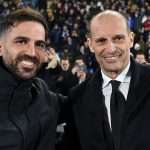
Allegri’s Milan win away at Como in Thursday night’s rescheduled fixture widens the philosophical gap between “result-first” football and “play-first” football.
Last night delivered a very entertaining match between Fabregas’ Como and Allegri’s Milan. In the first half, Como dictated the tempo, deservedly taking the lead and creating several clear-cut chances to make it two — a second goal that never came but would have been fully deserved. Maignan was outstanding, bailing Milan out on at least two occasions.
At the end of the first half, a controversial incident led to Milan’s equalizer from the penalty spot. Much debate surrounds the severity of the contact inside the box, as well as a prior foul in midfield by Saelemaekers that sparked the move.
In the second half, Allegri made tactical adjustments, Milan held firm, managing the game without necessarily dominating possession, and Rabiot scored twice to seal a 3–1 final scoreline for the Rossoneri.
That’s the stripped-down match report. From the final whistle onward, the carousel of comments and analysis restarted, no longer focused solely on the game itself but on the opposing footballing philosophies.
Milan and their leader Allegri once again found themselves in the eye of the storm, almost as if Milan hadn’t actually won the match, extending a positive run of 19 (!) consecutive games unbeaten. Almost as if criticism wanted to forget where this Milan started from — the ashes of last season, which ended without even securing qualification for European competitions.
A true “War of the Worlds” is underway, to quote Spielberg’s 2005 film, with the factions of the “giochisti” — the most aggressive in the debate — and the “risultatisti” destined to clash without interruption.
It is perfectly legitimate to say that we don’t like the way the Rossoneri play, that this conservative, pragmatic philosophy doesn’t appeal to refined football palates devoted to orthodox Guardiolismo and loyal only to the disciples of that school, from De Zerbi all the way to Fabregas himself.
It is legitimate to express an aesthetic judgment that can — indeed must — be detached from the result. But it cannot be denied that there is another side of the coin: another way of playing and interpreting football, regardless of the players at your disposal, who nonetheless always make the difference.
The most recent Champions League, Europe’s premier club competition, was won by Luis Enrique’s PSG, a result that reignited the play-first philosophers — bold and relentless evangelists of a footballing creed that pushes the narrative of a single correct way to play the game. Because “football has evolved and you have to keep up with the times.”
Too bad that just 12 months earlier it was Ancelotti’s Real Madrid lifting the trophy, with a squad full of stars but a footballing philosophy that calling pragmatic would be an understatement: defensive solidity, a low block, and counter-attacking, to oversimplify the concept.
Last season’s Europa League was won by Tottenham, perhaps one of the least attractive teams to watch in Europe in terms of quality and attacking principles, defeating United in the final — a side that, if not on the podium, was still comfortably among the top ten in this unofficial ranking.
In 2024/25 it was Gasperini’s Atalanta who triumphed, a coach whose philosophy deserves a separate editorial altogether, as he does not belong to the giochista camp and defends man-to-man all over the pitch, as was done 50 years ago. Of course, Gasperini and his football are not just that, but as stated, the current Roma coach warrants an article of his own.
It is also interesting to look back at 2022/23, when Roma and Sevilla faced each other in the Europa League final, led by two coaches — Mourinho and Mendilibar — who, if football were judged strictly through the lens of the dominant contemporary narrative, should be considered (and by some are considered) tactically obsolete.
José Mourinho in particular has endured the same attacks Allegri is facing now: outdated, unwilling to adapt, left behind as football moves on. And yet, with a Roma side that was little more than modest, he lifted the Conference League in 2021/22 and would have won that Europa League as well, if not for one of the worst refereeing performances in the history of European finals — the disgrace overseen by Taylor.
Mourinho, like Allegri, is a “victim” of a distorted media narrative that wants to convince people there is only one way to play football, and that anyone who doesn’t conform or adapt is obsolete.
A narrative that does little harm to those directly involved — who can laugh it off and have millions of reasons (equal to the euros in their bank accounts) not to care — but that ultimately does a disservice to common sense and, above all, to the truth.
The objective truth lies in results. And results — trophies — show that in football, even today, you can win in different ways, not just one.
The truth of the facts also tells us that Italian football DNA has always been pragmatic, and historically, that is how we have won. When we nostalgically celebrate Italy’s 2006 World Cup triumph, for example, we never stop (rightly so) to analyze how that success was achieved, yet the semifinal against Germany and the final against France were dominated by them and won by us.
Last season’s Napoli under Conte won in a very different way compared to Spalletti’s Napoli two years earlier. And the fans — the most genuine soul of this entire circus — celebrated and enjoyed it in exactly the same way.
L’articolo War of the Worlds proviene da Soccer Made In Italy.
