
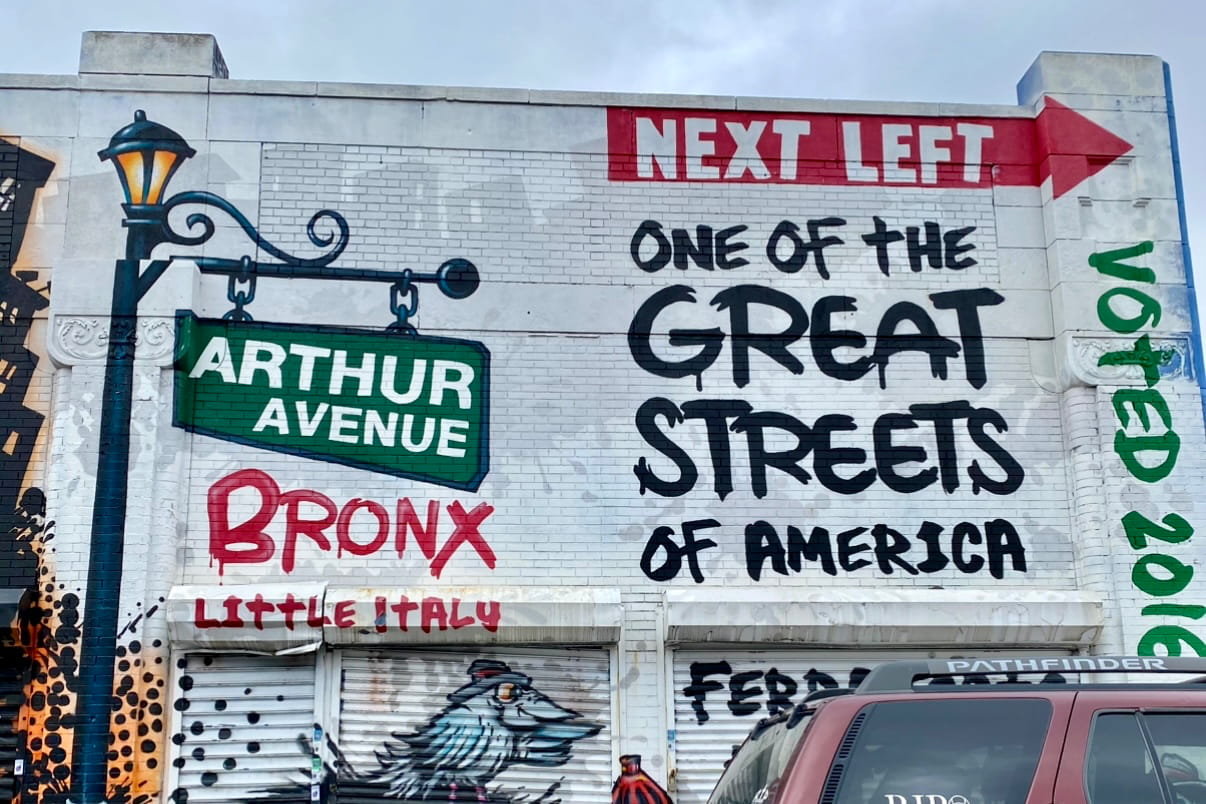
Step by step, in our World Tour in New York, we have attributed several flags to the neighborhoods of the city. I thought it was time, now, to start talking about our Italy by exploring the impact of emigration from our country over the centuries and tracking the stories that make New York, today, a city where the Italian heritage has a leading role. Let’s just say that different neighborhoods have seen the Italian community root and develop: from Manhattan’s Little Italy folklore to the Lower East Side, from East Harlem to Staten Island to Williamsburg and Bay Ridge to Brooklyn. In this article, however, it is in the Bronx that we want to go, discovering an authentic Little Italy, which has as its center the iconic Arthur Avenue, entitled to the 21st President of the United States, and the blocks between East 187th and East 189th street.
It is between the end of the nineteenth century and the beginning of the twentieth century that the Bronx joins, structurally, the geography of Italian emigration in New York. In those years, while Manhattan begins to become increasingly crowded and expensive, many Italian families move north, following the expansion of the subway and the construction of large residential complexes. Between 1900 and 1930, the Italian population of the Bronx grows exponentially, until it represents one of the city’s most numerous and rooted communities. Immigrants come mainly from the regions of South Italy – Campania, Sicily, Calabria – and find employment in construction, markets, transport and factories, contributing in a concrete way to the urban development of the district.
Unlike other areas of the first landing, marked by a strong transience and interculturality, here the Italian settlement immediately assumes a stable character: families are recomposing, creating mutual aid networks, opening specialized shops and aggregation sites that transform Arthur Avenue into a real community center. The road is not born as an identity symbol, but as a functional space and is perhaps this origin to explain why, still today, the Little Italy of the Bronx is perceived as one of the most authentic expressions of Italian heritage in New York. Although this district has long lost part of its nature and is now in all its effects populated by a cultural mix that involves other nationalities, the Italian heritage here remains alive with the persistence of gestures, rituals and symbolic places. Arthur Avenue is not a stage, (and does not seek to be) but it is a path lived, where historical workshops and new presences live, maintaining a fragile but surprisingly vital balance.
Walking through these streets is the impression of going back to history to land in a time that could easily correspond to the 1950s. By coincidence, I found myself exploring the neighborhood often during the winter weekend, with the sky mostly grey, factors both well evoke a certain degree of nostalgia. And I think it’s just nostalgia a feeling that well defines Arthur Avenue, or at least this is the effect that these roads have on me. Nostalgia mixed with that kind of melancholy amazement that we try sometimes in our Italian cities in front of the sporadic old signs left, at some shop still in activity or to the story of who other epochs lived them and begins every conversation with the typical “in my time…”.
It is not surprising, then, that these roads have left a mark even in the literary imagination. Don DeLillo, one of the most important contemporary American writers, was born in the Bronx and raised a few blocks from Arthur Avenue, in an Italian-American context that helped to form his gaze on the world, made of memory, identity and urban stratifications. More explicit and clearly linked to the neighborhood is instead the look of Joseph Tusiani, Italian poet and intellectual, who in his novel “In a house another house I find” told the daily life of the Little Italy of the Bronx by returning its human, linguistic and affective dimension.
For an Italian in New York looking for its roots, the Little Italy of the Bronx is a real discovery! An exploratory walk along Arthur Avenue can start with one of his most famous and visited places: the Casa della Mozzarella where time is marked by the slow rhythm of the counter, the shapes of the cheeses exposed and the secular experience of a tradition and a patient work handed down from generation to generation. The mozzarellas here are very fresh and one of the gastronomic purchases that is undoubtedly worth the “journey” to the Bronx. Without moving too far from here, it will probably be the showcases of Biancardi and Tino’s Delicatessen to catch the attention. Hanging cuts, tricolor labels that recall Italy, shelves that tell a daily life made of shopping, homemade lunches, typical recipes and habits that resist. They are shops that in a moment bring us back to Italy, among products that in New York are difficult to find, family scents, residues of dialects mixed with new languages and belonging to a culture that must not be shouted to be recognized. This, for example, has not happened for a long time in Manhattan, where the most famous Little Italy is now more a stage than an authentic reality. But we will talk about this again. Let’s go back to our walk and now let’s get a coffee, maybe from Egidio Pastry Shop, where nostalgia is almost tangible, and not so much for what is consumed, as for the way it is done, for the atmosphere that recalls an idea of simple and direct sociality so alien from the rhythms of the great metropolis. And again the neighborhood continues to surprise us with Borgatti’s Ravioli & Egg Noodles that since 1935 brings fresh pasta to New York, Calabria Pork Store and the bakery Addeo & Sons that return the idea of a tradition that has not stopped, but has simply adapted to a new place.
The heart of this Little Italy remains the Arthur Avenue Retail Market, a large market space, born in October 1940 to serve the Italian community of the Bronx. Here many of the historical activities of the area gather under the same roof, in a context that still embodies today a very Italian idea of shared space, where commerce intertwines with sociality. As soon as you enter, you are greeted by intense aromas and a variety of family products, from cold cuts at the moment, to cheeses, meat, to fresh bread, but also by unexpected details such as craft cigars, which tell a time when the market was a daily meeting place before even a destination for gastronomic purchases. Historical benches live with more recent presences, keeping alive that balance between tradition and adaptation that allowed the market to cross decades without losing its original character. There is no lack of details that today we find a little kitsch and the inevitable stereotypical references to the clichés of “Il Padrino” of pizza and mandolin, which remain in the background as an inevitable scenography. Today the market is constantly evolving but remains a reference point frequented both by residents and by those arriving here with the intention to discover a New York still authentic.
Beside the shops and places of everyday life, the Little Italy of the Bronx has built its identity around symbolic spaces of religious and cultural aggregation. Among these, a central role was the Our Lady of Mount Carmel Church, founded at the end of the nineteenth century to serve the growing Italian community in the neighborhood. The church was not only a place of worship, but a true social point of reference for the Italian community just arrived in the Bronx and for its descent and still today, the celebrations related to the Madonna del Carmine and the annual processions keep alive the bond between faith and traditions. A few steps away, over time, have found space also cultural initiatives designed to tell and hand down this story: district theatres, events halls and, more recently, cultural centers dedicated to the Italian American heritage have contributed to make Arthur Avenue not only a gastronomic destination, but also a place of narration and representation.
This ability to adapt is not only the result of nostalgia or the strength of memory. In recent decades, Arthur Avenue has also been able to count on a structured work of protection and enhancement carried out by the Belmont Business Improvement District (BID), an organization that brings together traders, real estate owners and local realities with the aim of preserving the identity of the district while at the same time accompanying its evolution. Through cultural promotion, event organization, urban space improvement and support for historical activities, the BID helped keep the Bronx’s Little Italy alive, allowing the neighborhood to transform itself without ever falling apart. One of the most visible expressions of this work is the Feast of August, the annual event that, every September, returns to Arthur Avenue and the nearby East 187th Street the size of the shared party. Organized by the Belmont BID along with the neighborhood traders, the Fragosto festival has its roots in an ancient tradition that, for over twenty-five years, has been reinterpreted in the Bronx as an opportunity to gather residents and visitors around food, music and Italian culture. Between stalls, live performances and a heterogeneous crowd that arrives from all over the city, the Fragosto festival is the ideal time to visit the neighborhood in excellent company and with good Italian food to be a protagonist.
In this balance between past and present, between collective initiative and district life, the Little Italy of the Bronx continues to stand out in the New York landscape. Not because she remained unchanged, but because she knew how to change without losing her center. And perhaps this is his most current teaching: identity is not something that is inherited once and for all, but something that is built together, day after day. I don’t have to wait for the next holiday of Ferragosto, Sunday 13 September 2026 from 12.00 to 18.00! In the meantime, we will continue our journey to the city looking for authentic stories and cultural heritage to be discovered and handed down!
Article Where Italy has taken root: Arthur Avenue and the Little Italy of the Bronx comes from IlNewyorkese.
