
William Geiger, a New York-born U.S. director known for his 2010 film “Free Willy – The Great Escape,” accompanied his Italian-American wife about four years ago to visit an uncle in Sicily. He became fascinated by the Strait of Messina and the places on its two shores, Sicilian and Calabrian. So much so that he stayed there for four years, living among the people of Sicily and Calabria, to learn more about the customs, traditions, myths and legends that make that corner of the world unique and extraordinary. In an interview talking about the Strait of Messina he said, “This Strait has something magical about it. I have never seen such a beautiful sea. I have never seen such beautiful light as here on the Strait.”
Yet, of places in the world he has visited many. Those found treasures, those environments rich in history and charm, those well-known characters, cannot remain hidden. He decides to write a screenplay to make a film out of them and make them known to the general public. The Sicilian Region, the Calabria Region and a private individual finance his project, and the film entitled “Glass Beach” has already been in theaters since June 30. It is an intense story that fascinates and moves, cast in the sociocultural context of the Strait of Messina area, where it takes place, touching on a multiplicity of themes. One above all is the theme of forgiveness. Salvo, the protagonist, must forgive himself and then forgive others. Salvo is a fisherman and practices swordfish fishing, which in the Strait has bimillenary roots, constituting a pivotal element of the Straitese culture and tradition. It therefore deserves to be told.
Those who watch the Strait of Messina, at this time and throughout the summer, will be able to observe strange boats going, far and wide, to explore its waters. These are the modern motorized “feluccas” with iron trellis and gangway, used for swordfish fishing.
Il pescespada nello stretto di Messina
For six months of the year, from October to March, the swordfish, stays in the deep sea, just razor-sharp to the bottom, both because the waters down there are warmer and because it easily finds something to feed on. In early April it floats up and heads for the coasts. It is around June 15 that the mating period begins and then the mating period that lasts throughout the summer. The female lays eggs on several occasions, numbering up to 800,000.
It is at this time that they enter the Strait of Messina and head for the Sicilian coast, following a millennia-old ritual, often in pairs, male and female. Of the two, the smaller is the male, who always precedes the female and never leaves her, partly because the female needs to be well courted, with significant foreplay, in order to accept the male. In “traffinera” fishing, that is, harpoon fishing, fishermen always try to hit the female first.
When this pierced female struggles and struggles to free herself, the male does not abandon her, strives to help her and remains present on the spot throughout the struggle, even if the struggle lasts a long time. When the female is then pulled up now dead, the male continues to try to follow her exposing himself to certain death, which almost always comes on time. When, on the other hand, it is the male who is struck first, the female abandons him without any delay, so soon will she find another male as a mate to ensure the procreation of new creatures. Sometimes it may happen that three specimens are spotted together, two males and one female. This happens when one male has lost his female and tries to woo another’s. Then there the spoils for the fishermen can become more substantial.
Feluche e luntri, nello Stretto di Messina in una stampa del ‘600
La pesca del pescespada
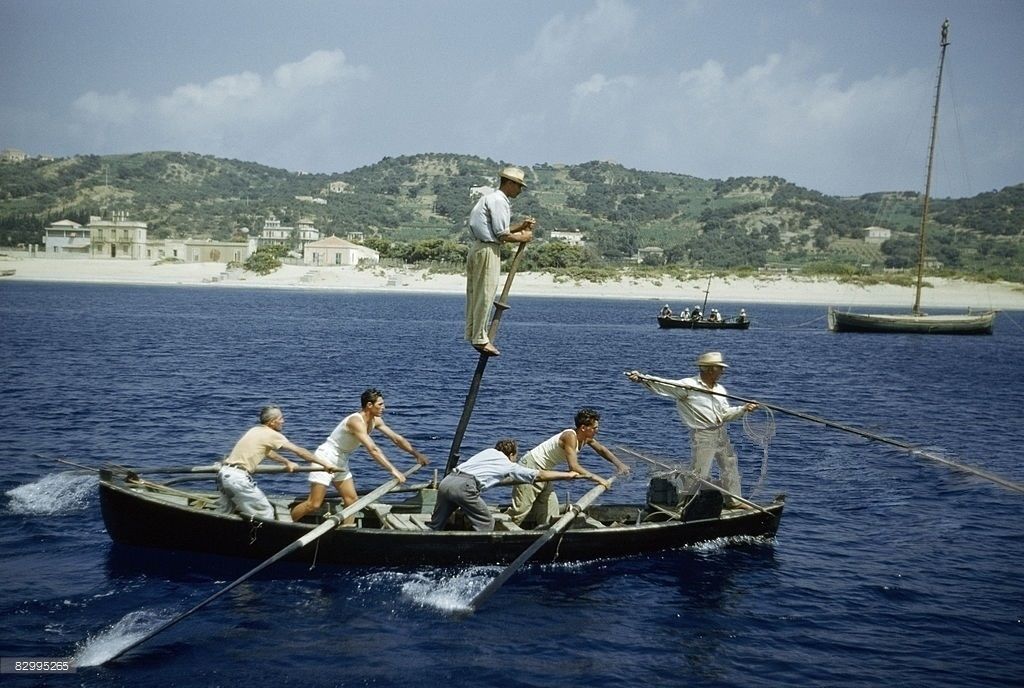
This fishery is an inseparable part of the culture developed among the people of the Strait since the time of Greek colonization. Polybius, a Greek historian who lived between 206 and 124 B.C., already describes in great detail the swordfish fishery, practiced in the Strait of Messina with fishing systems, which lasted until the 1950s. It was practiced, at that time, with the stationing of “feluccas,” boats of about 12 m., equipped with a “antenna” (central pole) of fir 22 m., on top of which climbed “u ntinneri,” who had the task of spotting the swordfish and signaling it to the boat, called “‘u luntru,” which had the task, in turn, of chasing and hunting the swordfish.
Feluccas were anchored about 800 m. from the Sicilian shore and kept one or two other small boats tied up. One of said boats was precisely “u luntru,” painted black on the outside so as not to be seen by the fish, with a small mast placed in the middle, where “u farirotu,” the person who received the signal from the felucca and kept an eye on the fish as it went by, was placed. “U luntru” would chase, by rowing, the fish until it was within reach of “u lanzaturi” (the bowman) who would harpoon it.
Having caught the fish, they would pass it on to the second boat in the felucca’s equipment, where other sailors were in charge of “handling” the harpooned fish until it was exhausted, and then pulling it lifeless onto the boat. While “u luntru” resumed his place behind the felucca, ready to set off again for a possible next pursuit on the instructions of “u ntinneri.”
Beginning in the late 1950s and early 1960s, “motorized feluccas,” otherwise known as “catwalks,” made their appearance. They change the “traffinera” system of swordfish fishing, which had been practiced for more than two thousand years until then. And they replace, in a single medium, the old “feluccas” from posta and “u luntru.” They are between 12 and 20 meters long, with one, two or even three engines of varying power that allow them the right speed, for the pursuit of prey.
Protruding from the bow of the boat is a long gangway, partly retractable like firemen’s ladders, for a length that can vary from 20 to 40 meters, supported by a dense tangle of metal cables, with the function of creating distance between the bow, easily spotted by the fish, and the spotted prey. In the center of the same boat is placed a “trellis” mast measuring 20 to 35 meters, supported, also, by a dense tangle of cables. On said “trellis” two or three “lookouts” or spotters go up and position themselves, in what is called the “crow’s nest,” with the task of scouting the sea travelled far and wide to spot fish in transit. In the “crow’s nest,” placed at the very top of the “pylon,” are also arranged the engine control levers and the boat’s steering organs, operated by one or two lookout men.
Having sighted the prey, they, from above, have the task of alerting the men on deck and precisely directing the boat along the paths of the fish. By making sure to bring the front end of the gangway onto the fish’s vertical, putting “u lanzaturi” in a position to hit the fish accurately, with little chance of failure. Today everything has become easier, whereas in the fishing of yesteryear there was a real struggle between the fishermen and the fish. The skill of the fishermen, who were often forced to face, by rowing, contrary winds and waves, and with only the strength of their muscles, was measured by the skill of the fish, which often got away with it.
Don Giovanni d’Austria e la pesca del pescespada
It is said that Don John of Austria, the illegitimate son of Emperor Charles V of Habsburg, being in Messina in the summer of 1571, awaiting the formation of the fleet of the Holy League, with which, on October 7 of that year, he defeated the Turkish power in the famous battle of Lepanto, became so fond of swordfish fishing that he wanted to instruct himself in the use of the harpoon, becoming a very good harpooner (lanzaturi), so much so that he once killed six swordfish of his own hand. Another time it also happened to him that a wounded swordfish, but not very resigned to die, swooped down on the boat and pierced it from side to side. The Prince sent his father, Charles V, the sword of that fish as a sign of the narrow escape from danger.
Today this fishery does not yield as much as it used to, due to environmental changes. It represents, more than anything else, a value to be defended and guarded, with its roots going back thousands of years. To safeguard it, fishing-tourism has been devised, regulated by law, which offers the opportunity for anyone who wishes to do so to share a day of maritime experience with the fishing crew aboard the spectacular motorized feluccas (motopasserelle).
The article William Geiger falls under the spell of the Strait of Messina and makes a film of it comes from TheNewyorker.
