
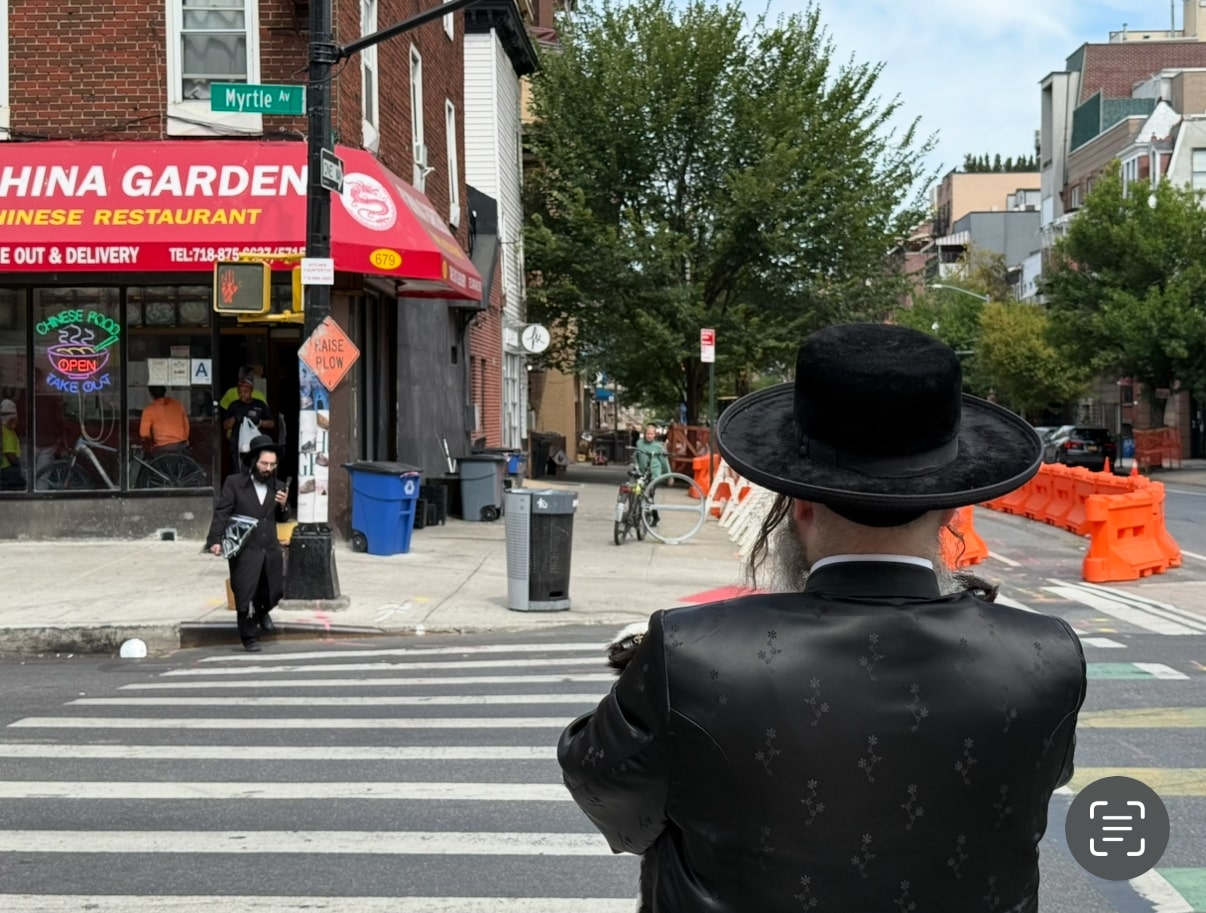
In an increasingly globalized and chaotic New York, there is a cultural island that escapes the logic of modernity: the Williamsburg Orthodox. One cannot think of talking about world influences in New York without considering the impact of the Jewish Orthodox presence on the cultural substrate of the city. In the heart of Williamsburg, in Brooklyn, just a stone’s throw from the streets that are protagonists of an unstoppable transformation towards movida and consumerism, lies, in sharp contrast, one of the most impenetrable communities in New York. Knowing that Orthodox Jews are an extremely complex reality to study and tell, we will limit ourselves, in this place and for the purpose of this column, to present the fragments that contribute to enriching the unique, faceted cultural identity of the city of New York.
Of the Orthodox Jews we have recently learned some cultural aspects thanks to the television series “Unorthodox” which brought the attention of the great international public on a lifestyle away from the contemporary Western imaginary. Based on the true story of Deborah Feldman, the series tells the story of a young woman who chooses to leave Williamsburg’s Hashedic community to embark on a personal emancipation journey: a decision that in its reality of origin is equivalent to a deep break and a social condemnation without return. Released in 2020, “Unorhtodox” has become one of the most viewed series on Netflix, both in Europe and in the United States. While showing only a part of a much wider and complex reality made of religious rules and traditions handed down, “Unorthodox” has known without doubt to turn the spotlight on this world and to stimulate a more universal debate on the relationship between individual freedom and tradition, touching themes such as identity, emancipation and belonging.
As the orthodox community is extremely reserved and waterproof to the external mixes, testimonies like this become extremely valuable for those who want to approach this culture. Remaining in the world of narrative, another interesting stimulus is the reading of the novel “Danny the Elect” by American writer Chaim Potok, released for Garzanti in 1969 as a translation of the original text “The Chosen”, published in the United States in 1967. Set in Brooklyn in the 1940s, the book tells the friendship between two boys belonging to two different branches of Orthodox Judaism, one more modern and open to the outside world, the other very strict. Through their eyes the reader discovers the challenges, conflicts and inner reflections that accompany the difficult balance between tradition and modernity, discovering a more intimate perspective on the cultural tensions that cross the New York Jewish community.
Both the book and the TV series are set in New York, Williamsburg which belongs to this community. The district began to become an important center of Orthodox Judaism in the second post-war period, when many survivors of the Shoah, in particular belonging to the Hasidic movement Satmar, originally from Hungary and Transylvania, settled here looking for a place to rebuild their lives and preserve intact their religious and cultural traditions. Williamsburg, with its accessible rents and the possibility of creating a cohesive social fabric, offered the ideal conditions to found a compact and autonomous community. With time the Orthodox presence has become increasingly rooted, giving rise to religious schools, synagogues, kosher shops and dedicated services, transforming some roads into a self-sufficient microcosm where language, clothing and life habits refer to a past that has been wanted to keep alive. Today, despite the pressures of gentrification that are changing the face of Williamsburg, the community continues to jealously guard its spaces and to represent one of the most identity groups of Orthodox Judaism in New York.
Walking through the streets of Williamsburg inhabited by the Jewish-Orthodox community is like entering a parallel world. Along Bedford Avenue, Wallabout Street and especially Lee Avenue, the heart of community life, the atmosphere suddenly changes compared to the rest of the neighborhood. Here the fashionable bars and hipster shops give way to religious schools, where the sacred studio plays a central role, kosher shops and small tailors of traditional clothes. Coming from the roads along the East River, or going south from Greenpoint, the fence is clearly perceived. Just cross a street because meetings become fleeting and the strict dress code. This is perhaps the first recognizable element in the street: men wear long black coats, white shirts, wide-sleeved hats and, on holiday days, some wear the traditional round fur headdress. Women, on the other hand, wear long dresses that cover arms and legs, complemented by wigs or turbans to cover the garment, and always sober shoes. Children also follow similar rules with dark uniforms for males and long skirts for females, witnessing an education to tradition that begins from the earliest age. Everyone walks quickly with a glance downwards and young women accompany small groups of children to school or to the yellow schoolbuses that carry strictly written in Hebrew.
The architecture of these roads is also peculiar. Just a look up to meet houses with large balconies protruding and closed by metal grates. It is not an aesthetic hub, but a practical and religious necessity: These balconies are used in fact as sukkah, temporary huts to be set up during the feast of Sukkot, when observant families are required to consume meals and, in some cases, also to sleep in an outdoor structure reminiscent of the huts in which the Jews lived during the Exodus. In Williamsburg, where the space is limited and the gardens are scarce, the balconies have become the ideal solution to respect this millenary tradition. These solutions, moreover, are particularly effective to guarantee privacy and privacy to families within their homes, maintaining each nucleus protected by indiscreet eyes.
In Williamsburg the life of the Jewish Orthodox community follows precise rhythms. Women, besides taking care of the house and children, work occasionally in local commerce or religious schools. Men spend most of the day between the study of the Torah and community-related work, which takes place both in the neighborhood itself and beyond its borders, in the cosmopolitan Manhattan just beyond the river. In particular, a significant presence of commercial activities managed by Orthodox Jews is concentrated in the Diamond District of Midtown, between Quinta and Sixth Avenue, where many are engaged in the sale and import of diamonds and precious stones: an activity that requires specific skills and is based on established trust networks over time. Still today, walking along the 47th street, it is easy to meet men with kippah and black hats moving between cutting labs and small offices, keeping alive a commercial tradition that made the Diamond District one of the most important poles in the world for diamond trade. Contacts with the outside world exist, but are always measured, and to this is added a very strict management of technology: smartphones, internet and social media are often limited or filtered, creating an additional cultural boundary that contributes to the voluntary isolation of the community and to the protection of internal life.
For a few decades, Williamsburg has been undergoing a transformation. New residential buildings, luxury lofts and trendy bars have profoundly changed the face of the neighborhood, creating tensions with the Orthodox community that continues to live according to traditional rhythms and rules. The increases in rents and pressure on the real estate market have made it more difficult for some families to maintain their historical homes, while the new buildings and the constant presence of tourists and residents not belonging to the community, generate constant contact with a foreign lifestyle. Despite this, the community has demonstrated a strong resilience: Schools, synagogues and kosher shops remain the heart of everyday life, and many families try to preserve their spaces, adapting themselves to changes without sacrificing traditions. Williamsburg is an example of functional integration but without complete assimilation.
Recent episodes, such as the years of the Covid-19 pandemic, have further highlighted these tensions: the restrictions imposed by the health authorities – accepted hard if not completely ignored by the Orthodox community – have led to clashes with some local institutions and with members of the wider New York community, showing how the balance between the protection of tradition and respect of external norms can be delicate and complex.
In addition to religious and family life, the Jewish Orthodox community also exerts significant influence on the political and social level of the city. Thanks to the internal compactness and a strong sense of cohesion, he often manages to express a decisive electoral weight in local elections, supporting candidates who guarantee attention to their specific needs, such as the protection of religious schools or the regulation of neighborhoods. In addition to the political dimension, a dense network of community organizations is developed that provide essential services to their members: from the ambulances and rescues managed by the Hatzolah volunteers, known for the rapidity of interventions, to associations that collect funds for families in difficulty or for weddings and religious ceremonies. This system of mutual aid further strengthens the autonomy of the community and consolidates its resilience. It is interesting to note, however, that there is no single thought on the political level: Some fringes of the Orthodox Jewish community, for religious and historical reasons, have manifested for example in recent months openly in favour of Palestine, believing that the State of Israel does not represent the authentic realization of the Jewish faith.
Visiting Williamsburg and the streets inhabited by the Jewish-Orthodox community is a unique experience, able to offer a closer look on a world that elsewhere is likely to remain invisible. At the same time, it is important to remember that for those who live here it is not a tourist attraction, but of their daily life, and the presence of organized groups or curious visitors is often perceived as invasive. For this reason, those who choose to walk in these streets should do so with respect, avoiding indiscreet or intrusive attitudes, choosing a sober clothing and taking into account that community life follows rules and rhythms deeply different from those of the rest of the city. Without forcing looks or judgments, one can perceive the authenticity of an otherwise impenetrable world and can grasp its value.
Williamsburg thus represents a fragment of New York that deserves to be observed with awareness, as an integral part of the cultural mosaic that makes this city unique. In the next appointment of our “World Day in New York” section we will continue this journey among new corners of the world, discovering another community that contributes to defining the cosmopolitan soul of the city!
L’articolo Williamsburg Orthodox: a parallel world in the heart of New York proviene da IlNewyorkese.
