
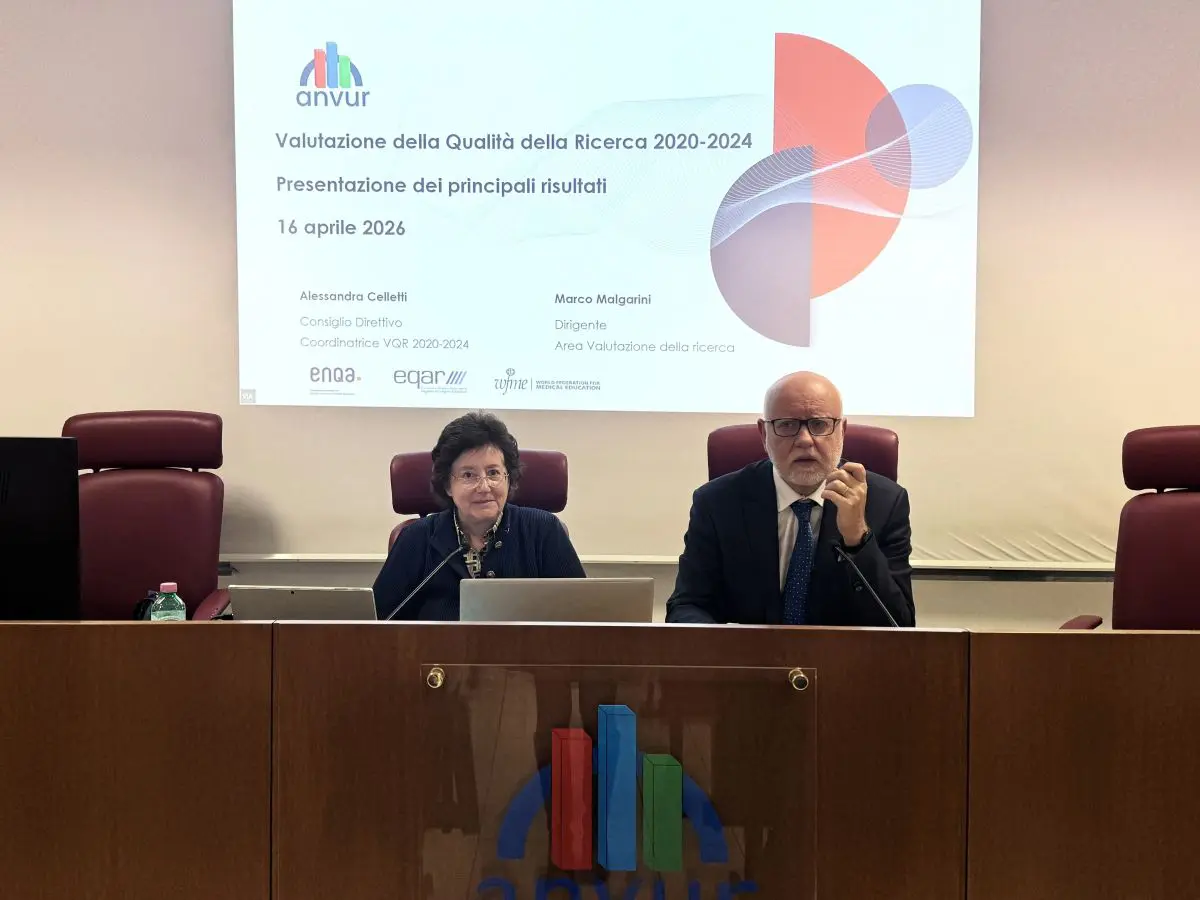
ROMA (ITALPRESS) – The fourth Evaluation of Research Quality (VQR) was completed by ANVUR (National Agency for Evaluation of the University System and Research), referred to the five-year 2020-2024 and concerning the evaluation of the results of scientific production, the activities of Valorization of international knowledge and competitive projects. For the first time, in an experimental and limited way to research bodies, research infrastructures were also assessed. The evaluation of the VQR began with the publication of the Bando in October 2023 and ended in March 2026, with the transmission of results to the MUR.
The objectives of the Research Evaluation The main objective of the VQR is to provide the Ministry of University and Research with the data necessary for the distribution of the award-winning share of the Ordinary Fund (FFO).
“The VQR is a tool aimed at achieving specific strategic objectives for the research system. First, it aims to strengthen quality and participation, promoting the excellence of national research, encouraging the involvement of researchers and supporting more effective processes of recruitment and career progression, says Professor Alessandra Celletti, member of the ANVUR Governing Council and referent for Research Evaluation activities. A further objective is to consolidate collaboration and social impact through greater integration between research, business, institutions, school and civil society, in order to maximise economic and social benefits. The VQR also intends to contribute to the improvement of training, with particular attention to the quality of the doctorate. In this perspective, internationalisation and access to competitive funding are also strategic aspects, with the aim of increasing the visibility of the Italian system and participation in European and international programmes. Finally, the VQR promotes the efficiency and enhancement of infrastructures, promoting the full use of available research resources at national level”.
The scientific publications evaluated (articles, monographs, volume contributions etc.) were 199,816 compared to the approximately 182,000 presented in the previous VQR referred to the 2015-2019 period; accredited researchers were more than 75,800. The number of universities that have been evaluated has also increased, climbed to 100 (the 2 that have been added to the previous year are CASD and the Southern Higher School), while the research agencies have decreased, 13 in total (in the current VQR the ASI was not evaluated), and the institutions that voluntarily submitted to the evaluation, went down to 19 (3 in less). The works were divided between 19 Groups of Experts of Evaluation (GEV), consisting of 719 disciplinary experts and 37 interdisciplinary experts from Italian and foreign institutions; in the evaluation, more than 6,740 external auditors were also involved, both Italian and foreign. These figures are sufficient to give an idea of the relevant coordination effort supported by ANVUR, which involved, in addition to officials and members of the Governing Council, a total of 27 GEV assistants selected through a specific procedure.
The results must be analyzed and read as a whole, so as to return a general picture of the research currently carried out in our country. In particular, the indicators provided by ANVUR must be interpreted with caution. It is first of all necessary to compare homogeneous sets (e.g. for scientific area and size); moreover, it is recommended to combine the indicators, so as to grasp the multidimensional nature and obtain a representation the piaccurate research quality can be measured.
“The analysis of the results as a whole allows to draw some conclusions that apply to the whole of the Italian research system – says Professor Celletti -. From the analysis of indicators it is confirmed that, as already in the previous VQR, on average neo-absorbent or promoted researchers have given a number of per capita products (2,7) greater than that of stable researchers (2,1), among other things with a higher average quality».
In VQR 2020-2024, case studies were also evaluated on the activities of Knowledge Valorization, i.e. the whole of the initiatives with which the Institutions collaborate and interact with the territorial contexts and society, in a complementary manner to the other two traditional missions of teaching and research. Each Institution has been called to present one or more cases of study, depending on its size, choosing from 5 themes: Technology transfer, Production and management of public goods, Public Engagement, Life and Health Sciences and, finally, Environmental Sustainability, inclusion and contrast to inequalities with particular reference to UN Agenda 2030. In VQR 2020-2024, the impact of these case studies has been assessed, in particular, as the ability to generate changes or improvements in the economic, social, cultural, health and environmental sectors.
“The evaluation of the activities of valorisation of knowledge – says Marco Malgarini, Managing Area Evaluation of Research of ANVUR – represents a significant indicator of the degree of openness of the Institutions, understood as places of connection between research and society. Thus the Institutions play an increasingly active role in the territorial contexts, making available to the community the patrimony of skills and knowledge that they produce and preserve”.
The evaluation of the activities of valorisation of knowledge has evidenced a widespread commitment of the institutions, articulated in a broad spectrum of initiatives and areas of intervention. The introduction of international competitive projects in the evaluation has allowed the analysis to be integrated even on a dimension that is not considered today, which is of fundamental importance for the competitiveness of Italian research. The experimental exercise on EPR research infrastructure has also allowed us to check with positive results methodologies and evaluation criteria, laying the foundations for their more systematic application in future currency cycles. As a whole, these evidences help to outline an evolving research system, increasingly oriented to quality, impact and international projection.
“Today the aggregated results at the level of institution have been published, waiting for the diffusion of the results for Area, which will be held on the occasion of the event dedicated to the Final Report and the Reports of Area, scheduled for the next 28 May. This appointment – concluded Malgarini – will also constitute a moment of deepening and reflection”.
– Anvur press office photos –
(ITALPRESS).
