
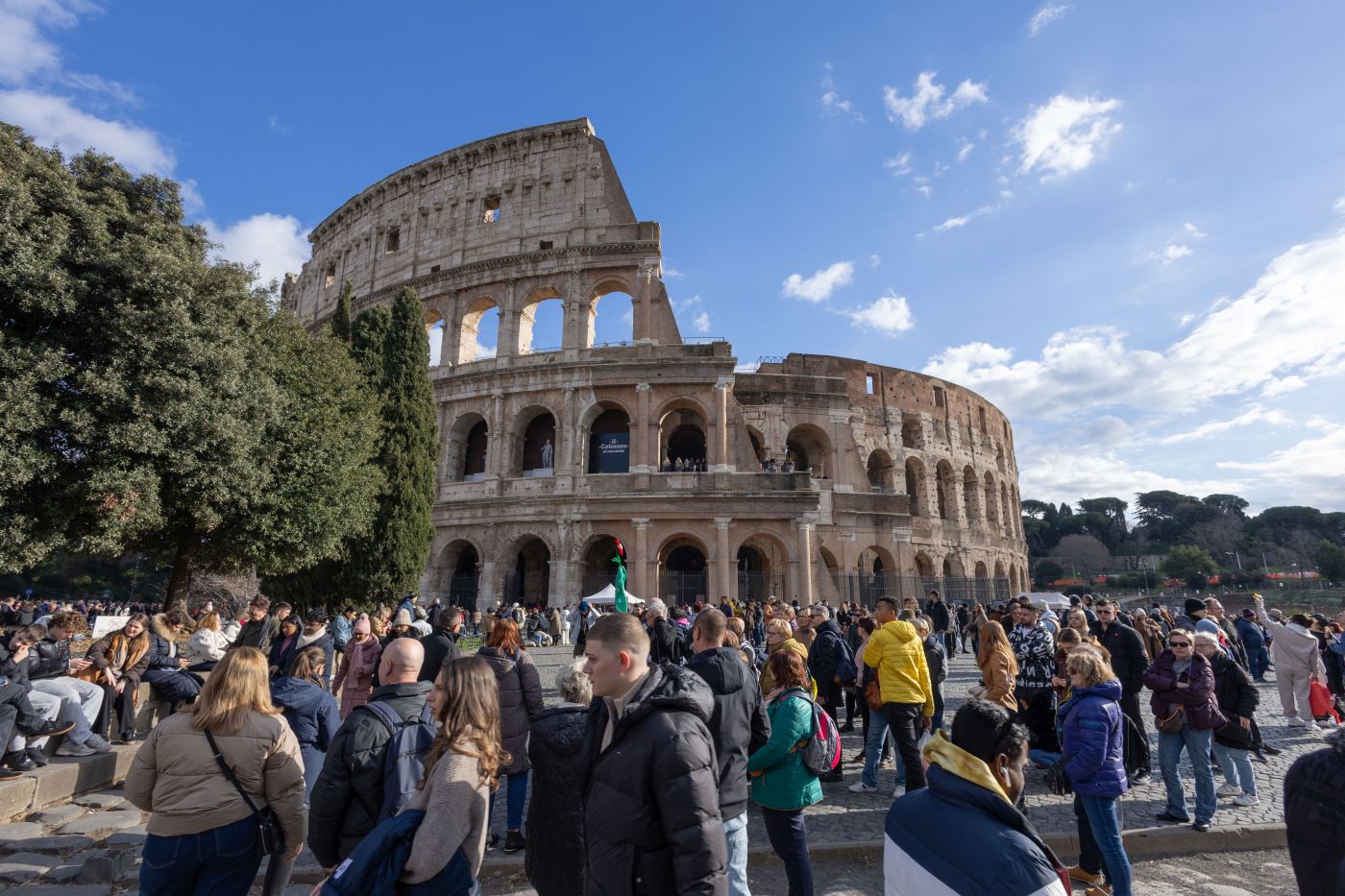
SASSARI (ITALPRES) – Cultural tourism in Italy confirms a leading economic asset and events today represent one of the most dynamic levers. According to the investigations of the Observatory on the Economy of Tourism of the Chambers of Commerce of Unioncamere-Isnart, in 2025 about 10% of tourists chose the destination mainly to participate in an event, in particular of cultural and folkloric character. Those who travel to attend these appointments spend on average 107 euros per day, net of travel and accommodation expenses, against 96 euros of the average tourist in Italy in 2025: an expense that rises to 109 euros among foreign visitors and reaches 121 euros between the mature public, the so-called “Baby Boomers”.
The artistic and monumental heritage is also an important component of the experience of living, indicated by more than 84% of these tourists, while 32% indicate among the motivations of travel also initiatives related to local traditions and culture, with an expenditure on the territory greater than 11% compared to the average.
Numbers which, according to the Chamber System, cannot remain one isolated, but must become the basis of a structured policy. These some of the elements emerged from the Mirabilia Day “From events to events policy”, organized on 17 and 18 September in Sassari and Alghero, which brought together the Chambers of Commerce belonging to the Mirabilia project in a comparison conceived as a national laboratory.
The goal was to set up different experiences, coming from distant territories but united by the same evolution: cultural events are no longer considered individually, as separate initiatives, but as real spatial development assets. It is the step from the promotion of the individual event to the construction of a policy of structured and replicable events.
Loretta Credaro, President Isnart (National Institute for Tourist and Cultural Research): “When it is part of a territorial strategy, an event generates economy, strengthens the identity of the destination, enhances the local heritage and contributes to distributing tourist flows in space and time. The data confirm it: 32% of the tourists of the events travel for events related to local traditions and culture and their spending on the territory is on average higher than the average tourist. This is why it is essential to build a real policy of events and measure them with rigorous sustainability and relapse: not by chance Isnart presented, ‘Destination’, a model to evaluate, qualify and value territorial events as generators of tourist attraction”.
Giuseppe Tripoli, Secretary General Unioncamere: “Tourism is a fundamental engine of the Italian economy: it generates over 200 billion euros, equal to 9,6% of GDP, and gives work to almost one Italian out of seven. Important numbers, which can grow again, contributing to create development and new opportunities also in the territories that today are less present in the great tourist circuits. To grasp this potential, it is necessary to focus on an increasingly qualified and thematic offer, able to intercept the different interests and needs of travellers, enhancing the specificities of the territories through recognizable brands and targeted marketing strategies. This is the direction in which the Mirabilia network moves: to make territories that host the least frequented UNESCO heritage sites to build an integrated tourist enhancement system around them, networking territories, businesses and skills and promoting an organized, coordinated and capable of generating widespread value.”.
If events become part of a development policy, then it is necessary to be able to measure its impact and economic return. It is for this purpose that Isnart has created Destination, the national disciplinary that allows Chambers of Commerce to evaluate and value events in a tourist key, identifying those capable of generating attractiveness, identity and development for the territories. The heart of the model is InVITE – Index of Value and Tourist Impact of the Event, which measures both the attraction and the tourist impact, and the level of integration and the capacity of the territory.
The measurement thus becomes an instrument within a wider strategy, which aims to transform cultural heritage and events into a stable leverage of attraction and territorial development. A perspective in which the Chamber System can play a role in connection with local experiences, skills and models of enhancement.
This system logic finds one of its most significant applications in the experience of the Chamber of Commerce of Northern Sardinia, which has not limited itself to supporting individual events, but has built a real network of events with Salude & Trigu. A system logic that marks the passage from the simple “cartel” of appointments to the governance of a structured network, able to generate a coordinated calendar of initiatives for North Sardinia.
Stefano Visconti, President Chamber of Commerce of North Sardinia: “North Sardinia has all the cards in order to assert itself as a tourist destination of excellence in every period of the year. To achieve this, it is essential to focus on the network of events, a strategic tool capable of enhancing our traditions and creating real opportunities for local businesses. Initiatives like Salude & Trigu show how synergy between culture, identity and promotion can make a difference to seasonalize flows. We are building with the main entities and subjects of the territory a new tourist season and at the same time a real destination, sustainable and authentic, able to put in the center the extraordinary naturalistic and historical heritage of Northern Sardinia, offering a unique integrated experience”.
The story of experiences presented in Sassari shows that there is not only one successful event model, but that there may be a common methodology to enhance them. In the course of the conference there have been very different realities as the Disciple of the Candelieri (North Sardinia Chamber of Commerce), the Palio di Siena (Camera di commercio Arezzo-Siena), the GIO Festival – Giordano International Opera Festival (Camera di commercio di Foggia), Tocatì – International Festival of Street Games (Camera di commercio di Verona).
Some significant experiences from the territories of the Mirabilia network, including the Festivalphilosofia of Modena, Carpi and Sassuolo, Matera European Capital of Culture and the projects dedicated to Transumanza and Cineturismo.
Angelo Tortorelli, Counselor Isnart for the Mirabilia Special Project: “Mirabilia is the proof that the UNESCO heritage, events and tourist development can walk together: our national network serves to put into circulation models and skills between different territories, transforming good local practices into replicable tools.”.
-Photo IPA Agency-
(ITALPRESS).
