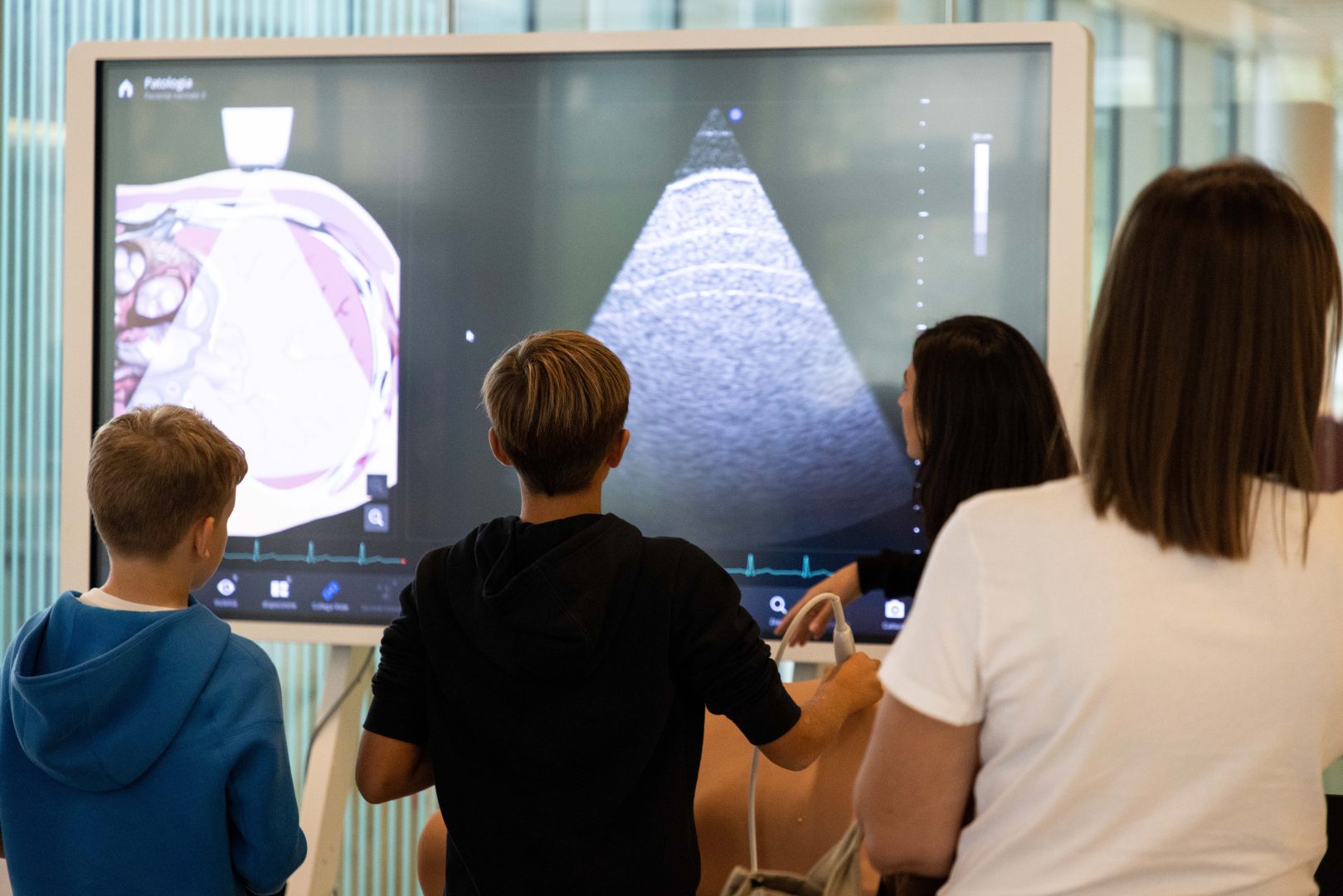
MILAN (ITALPRESS) – Friday, September 25, from 17.00 to 20.00, the Campus of Humanitas University in Pieve Emanuele (MI) will host a special event on the occasion of the European Night of Researchers and Researchers: an evening dedicated to science and research, narrated in a simple and engaging way by those who live it first person every day. After the positive experience of last year, which has recorded a wide participation and a warm response from the public, Humanitas University returns to open the campus doors to children, young people, families and adults, with a program designed to make research accessible, curious and participatory. Experiments, demonstrations, interactive activities and guided tours will allow children from 6 years to get closer to Biomedical Research and discover some of the areas where researchers, researchers, doctors and professionals work every day. Among the scheduled appointments, at 7 pm, “Research takes voice”: dialogue with Simona Lodato and Marco Riva, researchers and doctors of Humanitas in the Neurosciences. To guide the participants will be a real research passport, a personal badge to carry with you during the evening and to complete stage after stage. A small travel companion to browse through experiments, discoveries and technologies and build, experience after experience, their path through Humanitas Research.
The journey will cross eight areas of Biomedical Research, with activities designed to bring even the smallest to complex scientific themes through concrete experiences and simple languages. In the world of cardiovascular research, you can discover how important it is to intervene quickly when the heart stops: participants can test themselves on mannequins for reanimation, in a challenge to strokes of chest compressions and times to beat, and observe through simple models how blood flows in the vessels. To know the immune system, instead, you will have to enter an invisible universe made of cells, bacteria and other microorganisms. Bolts, screws and inks will help to understand how our defenses recognize what belongs to the body and what instead represents a threat. And also a daily gesture like washing your hands can turn into an opportunity to discover something surprising. The gastrointestinal system can also be observed through a small window on the search for the future. The organ-on-chip allows to reproduce in the laboratory some characteristics of the human organs: you can see from close to these tiny systems and experience how a liquid can cross the very thin channels, just like in a small miniature organ.
From biology to technology, 3D printing will show how a digital model can take shape and become something concrete: real phantoms of organs, anatomical models that reproduce weight, texture and mechanical properties and which can find application in research and clinical practice. Finally, a task dedicated to clinical research will allow to follow, through a game, the challenges that a discovery must face when from the laboratory approaches the cure: what steps do you need? What obstacles can appear along the way? And how many different skills are needed so that a new knowledge can become a concrete opportunity? A synthesis of the evening will be the talk “La Ricerca takes voice”, on the central stage, which will see protagonists Simona Lodato, head of the Neurosviluppo laboratory of the IRCC Humanitas Clinical Institute, professor of Humanitas University, and Marco Riva, neurosurgeon of the IRCS Humanitas Clinical Institute and professor of Humanitas University. A dialogue to tell, from two complementary perspectives, what happens to a discovery when from the laboratory begins to approach the care, between insights, tests, new questions and results. An opportunity to show how basic research, clinical research and medical practice are part of a single process, where each step can open new roads and feed the next one. This is precisely the theme of the evening: the journey of research from discovery to care.
A journey that arises from a question, grows through experiments and new knowledge, takes shape thanks to the encounter of people, ideas, technologies and different skills, up to become concrete opportunities for health. A tangible account of translationality, through the people and stories of Humanitas research.
– photo print office Humanitas University –
(ITALPRESS).
