
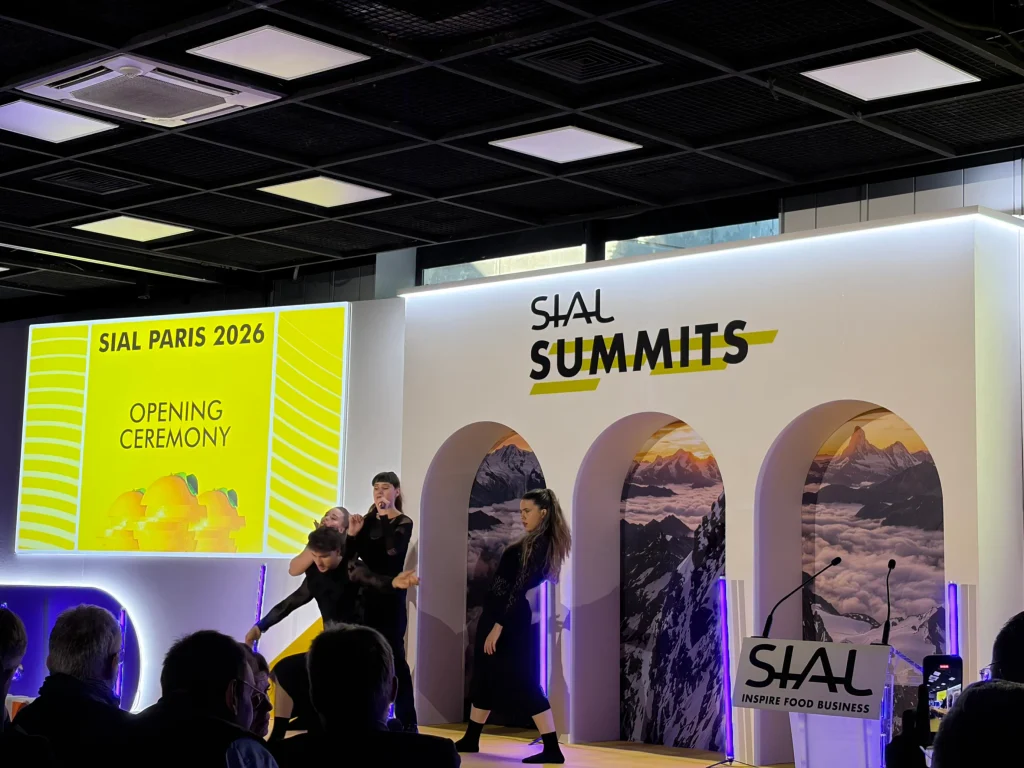
Italy’s food and beverage industry has a broad and varied presence at SIAL Paris 2026, bringing regional products, companies, consortia and institutions into direct contact with one of the sector’s leading international marketplaces. The Paris trade show thus reaffirms its role as a platform for business as much as for showcasing products: a place where product quality must translate into relationships with buyers, importers and distributors—and, particularly for small and medium-sized businesses, into new opportunities to enter foreign markets.
Among the Italian participants, Universal Marketing coordinated a delegation of around 200 companies across more than 3,000 square meters of exhibition space, supporting Sicily, Calabria, Campania, Molise, Lazio, Sardinia and Puglia, alongside consortia and other industry organizations. This participation builds on the company’s work with regional governments to promote their food and agricultural supply chains internationally.
Universal Marketing’s role is part of a broader effort to support regional economies at major international trade events, from organizing their exhibition presence and promoting their products to facilitating meetings between businesses and industry professionals. In Paris, this approach allowed seven regions to present their very different food industries within a shared framework, while retaining their distinct identities and regional characteristics.
The diversity of the participants reflects the structure of Italy’s food and agricultural sector. Molise, whose businesses are predominantly micro and small enterprises, is focusing on certified products and public support to help companies expand internationally. Calabria came to Paris with 39 companies and a range spanning food and beverages, placing biodiversity and the connection between products and their places of origin at the center of its offering.
Sardinia focused on its traditional cheeses—Pecorino Romano, Pecorino Sardo and Fiore Sardo—and on the need to turn the island’s distinctive characteristics into a competitive advantage while addressing the higher costs associated with its island location. Sicily, Lazio and Puglia contributed their own companies and products to the coordinated presence, further broadening the Italian offering presented to international industry professionals.
Campania, meanwhile, chose to start with one of the most recognizable symbols of its food culture. Through TuttoPizza International, developed within the SIAL framework, pizza becomes a gateway to a much broader supply chain: flour, tomatoes, mozzarella and fiordilatte, olive oil and other regional products. The art of the Neapolitan pizza maker, recognized by UNESCO as intangible cultural heritage, is thus used both as an expression of regional identity and as a means of promoting Campania’s entire food production sector.
The relationship between food production and place also emerges in the work of the Approdo di Ulisse Local Action Group, which covers the Sorrento Peninsula, the Amalfi Coast and Capri. Its project, “New Routes to New Markets,” connects local products—including wine, olive oil, cheese and products with Protected Designation of Origin (PDO) and Protected Geographical Indication (PGI) status—with restaurants and tourism. Here, international expansion means more than selling products abroad: the aim is to use the reputation of local food and wine to strengthen the appeal of the destinations where they are produced.
This is a significant development because it reflects a broader shift in the promotion of Made in Italy. In increasingly crowded markets, quality remains essential, but it is not always enough. Origin, supply chains, landscape and production traditions become part of a product’s market positioning, helping distinguish foods that might otherwise be compared on price alone.
The issue is particularly relevant as food and agricultural products account for a growing share of Italian exports. At SIAL, Italian Trade Agency President Matteo Zoppas cited a value of around €72 billion for the sector in 2025, within a broader Made in Italy export economy aiming to reach €700 billion. Tariffs, conflicts and geopolitical instability complicate the outlook, but they also make an organized market presence—and coordination among businesses, institutions and organizations supporting international expansion—increasingly important.
The issue of Italian sounding—the use of Italian-sounding names and imagery to market products that are not Italian—also remains unresolved. It continues to take market share from authentic products while indirectly demonstrating the strength of Italian cuisine’s international appeal. The challenge is to turn that recognition into a clearer understanding of origin and a more informed choice of Italian products.
In this context, trade shows such as SIAL continue to serve a practical purpose. Live cooking demonstrations, tastings and professional meetings showcase products, but above all they allow companies to gauge market responses and build business relationships. The scale of the participation coordinated by Universal Marketing shows how a collective presence remains one of the tools regions use to help their businesses reach international markets.
The picture emerging from Paris is therefore of an Italian food and agricultural sector whose regional diversity remains one of its greatest strengths, but which must support that wealth of products with organization, sustained effort and commercial expertise. The product remains central; increasingly, however, success also depends on the supply chain, the place of origin and the ability to build lasting relationships in international markets.