
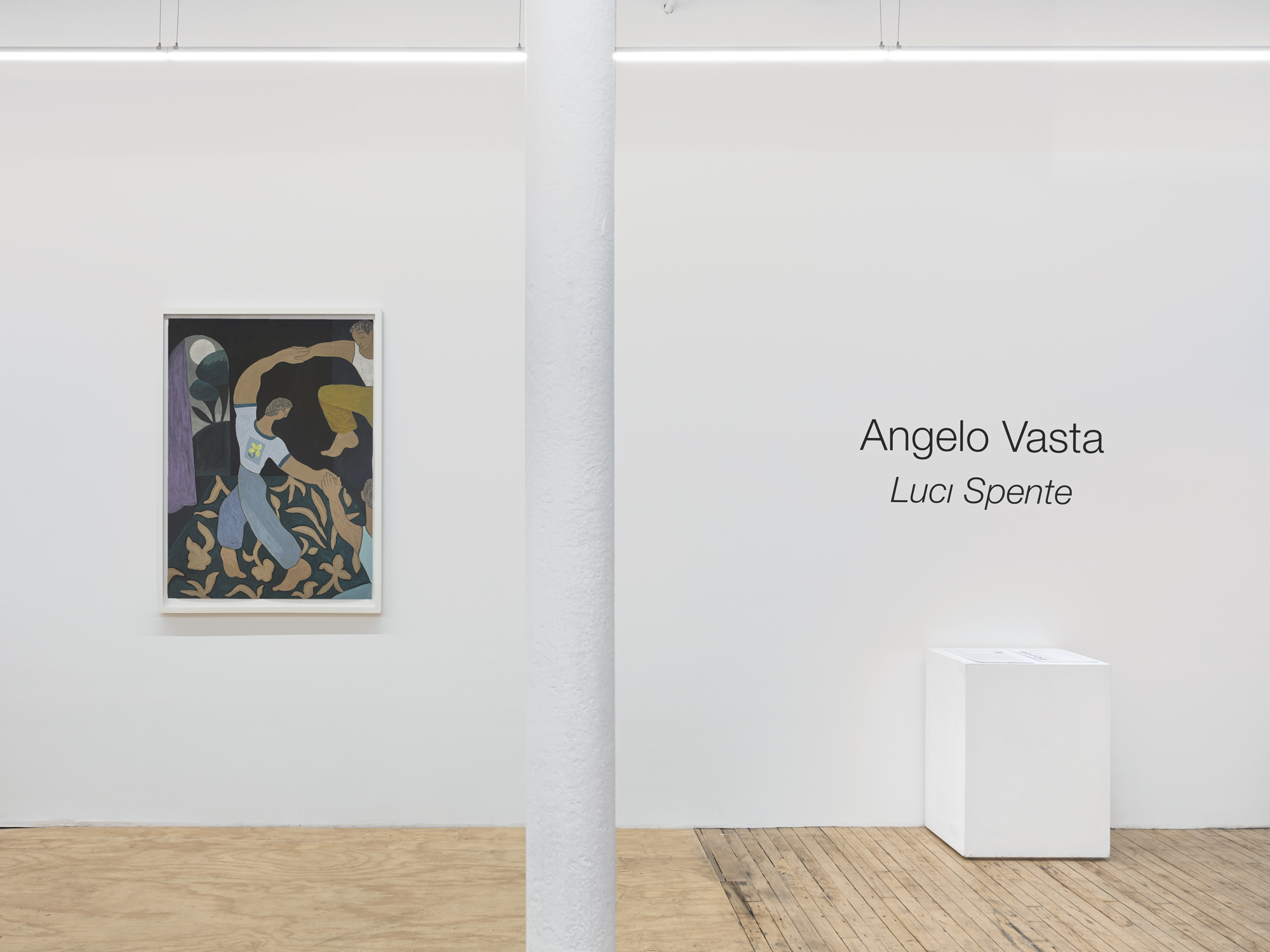
Walking to the new Tappeto Volante Gallery from Little Italy, I thought about passages. Passing can have many different meanings: from one place to another, from one life to another. And art, truly evocative art, can also transport us in time and in our memory. This was the quality that first attracted me to Angelo Vasta’s work, whose focus on concealment and revelation represents an in-betweenness that carries particular emotional resonance. For me, it was seeing my father’s life, though cut short, celebrated through Vasta’s exploration of vulnerability. By focusing on transitions, from solitude to collectivity, darkness to light, disappearance to presence, Vasta challenges the viewer to see not just the end result, but the act or process of moving on.
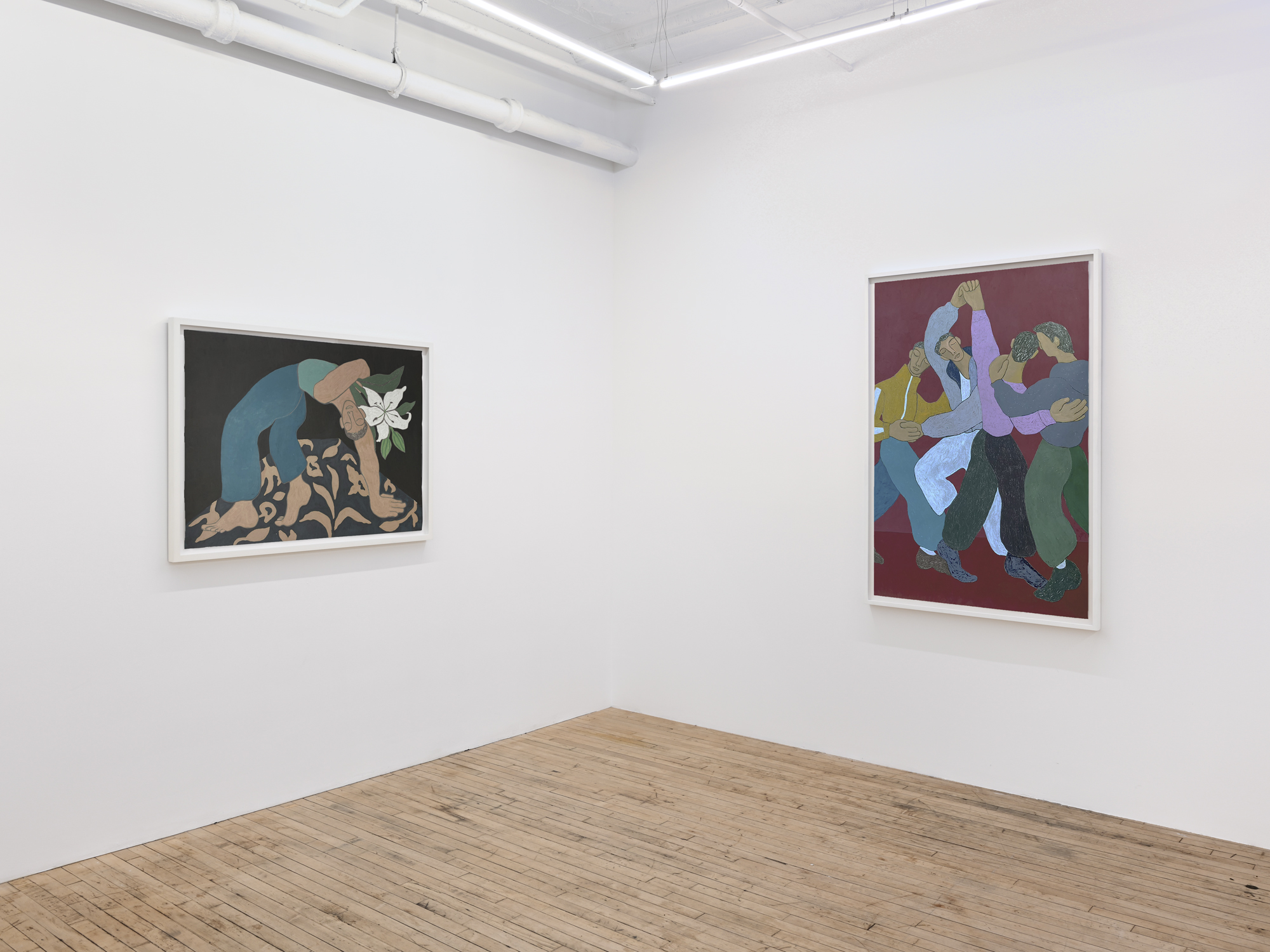
Luci Spente, Vasta’s first solo exhibition in New York, inaugurates the new location of Tappeto Volante Gallery with a body of work that demonstrates both formal evolution and emotional intensity. Drawing from personal memory, dance cinematography, and art historical references, Vasta builds layered compositions in which figures oscillate between representation and abstraction. This vacillation creates an atmosphere of discovery, while the intimacy of the new Tappeto Volante space encourages undisturbed ambling between artworks. The gallery’s long central corridor encourages sustained looking, allowing the emotional and material complexity of Vasta’s drawings to unfold gradually and in tandem with one another. Across the exhibition, bodies gather, lean, dance, and engage each other and the viewer to see comfort in community, and joy in the intimacy of relationships, both familial and romantic. Ultimately, Luci Spente is an exhibition about how we survive the rupture of loss.
To create the immersive scenes that characterize his work, Vasta works in oil pastel on paper to combine figures, textiles, and landscapes into rich tapestries of color. The nocturnal tones that recur throughout the exhibition create a perceptual tension between concealment and revelation, while dancing bodies often appear suspended in movement. In this way, the exhibition treats darkness not only as context but as the source from which figures and color slowly emerge. Walking between Di Notte and Ragazzo con giglio, the show becomes (though perhaps unintentionally) bookended by these two works. Both share a visual vocabulary of gold-patterned textiles and dark grounds, flattening pictorial depth even as the figures strain toward movement. At moments, the flattening risks oversimplifying the emotional charge of the figures, yet this freedom becomes central to the exhibition’s psychological evolution. While Ragazzo employs an acrobatic figure moving through darkness with closed eyes, suspended between vulnerability and performance, Di Notte features a series of dancing figures and an open doorway that extends toward the night landscape beyond, transforming darkness from enclosure into passage.
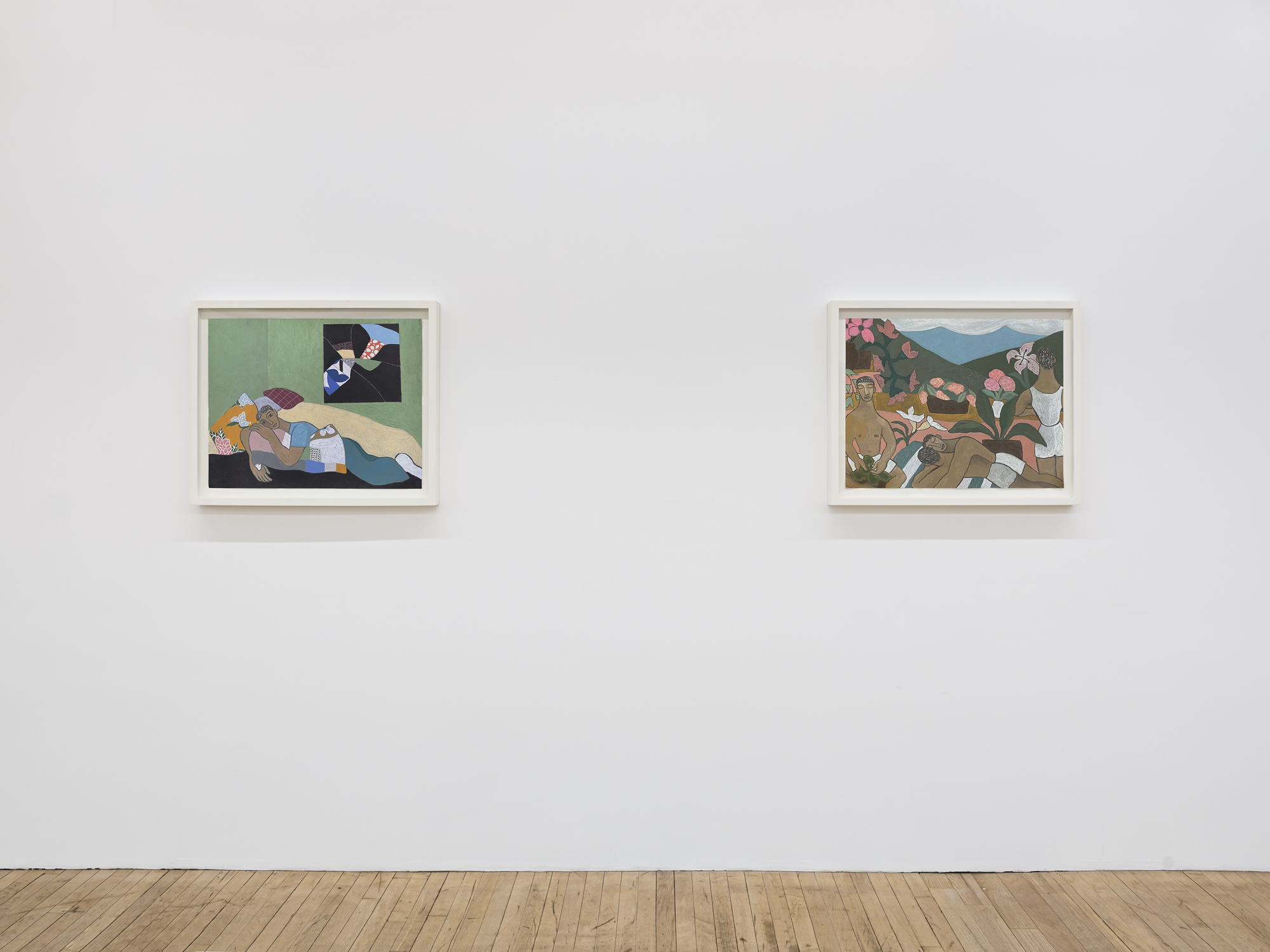
Between these two works the exhibition opens into the colorful, saturated vitality that characterized Vasta’s earlier drawings. While echoes of Matisse emerge in Vasta’s palette and patterned interiors, the drawings ultimately reject decorative content as an end in itself, imbuing both landscapes and interiors with layers of tonality and meaning. Speaking with Vasta about Dancers on Dunes, he described the connection to his late father and to a photograph he keeps of him standing beside Matisse’s Dance at MoMA. Combining his professional background in dance cinematography with personal experience, the work becomes more than citation. Where Matisse often used ornament to dissolve tension into harmony, Vasta mobilizes color and pattern as sites of emotional compression. Here, as elsewhere, groups of figures become abstractions in their own right, dissolving individual identity into collective movement. The dancers do not merely occupy space together; they negotiate forms of proximity after loss.
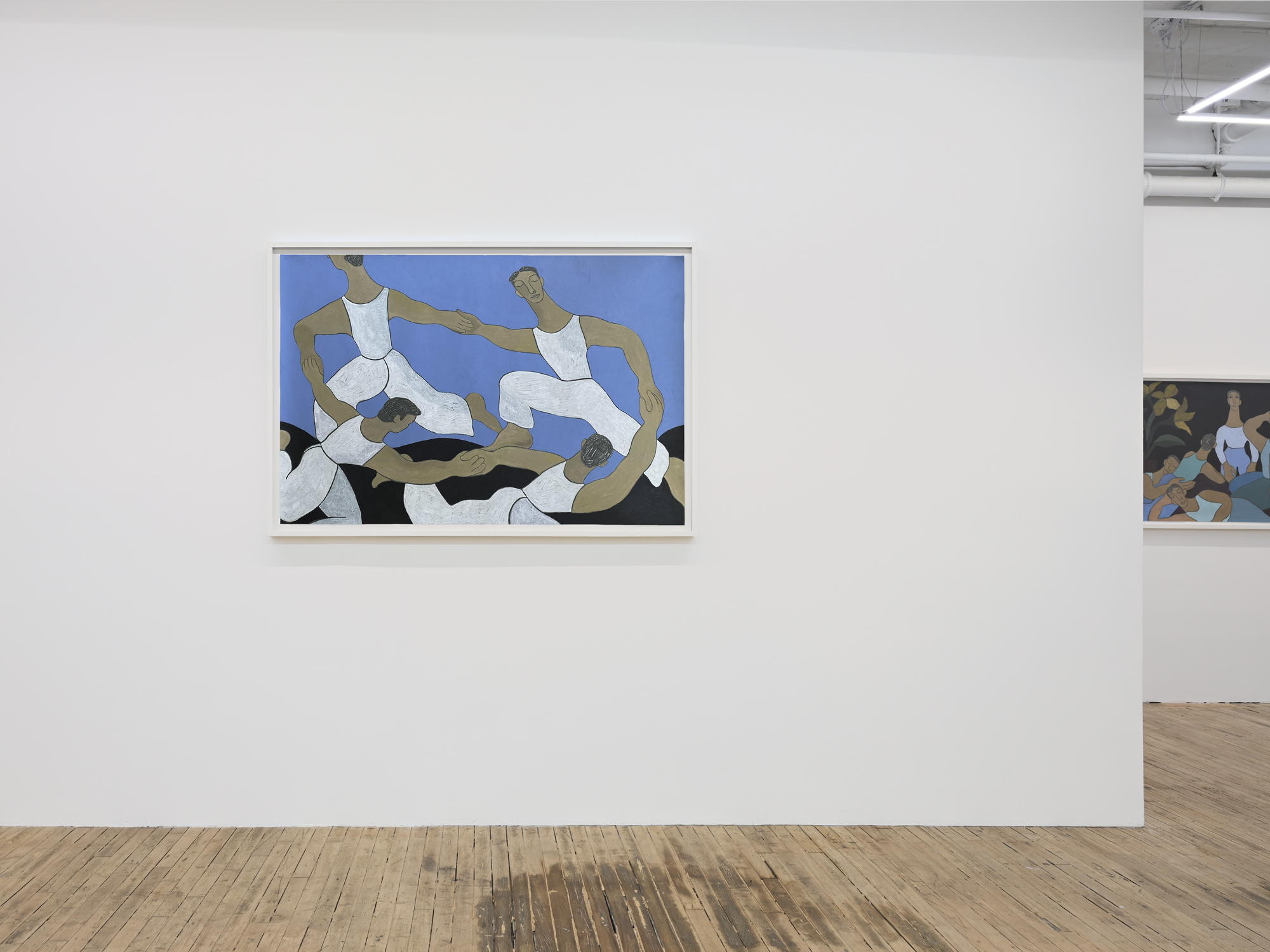
This emphasis on relationality gives Luci Spente its contemporary resonance. The tenderness between figures carries particular force within representations of queer intimacy, where touch becomes both emotional language and resistance against isolation. In Luci Spente, intimacy emerges not as resolution, but through the continual movement and grouping of bodies. For this reason, Vasta’s drawings excel at communicating vulnerability, offering spaces in which these figures remain open, unfinished, and dependent on one another. Even in moments of solitude, the drawings suggest the possibility of communion lingering just beyond the frame.
All the images above are courtesy of Tappeto Volante Gallery