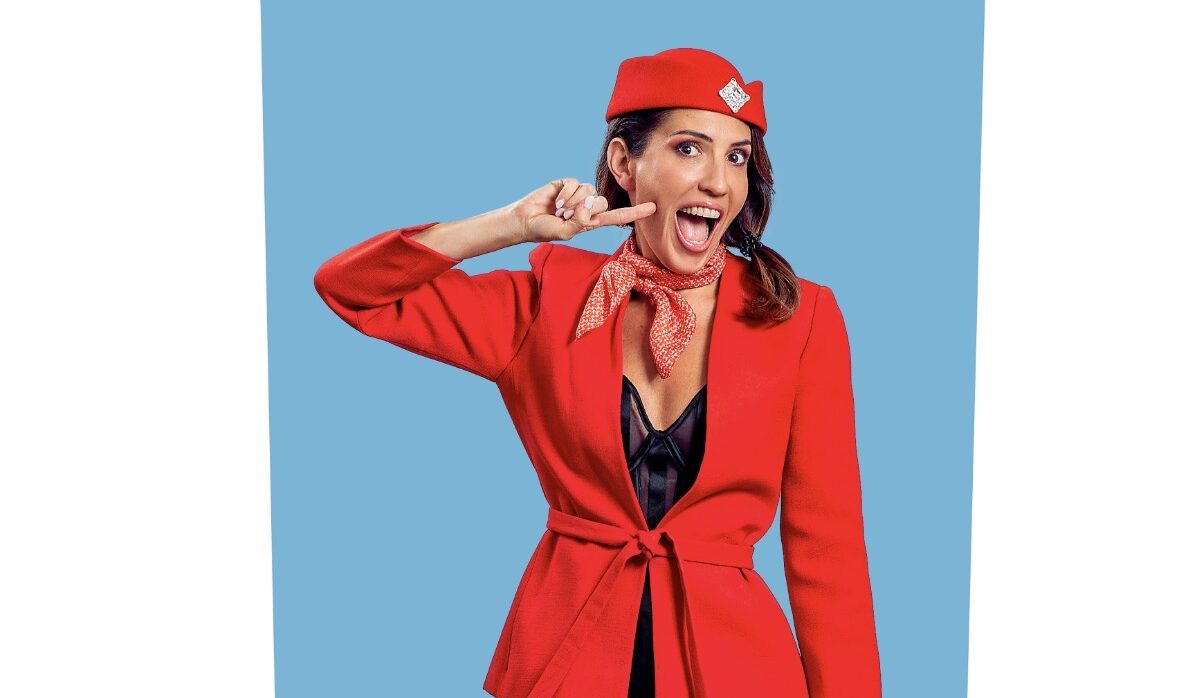
Arianna Bergamaschi, known simply as Arianna, is an Italian singer, actress, and performer who rose to fame at a very young age as the official Italian Disney voice and as the lead in numerous musical and television projects. Over the years, she has built an international career, collaborating with artists such as Pitbull, Shaggy, Flo Rida, and Giorgio Moroder. Alongside her recording and theatre work, she has performed at major global events, from the Vatican to international productions and North American tours.
You grew up in a family closely connected to the entertainment world. How much did that influence your desire to work in television, and how much did you feel the need to build an independent path?
“There was definitely an influence from my family, especially from my mother. I come from a family full of musicians. But my desire to be independent came quite early. At first, maybe out of fear of comparison, I wasn’t even fully convinced I wanted to be a singer—I was more drawn to dance. Then, thanks to my experience with Disney, I understood that music could truly be my path and not just something temporary. Building my own identity took time. Even today, I still listen a lot to my mother’s advice, especially on interpretation.”
Looking back at your beginnings, when did you first think: ‘Okay, this is no longer a game, this is my real job’?
“Very early, actually. I started working practically from infancy—I was in commercials at seven months old. But real awareness came later, around my twenties, when I finally started managing my own money independently. That’s when I felt a huge sense of excitement: you think you’re independent, but then rent, expenses, and responsibilities arrive.”
You started very young in the entertainment world. Did you ever find it difficult?
“There were moments when I saw my friends playing outside while I had to study a song or prepare, but the desire to be on stage was always stronger than anything else. I remember at three years old I literally ran out of my mother’s arms to get on stage. It was completely instinctive, almost uncontrollable. So I think joy has always outweighed any sacrifices.”
You also started very young in television. Is there anything about that world that still surprises you today?
“Television has very different rhythms compared to theatre, which is closer to my background. I’m still surprised by how little time you’re given to prepare a performance: you have to arrive ready because rehearsals are minimal and everything happens extremely fast. Television consumes and delivers content at an incredible speed. That’s what makes it such a demanding medium.”
What do you think about the evolution of entertainment through streaming platforms and social media?
“I really like streaming platforms. Social media, on the other hand, has both positive and negative aspects. On one hand, it gives immediate access to information and allows talent to emerge more quickly, without long traditional paths. On the other hand, it often creates the illusion that visibility alone is enough to be an artist. That’s the risk: believing that followers replace training. In reality, a career requires constant work.”
Today, do you feel more like an actress, singer, or performer? Or do you find these categories unnecessary?
“Performer is the definition that represents me best, because it includes everything. I don’t want to limit myself to a single label. What I love most is interpreting—whether through singing, dancing, or acting doesn’t matter. What counts is communicating something and moving the audience.”
Is there a character that stayed with you even after the stage or set?
“Definitely Bernardina in Masaniello. To play a Neapolitan character as a Milanese actress, I studied for six months. I had to portray a Neapolitan fishmonger in a company of forty people, almost all from Naples. When they learned the lead was from Milan, many were skeptical. That pushed me to fully immerse myself in Neapolitan culture, which I already deeply loved. It was an incredibly intense experience on a personal level as well. At that time, my father was very ill and I was constantly moving between Naples and Milan. That role became a real catharsis and helped me process a huge pain.”
What led you to leave Italy and move to the United States?
“At first it was supposed to be just a future home, then Covid completely changed the plans. My husband realized we could live anywhere and suggested moving to a seaside city, also for our son who suffered from asthma. For me it was a shock, because my entire life and career were in Italy. It was a family decision, but at first I experienced it as a forced choice. Over time, however, I understood that this experience was making me grow. It forced me to reinvent myself and create something that would keep me connected to my culture. That’s how Italiani Veri was born.”
How much did this move influence the creation of the show?
“A lot. Every morning I worked on Italiani Veri, which is designed for an American audience. I had to look at my country almost from an external perspective. Many things that are obvious to Italians are not at all for an international audience. It was a fascinating exercise and a major artistic challenge.”
What are you working on at the moment?
“I’m working on Italiani Veri – The Show. The first date was on October 2 in Toronto, as part of a tour supported by the Italian Ministry of Foreign Affairs and the Italian Cultural Institutes, which recognized its cultural value. After Toronto, we went to Chicago, Los Angeles, and Miami. Then we started a collaboration with Fever, which brought new dates such as Boston, Atlanta, and San Francisco. In San Francisco, the first show sold out immediately and a second performance was scheduled. Recently, the cover of the famous song That’s Amore was also released.”
How does it feel to have this response in the United States?
“It’s a wonderful surprise. Since it’s not my home country, you never take it for granted that people will buy a ticket for your one-woman show. I was very afraid, especially because the level of entertainment here is extremely high. But I’m receiving very positive feedback and I truly feel appreciated.”
If you had to define this phase of your life in one word, what would it be?
“Exciting. I feel like I’m in a very flourishing moment, both as an artist and as a person.”