
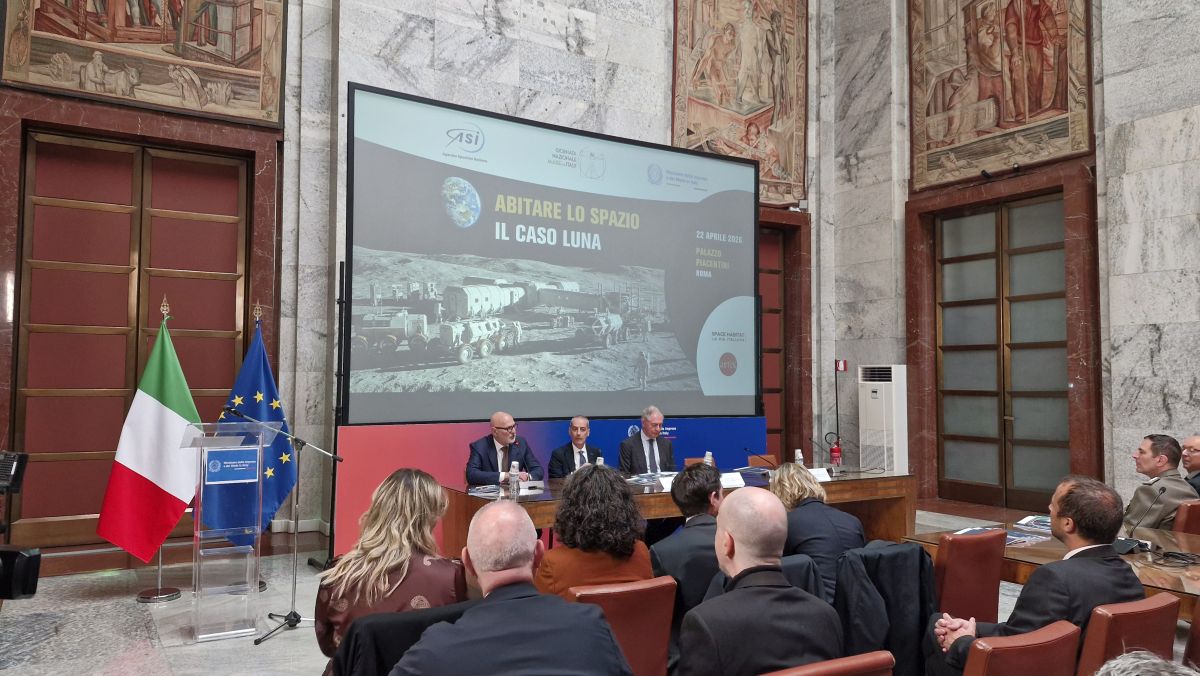
ROMA (ITALPRESS) – “Abiting Space is a challenge that Italy is ready to grasp. Thanks to our participation in the colonization of our satellite, we can open our way to future generations, creating the conditions for Italy to make another great leap in its technological and economic evolution”. Thus the Minister for Enterprises and Made in Italy, Adolfo Urso, opening the work of the event “Abitare lo Spazio: il caso Luna”, promoted by the Italian Space Agency in collaboration with the Ministry with the aim to define the conditions for a human permanence in the increasingly man-made space and identify new models of thought for the design of environments and infrastructures of future missions.
“We have included the Space Economy among the 5 new segments of Made in Italy, which join the 5 traditional compartments that have made the Italian product excellent, unique and inimitable in the world. Living the moon today is not just a slogan, but it is a possibility. Today the perspective is to look at the Earth from the Moon and to conceive the Moon as an extension of the Earth. I believe that this should also be done with the technology and research of Italian companies”, added the minister, recalling the recent signature in Washington with NASA administrator, Jared Isaacman, a Statement of Intent on cooperation for the lunar surface. “The housing modules on which they will live and work the astronauts will be realized in Italy, in Turin”, he emphasized.
“This highlights the role that Italy, Italian companies and Italian astronauts have achieved in international consideration. To some extent, inhabiting the space will be an Italian characteristic, it will be thanks to Italy that you will be able to participate in what will be the colonization of our satellite, from which then will start the largest and fascinating colonization of the space. The hope is that one of the first astronauts to walk and live permanently on the lunar base is an Italian”.
The president of the Italian Space Agency, Teodoro Valente, announced that “the result of the last discussions we had last week with the delegation of the Nasa is that Italy will not have only one Italian astronaut, man or woman who is, on the lunar surface, but we will have two. This is one, not the only, of the examples of Made in Italy in space. Our country has world-wide leadership on the theme of orbital infrastructure: I am absolutely convinced that we are in the full condition of being able to grasp all the opportunities and possibilities that will arise from here onwards and, for this, we are all working in synergy and concert. I am very optimistic and very confident.”.
For Massimo Claudio Comparini, Managing Director Space Division of Leonardo and president of the Thales Alenia Space cda, “for so many years we have been accustomed to seeing the Moon as the goal of our journey and exploration” but now “with the best scientific groups, we must also understand how to use resources at best”. The new phase “will be a phase in which we will go to the Moon for a few days. The challenges not only technological but also scientific, work and study of human physiology: we are talking about a strongly hostile environment and we still have to understand how to make human presence possible without impacts on health,” he recalled.
At the moment, “we can be proud because indeed in all these technologies, our scientific, academic and industrial communities are at the highest level,” he stressed. “Without science, all this would not be possible: so we must be careful to evaluate the spatial missions only on the eventual return of the investments they carry with them. I think that the challenge of artificial intelligence is fundamental not only to make it possible to make the Moon habitable – and perhaps even Mars in the future – but also to support the exploration of the space of the world”, concluded Comparini.
The president of the Committee Culture of the Chamber, Federico Mollicone, stressed that “with this meeting we take another step forward to broaden the vision of together” on space, completing “the academic, industrial and normative path already completed with the component of narrative, imagination, creativity, culture and design. A Commission resolution will soon be scheduled to support a culture of space: the goal, thanks also to projects like this, is to bring together humanism and scientific disciplines, combining cultural and technology worlds, to give a new and innovative narrative to a strategic sector for the nation,” he announced.
-Photo xi2/Italpress-
(ITALPRESS).
