
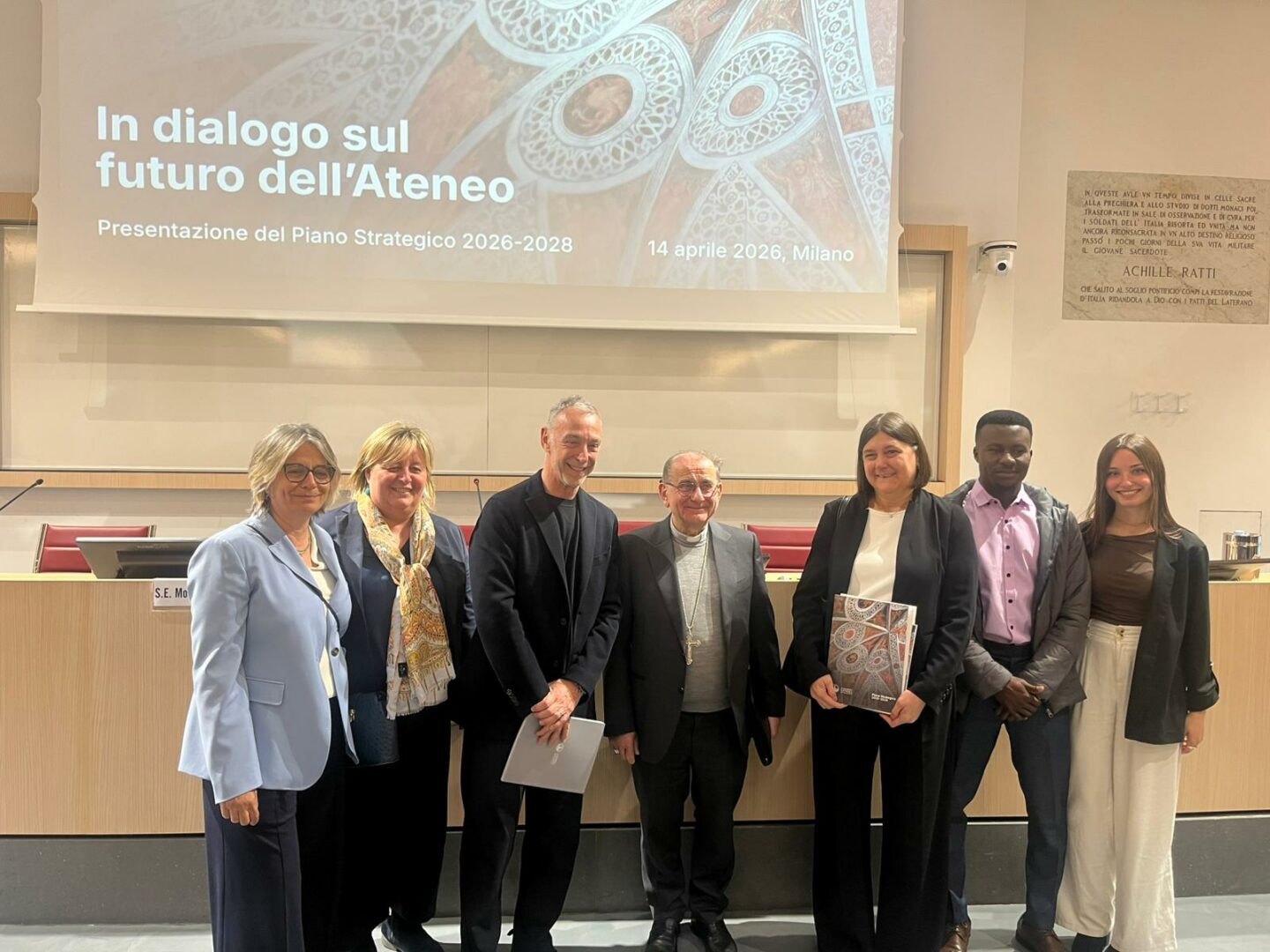
MILAN (ITALPRESS) – Not a document, but a shared process started nine months ago, characterized by 34 thematic workshops, which joined 665 community members, 1.711 respondents to the online survey and 54 project proposals presented through the call for ideas.
This is the path at the base of the Strategic Plan 2026-2028 of the Catholic University of the Sacred Heart of Milan, presented by Rector Elena Beccalli. “We have new design lines ranging from the School of Knowledge Integration to Lifelong Learning in collaboration with a primary international digital platform,” explains Beccalli. “Even the method – added – is original and distinctive: it is not usual for a Strategic Plan to set such a participatory method, founded on the active collaboration of the entire university community, on co-design and listening to the main interlocutors and write together the future of the University for the next three years.”
The strategic plan “is not a bureaucratic fulfillment. It is an initiative, that is, it declares responsibility and determination to cope and guide the life of the university.”
Illustrating the vision, the Rector identifies the “three addresses that guide our institutional mission: to enhance the profile of Catholic non-profit university; to foster a full integration between the dimension of educating community and that of research university; to build a place of experience of knowledge and not only of transmission of knowledge. This means, for example, to activate innovative pedagogical proposals such as service learning, based on the involvement of the student community in active citizenship paths and social participation, or as peer mentorship, to help even on content, knowledge and skills.”
The Strategic Plan 2026-2028 is divided into five pillars connected. “The first pillar – says Beccalli – concerns the establishment of a school of knowledge integration, able to enhance the interdisciplinaryity of the University in addressing the great issues of our time starting from a transversal perspective, avoiding the risk of a fragmentation of skills.” The second pillar is represented by the valorisation of research, research and researchers, “with the aim of making the research university profile even more incisive. It is intended, that is, to promote a favorable research environment capable of attracting and supporting young researchers and young researchers through incentives and awards”.
The third pillar rests on “a quality training offer that enhances the experience of knowledge in physical and digital spaces, for a full development of the educational community. This also through a renewal of content and teaching methodologies with particular attention to the tools of artificial intelligence and the development of paths in collaboration with the international digital platform FutureLearn for a training that embraces the entire arc of professional life”.
The fourth pillar draws on internationalization and moves along two directions. “On the one hand, the expansion of the global dimension through accreditations, attention to rankings and further dual degrees in addition to the 112 already active; on the other, a more identity-oriented orientation inspired by solidarity, aimed at continuing in the implementation of the Africa Plan”.
Finally, the fifth pillar is dedicated to fundraising activities “by leveraging on identity and institutional principles, guided by the idea of gift as reciprocity. The aim, therefore, goes beyond the collection of resources and embraces the strengthening of relations with pupils and external interlocutors to support strategic planning and ensure access to our courses to young people who are worthy but without means”.
According to the President of the Toniolo Institute, the Archbishop of Milan Mario Delpini, “with the strategic plan the University Cactyl reproposes itself as an expression of a Catholic presence that practices the autonomy of research and together expresses with gratitude the belonging to the Italian Catholic Church and to the international community”.
To tell how the university becomes a place of experience of knowledge and was the artistic director of Radio Deejay Linus, who in front of the audience of teachers, administrative staff and students, compared with three members of the university community: Margherita Lanz, professor of Applied Psychological Research Methodology, Jolie Casalini, student of the Faculty of Political and Social Sciences, Maddalena Baitieri, Research Office.
– photo f50/Italpress-
(ITALPRESS).
