
ROMA (ITALPRESS) – Italy generates 4.7 euros of GDP for each kilogram of resources consumed, the highest value among the great European economies, but also remains the country most dependent on foreign countries to obtain them: 46.6% of the materials transformed by the Italian industry comes from imports, more than twice the EU average (data of the VIII Report on Circular Economy in Italy, on Eurostat processing). A paradox that gets worse if you look at how much matter, instead of returning to legal production cycles, ends out of control: according to the report Ecomafia 2025 of Legambiente, in 2024 the crimes related to the cycle of waste in Italy were 11.166, up 19.9% compared to the previous year.
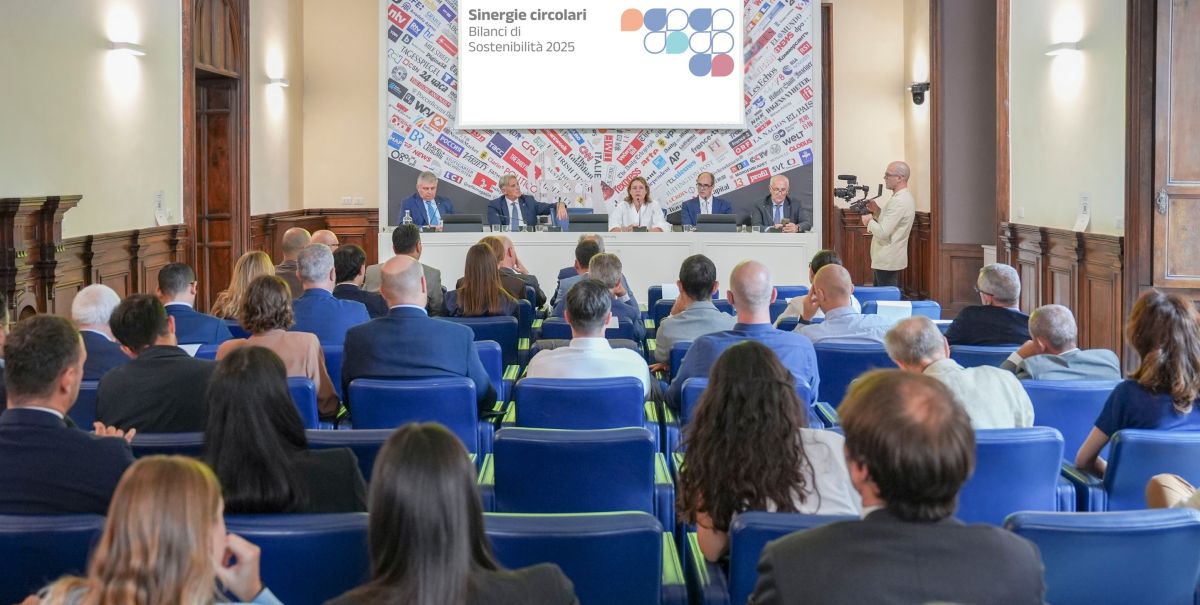
A photograph that returns the image of a country with great potential but still too many limits to overcome, and important challenges to grasp: strengthen the collection, arm the traceability of the supply chains and reduce dependence on virgin raw materials. It is on this ground that the action of the Consorzi Cobat, which today presented in Rome, at Palazzo Grazioli, the second edition of the Sustainability Reports. The event offered an integrated reading of the three Cobat chains: RIPA (pile and accumulators exhausted), RAEE (refused by electrical and electronic equipment) and TYRE (excessed tyres).
The event, organized together with Globe Italia – National Climate Association, saw the participation of Michele Priori, General Manager of Consorzi Cobat, Camilla Colucci, CEO of Circularity – Sustainability Partner who supported the drafting of reports, David Viva, General Manager of Cobat RIPA, Valentina Negri, General Manager of Cobat RAEE and Francesco Massaro, Managing Director of Cobat TYRE.
In the second part of the event, the round table entitled External Responsibility of the Producer: institutional addresses and perspectives saw the interventions of Fabrizio Penna (Director General, Ispra), Massimo Milani (Secretary Commission Environment, Chamber of Deputies), Marco Simiani (Capogroup Commission Environment, Chamber of Deputies), Laura D’Aprile (Capo Dipartimento Sviluppo Sustainable, MASE) and Giovanni Di Scipio (Capo Legislative Office).
“The transition to a more sustainable development model is not only measured in the ability to properly manage the end of product life, but in the possibility to transform that responsibility into shared value, for the environment, for the industrial system and for the communities,” said Michele Priori, Managing Director of Consorzi Cobat. “The Budget we present today, the second of our integrated ESG reporting path, tells not only the results achieved in 2025, but also the direction we have chosen to pursue: to strengthen a system capable of combining efficiency, responsibility, innovation and transparency, contributing to the construction of increasingly resilient and competitive chains.” Cobat RIPA has managed an increasingly strategic supply chain for the supply of critical raw materials: the members have introduced to consumption 231,688 tons of batteries and accumulators, 82% of which can be attributed to the automotive sector (SLI and electric vehicles), with the EV batteries up 87% compared to 2024. On the front of the collection, the portable batteries cover 84% of the total carried out by the consortium, a percentage that corresponds to approximately 43% of the consumption of 2024 and 30% of the collection at national level. An increase of 9%, compared to 2024, records the collection of batteries for electric vehicles and light mobility.
The 2025 represented for Cobat RIPA a year of profound transformation and strategic strengthening, marked by the evolution of the European regulatory framework and the acceleration of the energy transition,” said David Viva, Managing Director of Cobat RIPA. “In a scenario increasingly characterized by the spread of electric mobility andof energy storage systems, the batteries today take an unprecedented strategic role: the recovery of critical raw materials contained within them becomes an essential lever for the security of supply and the industrial competitiveness of the country”. Cobat RAEE has seen its members supply to consumption over 200,000 tons of electrical and electronic equipment (+34% from 2022), while the Consortium has collected almost 31,000 tons of WEEE, 8.2% of the national collection of domestic waste. The most significant data relates to the professional sector, raised by 264% thanks to the progressive revamping of photovoltaic systems: on the photovoltaic modules at the end of life, Cobat RAEE has reached a rate of recovery of the matter of 89%, with the provision in landfill equal to zero.
“The increasing spread of electronic technologies and the acceleration of the energy transition make the management of WEEE a strategic challenge for the country system today,” explained Valentina Negri, Managing Director of Cobat RAEE. “There are still strong territorial differences, which leave Italy far from the European collection objectives: for this reason the active participation of citizens represents a decisive lever, and continue investing in communication and environmental education remains essential to spread awareness on the value of raw materials contained in electronic devices.” Cobat TYRE has consolidated its role in the management of unused tires, collecting more than 42,000 tons of PFU (+31% compared to 2023), exceeding the ministerial target on the spare market of 10.85% and recording an acceleration of 58% on volumes intercepted by the ACI circuit. Over 9,400 requests for collection managed during the year by the Consortium’s logistics network.
“In 2025 Cobat TYRE achieved results that confirm the solidity of our consortium model and the ability of the supply chain to operate with efficiency, responsibility and vision,” said Francesco Massaro, Managing Director of Cobat TYRE. “For us sustainability means transforming PFUs from waste to resource, generating second raw material destined to new production cycles. We will continue our work, continuing to guarantee our Members regulatory and operational instruments at the height of a rapidly evolving context.” The results tell a lot more than a quantitative growth: they tell the ability of a system to transform the end of the product life into a new development opportunity, recovering second raw materials, reducing the use of natural resources and contributing to the security of supply in increasingly strategic sectors for the future of Europe.
“What we have presented is the fruit of a shared commitment with Members, partners, institutions and stakeholders, and at the same time represent the starting point to face the challenges that await us” concluded Michele Priori, Managing Director of Consorzi Cobat. “We will continue to work with the same determination to build ever more efficient, transparent and circular chains, capable of generating value for the production system, for the environment and for future generations.”
– photo press office Consorzi Cobat –
(ITALPRESS).
