
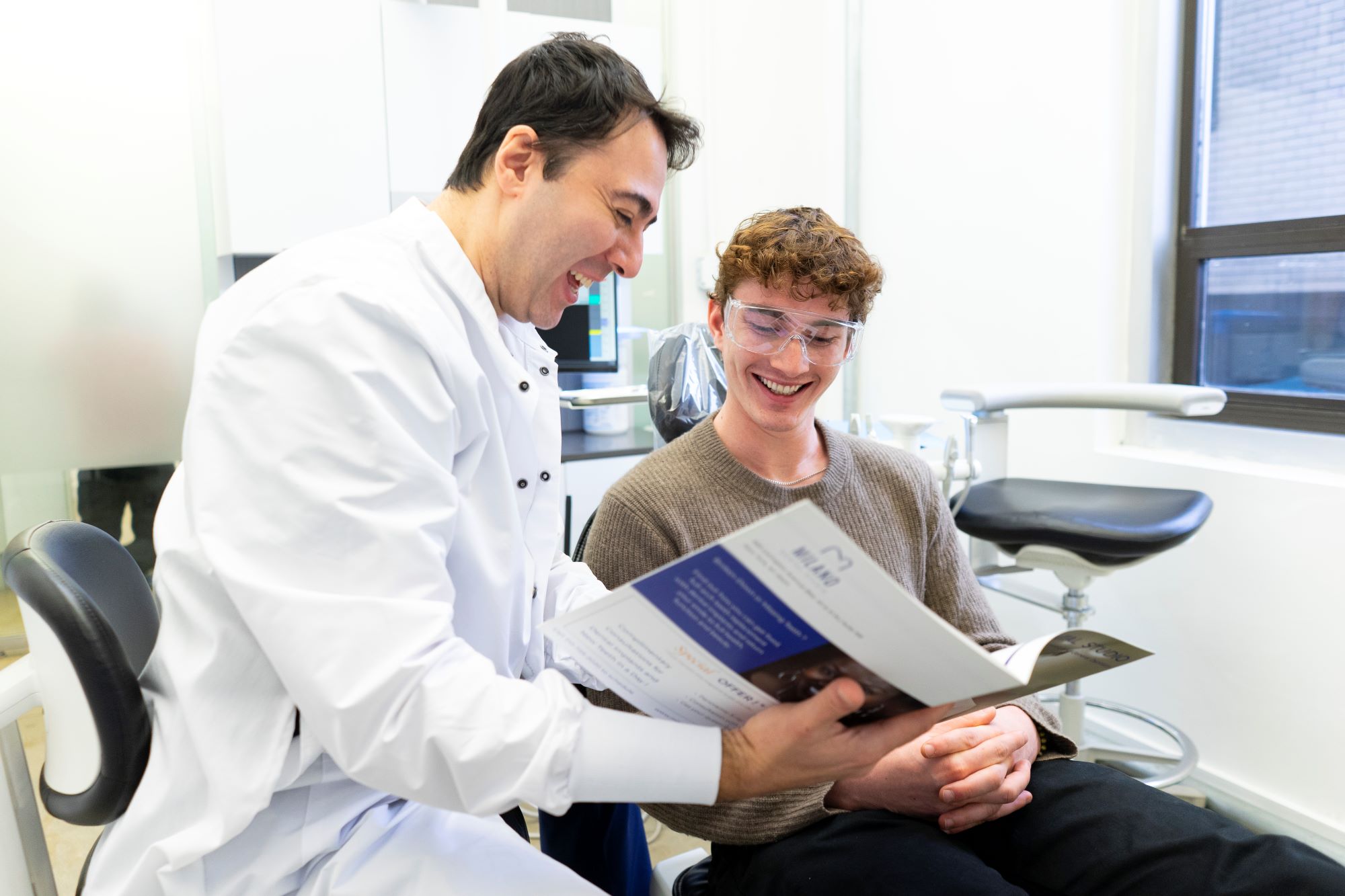
In a city where image matters and time moves at lightning speed, Dr. Davide Romeo has built his career at the intersection of medicine, aesthetics, and culture. He has lived in the United States for more than a decade, yet his work continues to reflect a deeply Italian vision of the profession.
His journey began in Milan, where he earned his degree in dentistry and completed a PhD in implantology and prosthodontics. Shortly afterward, between 2009 and 2010, he made the decision that would define his professional path: moving to New York to gain firsthand experience with the American dental system and to complete additional training in periodontology, the field that focuses on the supporting tissues of teeth and implants.
“The opportunity came through a clinical program designed for international dentists,” Romeo explains. The program, led by world-renowned periodontist Dennis Tarnow, offered a full-time, one-year clinical residency in New York City.
What was meant to be a temporary experience quickly became something more.
“During that year, I met my future wife,” he recalls with a smile. Also a dentist and originally from Guatemala, she was enrolled in the same program. From that moment on, the idea of building a professional future together in New York felt only natural.
Since 2022, they have been working side by side at Milano Dental Studio, located at 369 Lexington Avenue in the heart of Manhattan, just steps from Grand Central. The practice serves an international clientele: New Yorkers, foreign professionals, and members of the Italian community.
One of the studio’s defining features is its production chain for prosthetic work. All restorations are crafted in Italy and shipped daily to New York, ensuring high-quality standards and a strong artisanal touch. In some cases, the practice also collaborates with expert Italian dental technicians who relocated to the United States many years ago, blending tradition with a local presence.
Romeo notes that Italian identity carries more weight abroad than one might expect. “When you work outside Italy, you always feel, in some way, that you’re representing your country.” This sense of responsibility is especially evident in his clinical approach.
Italian training, he explains, is traditionally rooted in listening to the patient and in conservative dentistry, intervening only when necessary and preserving as much of the natural tooth structure as possible.
In the United States, and in New York in particular, cosmetic dentistry has grown exponentially in recent years. Veneers, full smile makeovers, and aesthetic treatments are increasingly in demand.
But Romeo draws a clear line: “First and foremost, we are doctors of the mouth and we know that oral health is closely connected to overall health.” Even when the request is purely cosmetic, clinical evaluation remains central.
“It’s essential to understand the patient, their expectations, as well as the biological and functional factors at play,” he explains. Bruxism—teeth grinding—for example, is a significant mechanical risk factor. Oral acidity, often linked to stress or metabolic conditions, can compromise enamel. Add to this a predisposition to cavities and gum disease: all elements that must be carefully assessed before any intervention.
“An accurate diagnosis, both functional and aesthetic, is essential because even the most beautiful cosmetic restoration, if performed on unhealthy teeth or without proper function, is destined to fail. My goal, as clinician, is not just to deliver a beautiful smile, but one that remains stable over time,” he explains. For this reason, professional cleanings and regular check-ups are an integral part of treatment.
In New York, he adds, the pace is relentless. “Patients have very busy schedules and expect efficiency.” To meet these demands, the practice has developed rigorous operational protocols and strong coordination between clinical and administrative teams, maintaining high standards without delays.
Cultural differences are clearly reflected in aesthetic expectations. In general, American patients often prefer to include more teeth in their treatment and tend to value a high level of symmetry, along with a brighter, more uniform color. Italian patients, on the other hand, they tend to involve fewer teeth and favor a more natural color and overall appearance.
These differences are also evident in treatment approaches. If the issue involves only one or two teeth, Italian patients are more likely to opt for targeted procedures, whereas in the United States more comprehensive treatments aimed at achieving overall harmony and balance are quite common.
There is no inherently right or wrong approach—these are simply two different perspectives and sensibilities when it comes to beauty and aesthetics. As long as the gum tissue is healthy and the bite is functional, both treatment philosophies are valid.
It is within this balance between aesthetics and medicine that the dentist’s role takes shape. “Our job is to find common ground,” Romeo concludes. “A successful cosmetic restoration is one you don’t notice, yet one that satisfies the patient and boosts their confidence.”
In a city in constant evolution, where private healthcare is often shaped by strong market dynamics, it is precisely this balance that guides his work: clinical expertise, attention to the individual, and a vision of dentistry that remains, above all, medicine.