
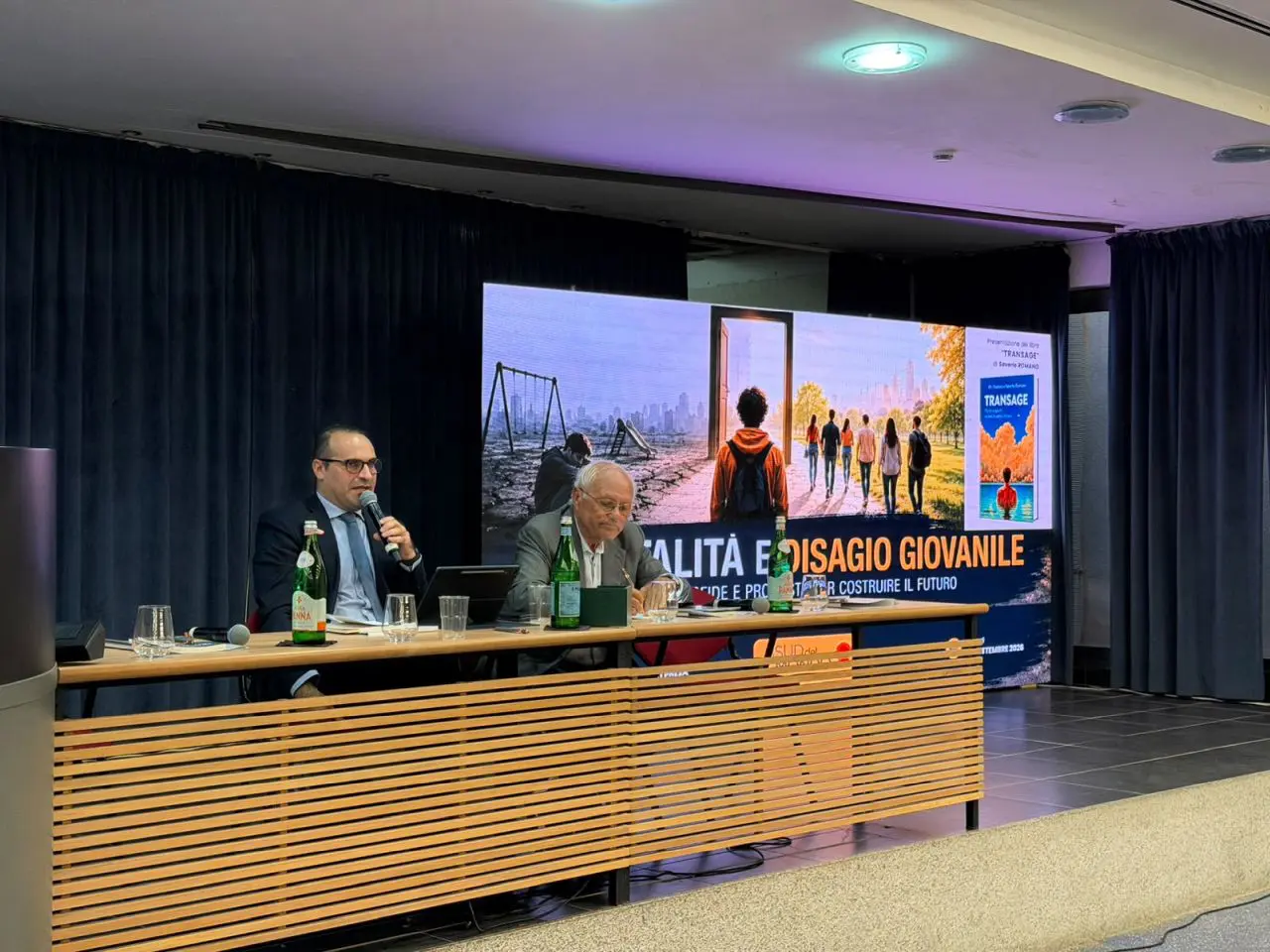
PALERMO (ITALPRESS) – A common path between institutions, academic world and civil society to seek answers to two critical issues among the most impending of current events: decrease in births and daily problems of young people. These themes at the center of the conference “Denatility and youthful discomfort. Reflections, challenges and proposals to build the future”, organized by “I Sud del Mondo” at the Hotel Village and Congresses in Palermo. The two themes are closely interconnected: the demographic changes in place offer an opportunity to draw a future that pays attention to the demands of young people, questioning the obstacles that can delay their autonomy and parenthood. The first step is to listen: a direct confrontation with children can be the first step to understand what does not allow them to achieve their goals. During the event the book “Transage” was also presented, written by Saverio Romano: the national president of Noi Moderati and the bicameral commission for Simplification participated in video connection. Present remotely also the general director of Svimez Luca Bianchi.To moderate the works is Pompeo Torchia, president of I south of the world: “We wanted to start from these themes, denatility and youthful discomfort, which have an important development for Italy – he emphasizes -. They must be considered relevant to the future of our nation. It is not necessary to start by simplifying banally an improvement of the mere birth indices: we must focus on the future of young people and create a 2050 pact that looks to future generations to try somehow to improve their living conditions and create the right working conditions and economic and social development. From here the contrast to youthful discomfort arises, because very often denatility is linked to the fact that young people do not have the opportunity to improve their living conditions: we also want to integrate the concept expressed in the book of Romano on Transage, that is to try to reorganize generations and various ages so that they are not distant among themselves.” Starting from the experience of Transage and other readings on the subject, Romano points out that “our society in 10-20 years will no longer be the same: we must put ourselves the theme of denatility, which can only be solved by facing it from now on and can only change the paradigm of our society; mass immigration cannot be the solution. The theme of denatility can be solved through an organic vision of tomorrow’s society: it is not a resolving theme through the tools we have available to date. The first thing to do is to break down the anagraphic barriers: we are all useful and indispensable in society, it is fundamental a different reading that allows the trentenni and forty years of the future that allows to live in a fairly comfortable dimension; it is wrong, for example, not to imagine abolish the right of cumulation for pension. Once the logic of putting people of a certain age outside the world of work was dictated by the fact that there was a very high youth unemployment but today, also because of the work in black, it is highly complicated not to find a job in our country: in recent years, however, we have witnessed a abandonment of the fixed place, with many public competitions gone deserted”. In the last report by Svimez, Bianchi explains, “we have integrated the theme of “restance” and freedom of movement: the two rights must necessarily be together. Freedom of movement is to look for opportunities where there are: mobility enriches both economic and cultural; Sicilian history first is full of contacts with external people, the European Union itself was born on this right. The “restance” has weakened in recent decades, as if young people were somehow obliged to abandon their territory: thethe right to remain is the job opportunities, as long as it is a stable job, well paid and that guarantees opportunities for growth; today the ‘restanzà also concerns the presence of certain types of rights which, especially in some areas of the Mezzogiorno, are not guaranteed. Over the years we have seen different types of migration, including university and health: the shift is also motivated by the absence of services. In the places where young people live badly, the same applies to the elderly: if they migrate one another, they often end up migrating also others. There are no countries for young people and old countries: where there are opportunities and services work well both generations, otherwise they live badly. Every year from the Mezzogiorno about 60 thousand young people go away: so we risk a fracture in the social estate of the territories, because even the elderly will start to go away”. To avoid any crisis scenario, he adds, “it is necessary to reconstruct the policies as a whole: it is necessary to continue with investments in social infrastructures, as done with the Pnrr; the differences have been reduced, but they have not been filled. As Svimez we proposed to work on a mechanism of reduction of Irpef, increasing the real wages of young people who remain in the Mezzogiorno: building a mechanism according to which those who remain to work in a southern region has a temporary advantage of fiscal character, to try to increase the wages of young graduates, can again make it attractive to stay in the territory. The South is a place where, if you invest, you can generate a positive reality: it can be a place of innovation as well as of culture; if we hold young people on the territory we will have a positive impact in terms of both continuity and participation. Any policy that favours the detainment of human capital on the territory is fundamental to guarantee prospects of growth: keeping young graduates on the territory can help us improve all the structural elements of a social context”.
– Photo xd8/Italpress –(ITALPRESS).
