

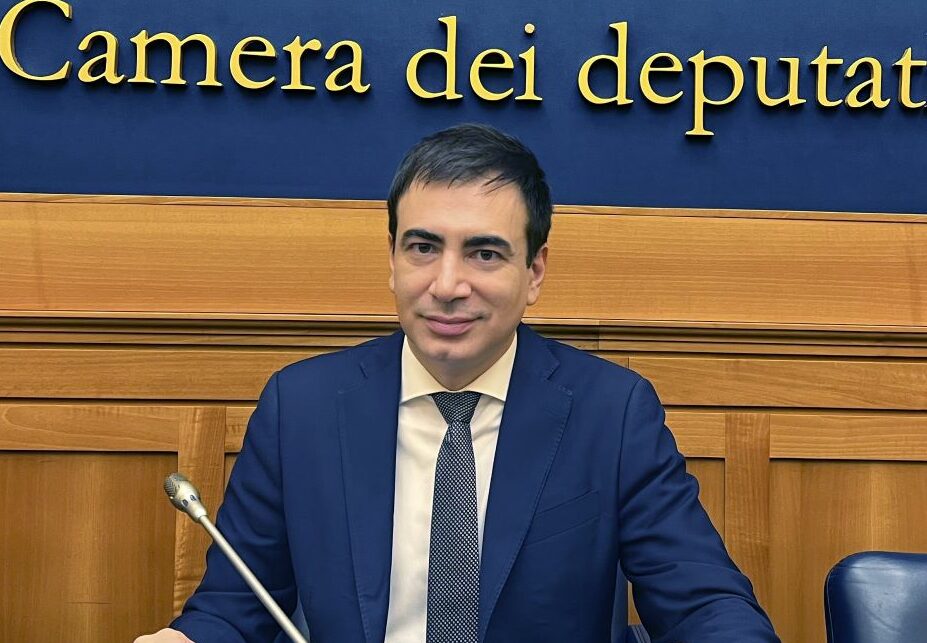
Davide Ippolito – founder of ilNewyorkese – interviews Hon. Christian Di Sanzo, a Member of Parliament elected in the Foreign Constituency (North and Central America), to delve into one of the most hotly debated issues among Italians abroad: the recent decree-law on citizenship. Approved on May 20, the measure has sparked strong reactions and concern within Italian communities in the United States and Canada, particularly among the new generations of expats.
Hon. Di Sanzo, let’s go step by step: what led us to this point?
“This is a truly important issue, one that significantly affects our communities of Italians abroad. It’s an opportunity to inform our fellow citizens in the United States, Canada, and all of North and Central America, because this provision directly concerns them.
When Minister Tajani held the press conference on March 28, he presented a decree approved by the Council of Ministers that came into effect at midnight the previous day. This decree drew a dividing line between those who had already submitted an application for recognition of citizenship before that date and those who would do so afterwards, between those who had already obtained recognition and those who had not.
We, the MPs elected abroad, were not informed. Nothing was communicated even to the General Council of Italians Abroad, which, by statute, must be consulted by the government on measures affecting Italians living abroad.
It was therefore Minister Tajani’s press conference — where he and Prime Minister Giorgia Meloni claimed ownership of the measure — that announced the decision, taken without any involvement of Parliament.”
It seems to be a rather exceptional measure. How do you explain it?
“When intervening in such a fundamental law — citizenship law is the foundation of the Italian Republic, defining who is a citizen and what rights and duties stem from that — it is very rare to use a decree-law, which is intended for cases of necessity and urgency.
This issue has existed for many years, so there was no real urgency justifying such a sudden move. It would have been more appropriate to start a parliamentary discussion through a government bill, which would have taken longer but been more participatory and democratic.
Instead, a decree-law must be converted into law within 60 days, leaving very little time for debate, which in fact didn’t happen.”
Speaking as an expat: will my grandchildren be denied Italian citizenship?
“If your children were born in the U.S. and have always lived there, their children — your grandchildren — will not be entitled to Italian citizenship. It ends with the second generation.
It’s a very severe limitation, and frankly quite unbelievable, given how this measure was introduced. As the Democratic Party, we proposed numerous amendments and tried to foster a wide-ranging debate, both in the Senate and in the Chamber, where we had a long and detailed session with various contributions from myself and other Democratic MPs elected abroad.
Brothers of Italy and Forza Italia, on the other hand, defended the measure staunchly and pushed it forward without compromise.
The practical result is that children born and raised abroad — which means most children of new emigrants — will not be able to pass Italian citizenship on to their own children. The only exception is if they move to Italy and live there for at least two consecutive years before the child is born.”
Many parents have written to us: “My child is 8-9-10 months old, and I haven’t applied yet. How much time do I have to apply for citizenship?”
“The new decree introduces a requirement: children must be registered with the consulate within one year of birth.
Until now, registration could be done until the age of 18. With this new rule, the timeframe has been drastically reduced, which is why a transitional provision was included: for all children already born, families have until May 31, 2026, to register them.
So, I’m making an appeal to all ilNewyorkese Network readers: if you have friends or relatives with young children born in the U.S., Canada, or North America, urge them to register them with the consulate as soon as possible. It’s truly important to do so within the deadline.”
This provision has a huge impact on the entire Italian community abroad. What can people do now, practically? And what are you MPs elected abroad doing? Is there a bipartisan effort here, considering your direct responsibility to your constituents?
“Actually, unlike other issues, there hasn’t been bipartisan agreement in this case.
MPs from Brothers of Italy, the League, and Forza Italia defended the provision and proudly endorsed its contents during parliamentary debate. For them, it represents a return to the idea of the homeland, a kind of identity recovery, and they are proud to have promoted it. They consider it a fundamental, untouchable law.
We, on the other hand, are examining the decree’s potential unconstitutionality, as there are elements that conflict with previous legislation and some constitutional principles. In fact, it interrupts an acquired right for many people who had started or completed citizenship procedures, which raises very serious concerns.
We will explore all legal avenues, but we don’t expect legislative changes as long as this Government remains in office, since it has strongly defended the measure.”
So it will be up to the Constitutional Court? Will we know more in the coming weeks or will it take longer?
“It will take weeks, if not months. Someone who is denied citizenship will need to take legal action, and from there, a judicial process will begin that could eventually reach the Constitutional Court through the Court of Cassation.”
Let’s talk about those who emigrated a hundred years ago, often discriminated against, and who had to renounce their Italian citizenship to become American citizens, especially after the war. Can those people regain it today?
“Paradoxically, yes — but it’s not all rosy. A brief historical note: before 1992, Italy did not allow dual citizenship. Those who emigrated to the U.S. or Canada often did so to seek better living conditions and escape discrimination. To become American or Canadian citizens, they had to renounce Italian citizenship — a real injustice.
Now, the decree reopens the possibility for those who lost their citizenship before 1992 to reacquire it.
Starting July 1, consulates are expected to publish operational instructions and application forms. These individuals will then be able to become Italian citizens again.
We’ve received very touching letters from people who have waited decades for this moment. Many express a deep desire to ‘die Italian.’
This part of the decree was actually the result of a bipartisan agreement. I myself submitted a specific bill on the matter, as did other opposition colleagues.
Unfortunately, the downside is that this reacquisition will be personal and non-transferable: the grandchildren of these people, in most cases born and raised in the United States, will not be able to obtain citizenship.”
One thing I’ve learned over the past two years is that many Italians abroad feel like second-class citizens. This decree, in effect, distances them even further. So let’s make a call to action: what can people who write to us today actually do? Can they protest? Can they write to someone?
“Unfortunately, we must also be realistic.
I strongly believe in parliamentary representation, in the democratic system of the Italian Republic. Letters have poured in, countless appeals have been made, petitions submitted.
During the conversion process of the decree-law, however, the government and the majority did not respond to these calls. In fact, paradoxically, despite the heartfelt demonstrations from the Italian community abroad, the requirements to obtain citizenship were further tightened.
So we arrived at the current law.
My invitation now is to look to the future — to the next elections. That is when citizens will need to carefully evaluate which political forces truly care about the continuity and vitality of our communities abroad.
Because the real risk is that, within a generation, a large part of Italians abroad will be lost. Our communities will disappear, sustained only by new annual emigration.
We need a strong appeal to carefully consider who can best represent these concerns in Parliament. Because, in the end, we can protest all we want, but laws are passed by those who sit in the chamber.”
If someone born in Italy moved to the United States over thirty years ago and has a child born in the U.S. who never applied for Italian citizenship, can that child still apply?
“Yes, there are many such cases. If the parent — born in Italy — lived at least two consecutive years in Italy before the child was born, then the child is entitled to Italian citizenship.
If that child is already over 18, they can submit a citizenship recognition application. At the moment, these applications are handled by the consulates. But the government has announced new measures: two additional bills are under discussion.
These will further tighten the criteria, also affecting new categories, such as spouses of Italian citizens.
Another planned change is the creation of a Central Citizenship Office, based at the Foreign Ministry in Rome. In the future, applications will be submitted to this office, not to the consulates.
The new bill also foresees an average processing time of four years per application — currently, in theory, it should be two. So these new proposals point to even longer wait times.”
A very hot topic, which we will continue to follow closely for our readers. Of course, we will also give space to other perspectives, should MPs from the majority elected abroad wish to intervene or offer clarifications.
Still, the situation already appears very clear — and very delicate. We thank Hon. Di Sanzo, who will certainly keep us updated as this issue evolves.
“Absolutely. Thank you.”