
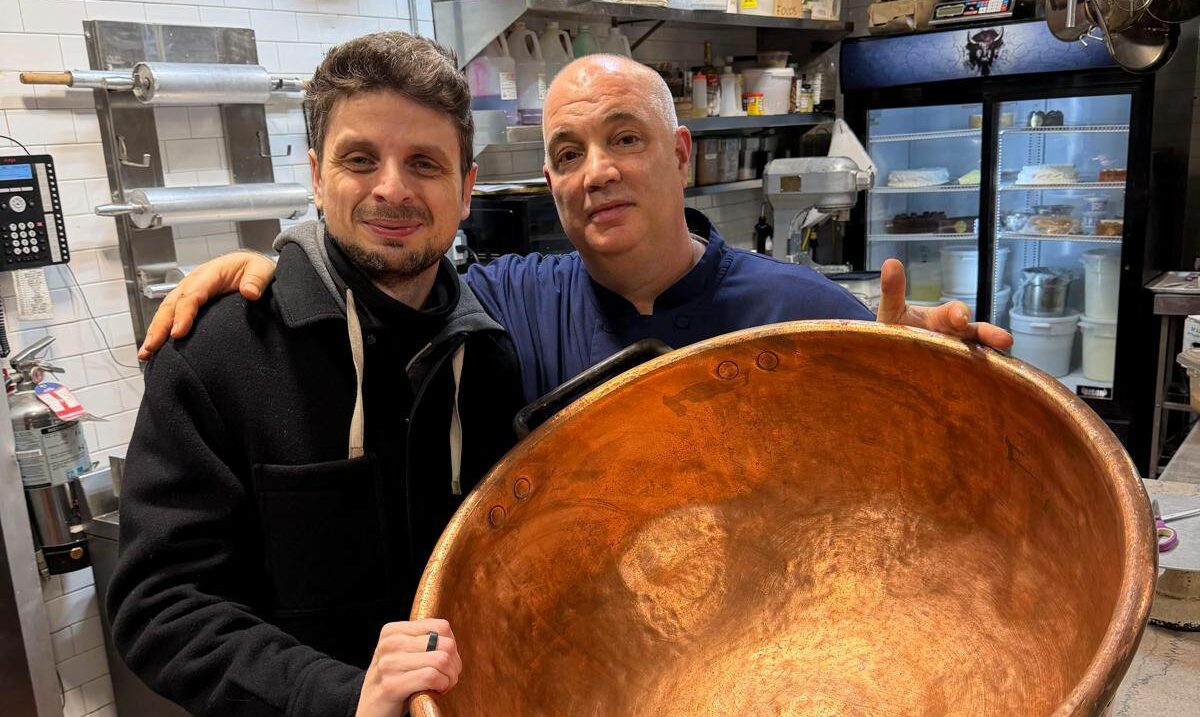
Ferrara is much more than a historic bakery in Little Italy: it is an institution. Founded as a community café in 1892, it is a living archive of the Italian American experience in New York, while remaining entirely contemporary and timeless. In this interview, Ernest Lepore, CEO and Executive Chef, looks back on more than a century of family history, from the first espresso served to immigrants who had just arrived at Ellis Island to the legendary “Holy Cannoli,” through inherited values, moments of crisis, benevolent spirits hidden under the stairs, and plans for the future, always faithful to the bakery’s roots.
Ferrara is a living piece of New York history. Can you tell us how it all began, even before the city itself took shape?
Well, it’s ironic to think about it, but Ferrara was founded before New York City received its charter. In 1892, we became official, but before that we were a café, a kind of old-fashioned “social media.” People would come here looking for Mr. Ferrara — a bricklayer, an accountant, an architect — for help. It was a reference point, a place where the Italian community found support and connection.
And how does the experience of Italian immigrants intertwine with your story?
If you came from Italy, from Ellis Island you would arrive at the Seaport, where you would meet friends or relatives who had already settled in America. Then, passing through the Lower East Side, you would walk here, to an area where most people were German, Dutch, and Irish. But for us Italians, this was home. We turned Italian food into fine dining. It was a real cultural revolution, a way to affirm our identity and our value in an America that did not always welcome us with open arms.
Yours is a family story, with deeply rooted values. What principle has guided you through the generations?
Our grandmother taught us: “Family first, then business.” Even if we didn’t like each other, on Sundays we all had to sit at the table together. And in the end, things would work themselves out. That is the nature of things. This respect for family became a deep respect for the business, which we had to buy back from the other partners. It is a bond that is passed down, like when my niece, who is not even four yet, tasted a tricolor cookie bought somewhere else and said: “I don’t like it, it’s not good.” Quality is in our DNA.
Were there difficult moments, times when Ferrara’s future seemed uncertain?
The hardest moment was when my father died, at only 47. There was no succession plan. It was a devastating blow, but it taught us the importance of being prepared. Today, we are each other’s successors, and we have a good insurance policy!
Looking to the future, what are your dreams and plans for Ferrara?
The future is global, but also attentive to new needs. I want to bring Ferrara to five key cities around the world, starting with Naples. And we are working on gluten-free and “sugar-correct” products, to educate people to eat the best in terms of nutrition per calorie. Italian food, and Ferrara, must continue to evolve, to teach, and to delight.
Finally, what is the secret to the longevity of a place like Ferrara?
If there were a secret, do you think I’d tell you? My mother would say “the munaciello.” We still have a staircase that leads nowhere because that is where the munaciello is. It is a spirit, like a leprechaun, but Italian, who spins gold. Maybe he is the real secret, or maybe it is the consistency of the product. But there is certainly something magical about this place.