
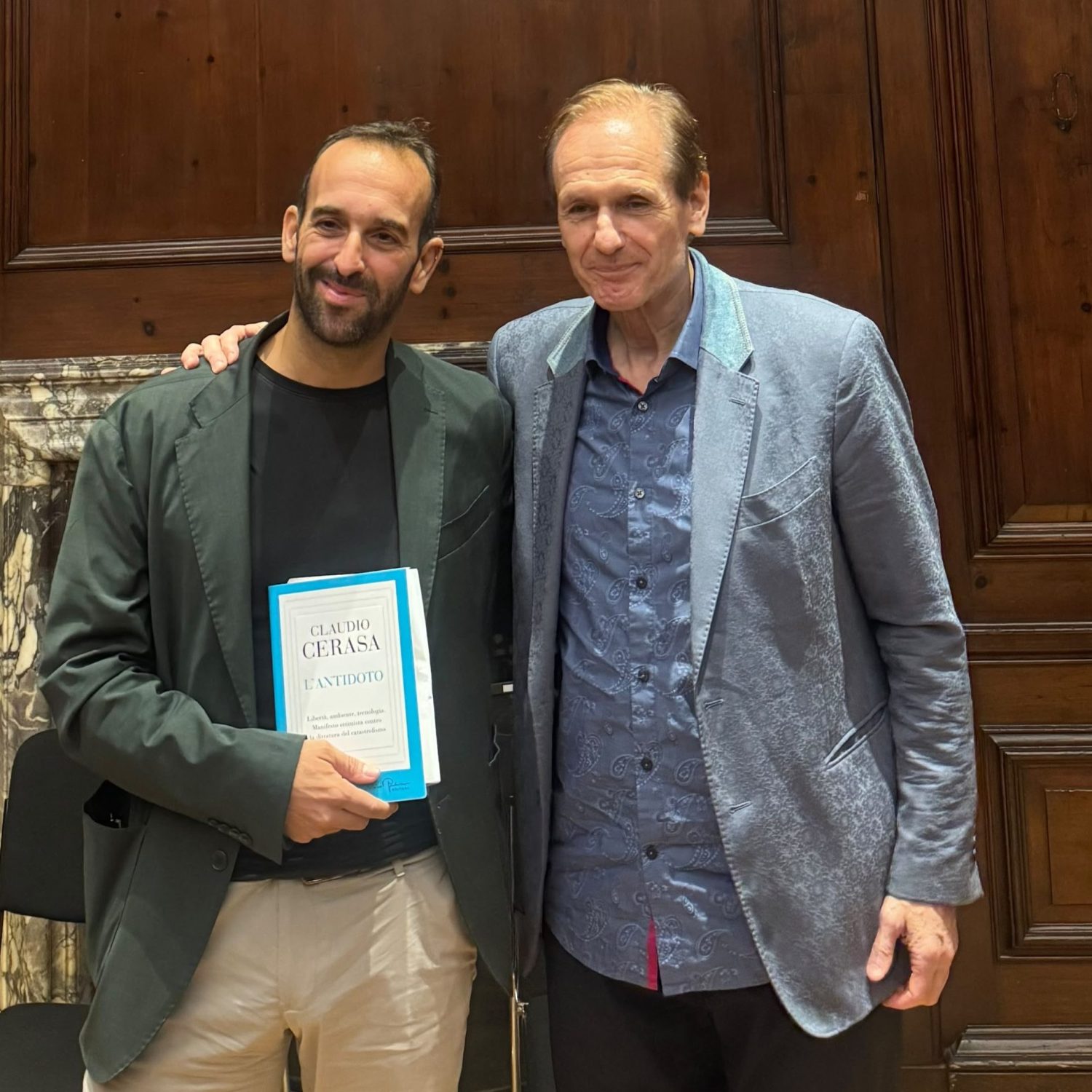
A news can be true and still contribute to giving a wrong image of reality. An episode of violence, for example, tells something that happened, but alone does not say if a city has become more dangerous. To understand it, other elements are needed: how many crimes are committed, how they change over time, which increase and which decrease. It is one of the issues addressed by Claudio Cerasa, director of the Foglio, in the conversation with Claudio Pagliara organized on October 2 by the Italian Institute of Culture of New York to present his latest book.
The essay is called The Antidote. Freedom, environment, technology. Optimistic Manifesto against the dictatorship of catastrophe, published by Silvio Berlusconi Editore. The main argument concerns the public debate and how pessimism is often mistaken for realism, while trust in progress is treated as a subassessment of problems. Cerasa proposes to test both positions through data, contesting the idea that wars, crises and international tensions demonstrate an inevitable deterioration of the world.
During the meeting, the author described optimism as an attempt to “transform disorder in order”. The reasons for concern exist and occupy a part of his reflection. The passage that disputes is the next one: to transform every problem in the confirmation that the future will necessarily be worse than the present.
Journalism has a central role in this reasoning. “Positive news is considered not news,” Cerasa said. A gradual improvement can receive less attention than a sudden crisis; something that works tends to be considered normal, while a failure requires an explanation and more easily conquer a title. According to the Director of the Sheet, this selection can make it difficult to recognize progress even when they are measurable.
That the negative language draws attention also finds feedback in research. A study published in 2023 on Nature Human Behaviour, based on experiments with alternative titles of the Upworthy site, found that, for a title of average length, each additional negative word increased by 2.3 percent the click rate. Among the words classified as negative by the researchers are ‘wrong’ (‘wrong’) and ‘awful’ (‘terrible’), both among the most frequent in the analysed titles. These are words that can direct judgment on a fact before the reader even knows the details. The study compared different titles proposed for the same article: to change was the way to present the news
The Italian example chosen by Cerasa is the centenarians. According to Istat data, on January 1, 2025 people living in Italy with at least one hundred years were 23.548, compared to 10.158 in 2009: an increase of 130 percent. The comparison therefore concerns the period 2009–2025. The institute also reports that growth has not been uniform, because the number of centennials affects the different consistency of the generations of birth. For Cerasa, a figure of this kind deserves more space in the story of the country. It does not erase the difficulties of health or those related to the ageing of the population, but adds an information that is likely to remain on the margins, when “the two can coexist”, he observed on the positive and negative news.
The question becomes more delicate when it comes to safety. A sequence of episodes of news can suggest a trend without showing it. “If those news is untied by the context, if the situation is not reported, if the trend is not reported”, Cerasa explained, the single fact ends up occupying all the space of interpretation. The problem therefore also concerns what is missing in the story: comparisons, proportions, the period under review.
From here comes the connection with politics. “Democracy is made of complexity, context, trends and is not only made of emotions”. In his reading, describing the problems as insoluble favors the search for guilty and weakens the discussion on possible answers. Optimism would require work, less immediate, to seek solutions and verify its effects.
Cerasa also applies this reasoning to the European Union. During the conversation he indicated the response to the war in Ukraine and the search for relationships with other areas of the world as examples of a often underestimated reaction ability. Crisis, he says, can produce «antibodies»: decisions and alliances that take shape right under the pressure of events. It is his objection to the story of a Europe destined for irrelevantness, even between divisions and difficulties.
The defence of Europe is accompanied by Western democracies. The director argues that recognizing its errors must be compatible with the defense of freedom of press, word and research. In the part dedicated to Italy he then proposed to observe the distance between some positions supported in the past from the right and the choices of the government of Giorgia Meloni, especially on Europe and immigration.
The broadest statement of the evening is that the present is “the best historical moment to be born”, for the opportunities available and for the possibilities offered by science. It is also the one that requires more distinctions: the living conditions depend on the country, the resources and the rights to which each has access. Overall progress does not make these experiences equivalent.
However, the criterion proposed by the book remains applicable without sharing all the conclusions of Cerasa. In the face of an episode, ask yourself how representative it is; in the face of a number, verify with which period it is compared; in the face of a crisis, look for what answers have already been attempted and with what results. For a newspaper, it means giving the reader the elements to understand if a news describes an exception, a worsening or a trend that is changing.
L’articolo For Claudio Cerasa, being optimistic is a job proviene da IlNewyorkese.
