
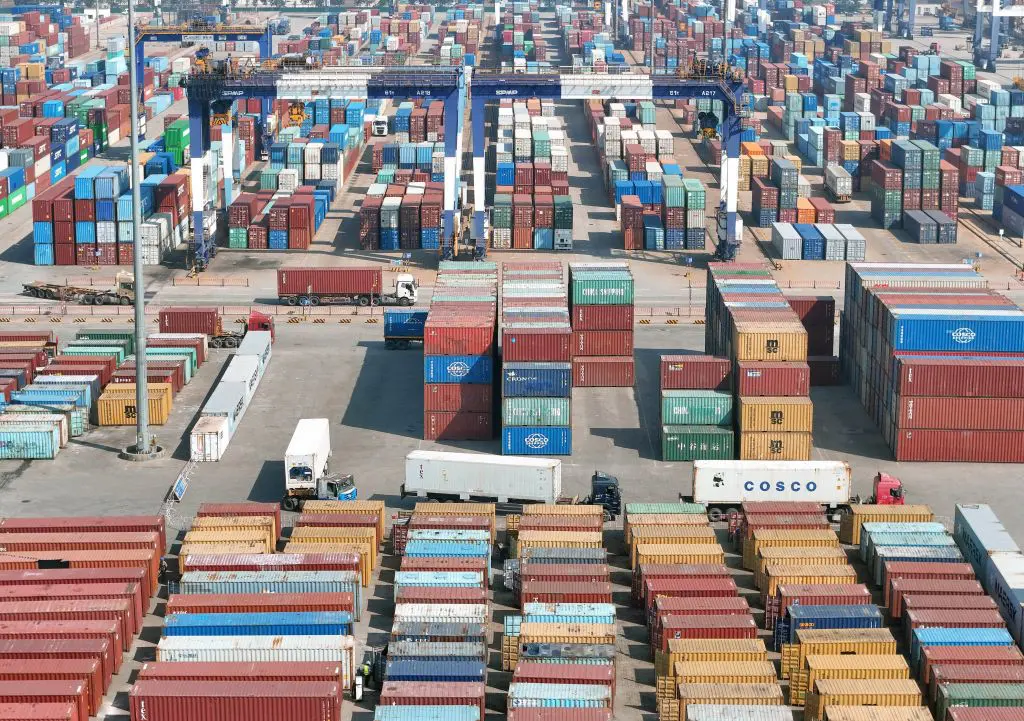
ROMA (ITALPRESS) – In February, the dynamics on a monthly and annual basis of the export is partly influenced by high-impact sales of the shipbuilding industry: net of these, it is estimated to be a less large conjunctural increase (+1.8%, from +2.6%) and a tendential growth of +0.9%. This is what emerges from Istat data on foreign trade and import prices. The trend of exports to the United States remains high but is concentrated in the pharmaceutical and other means of transport; the most sustained in Switzerland is mainly due to the increased exports of metals; while the sharp decline in exports to Germany is influenced by the sales of marine means detected in February 2025 (net of these, the decline is reduced to -0.7%). Import returns to grow on a monthly basis; net of energy, it grows on an annual basis of +2.7%. In February, the increase in import prices is due to the rise in energy prices ( crude oil and natural gas) and intermediate goods (particularly metals) in the non-Euro area; on an annual basis, their decline is slightly expanded. In February 2026 it is estimated a larger conjunctural growth for imports (+3.5%) than exports (+2.6%). The monthly increase in exports is due to increased sales to the extra EU area (+5.3%), while export to the EU area is stationary. In the quarter of December 2025-February 2026, compared to the previous one, export grew by 0.9%, import fell by 1.3%.
In February 2026 export in value is almost stationary on an annual basis (-0.2%); in volume, it is reduced by 2.2%. The almost annual rate of export in monetary terms is a synthesis of an increase in non-EU markets (+2.8%) and a reduction in EU markets (-2.9%). The import recorded a tensile decline of 1.3% in value, involving to a wider extent the EU area (-2.0%) compared to the extra EU (-0.3%); in volume, instead, imports grow by 0.4%. On a yearly basis, among the sectors that contribute to curb exports, there are means of transport, excluding motor vehicles (-22.1%), sports articles, games, musical instruments, precious, medical instruments and other products not classified elsewhere (n.c.a.) (-12.1%) and coke and refined petroleum products (-18.2%). On the contrary, the greatest positive contributions derive from the increase in sales of base metals and metal products, excluding machines and plants (+30.7%) and pharmaceutical, chemical-medicinal and botanical articles (+3.0%). On a yearly basis, the countries providing the biggest negative contributions to national exports are Germany (-15.4%), Spain (-15.3%), Turkey (-27.0%) and the United Kingdom (-13.6%). Exports to Switzerland (+33.2%), United States (+8.0%) and OPEC countries (+14.5%).
In the first two months of 2026, the export recorded a trend of 2.2%, which mainly contributes to lower sales of transport, excluding motor vehicles (-16.3%), coke and refined petroleum products (-29.1%) and machinery and equipment n.e.c.a. (-4.1%). The most positive contribution, however, comes from the increase in exports of base metals and metal products, excluding machines and plants (+24.2%). The trade balance in February 2026 amounted to +4.944 million euros (was +4.444 million in the same month of 2025). The energy deficit (-3.466 million) is less than one year earlier (-5,000 million). The advance in the exchange of non-energy products falls from +9,444 million February 2025 to +8,409 million February 2026. In February 2026 import prices increase by 0.4% on a monthly basis while they fluctuate by 3.4% on an annual basis (from -3.2% in January).
– photo IPA Agency –
(ITALPRESS).
