
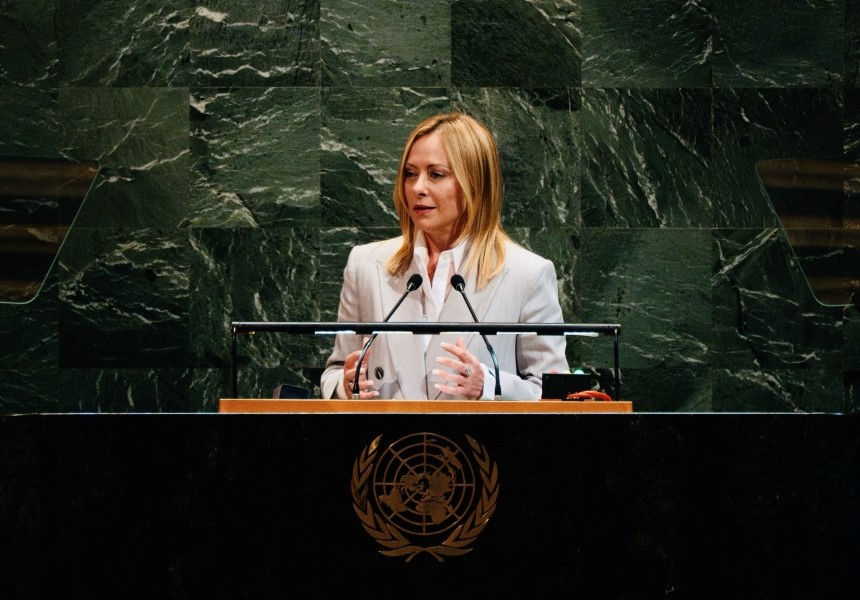
Giorgia Meloni opened her address at the 80th UN General Assembly in New York by describing a world on the edge «between war and peace». Quoting Pope Francis, the Prime Minister spoke of a «third world war fought in pieces», emphasizing that the number of armed conflicts is at a historic high.
«According to the 2024 Global Peace Index, there are currently 56 conflicts underway around the world, the highest number since World War II».
This, Meloni said, demonstrates the failure of the UN’s founding mission in 1945: to guarantee peace. «Have we succeeded? The answer lies in today’s headlines, and it is merciless. Peace, dialogue, and diplomacy are no longer convincing or prevailing».
Among the most serious crises, Meloni singled out Moscow for its invasion of Ukraine, denouncing an unprecedented violation of international rules by a permanent member of the Security Council.
«The Russian Federation has deliberately trampled on Article 2 of the UN Charter, violating the integrity and political independence of another sovereign state with the intention of annexing its territory».
The Prime Minister then criticized the Kremlin’s ongoing unwillingness to engage in negotiations: «Even today, Moscow refuses to seriously consider any invitation to sit at the peace table. This deep wound inflicted on international law has triggered destabilizing effects far beyond Kyiv’s borders».
A significant portion of Meloni’s speech was dedicated to the conflict in the Middle East, which she linked to the broader context of global instability worsened by the war in Ukraine. She described Israel’s initial response to Hamas’s October 7, 2023 attacks as «legitimate», but strongly condemned the ongoing military operation in Gaza.
«The ferocity and brutality of that attack, the hunt for defenseless civilians, pushed Israel to react—initially in a legitimate way, as every state has the right to defend itself. But the response to aggression must always respect the principle of proportionality. Israel has crossed that line, violating humanitarian norms and causing a massacre of civilians».
For this reason, Italy will vote in favor of certain European sanctions against Israel.
Meloni reiterated that primary responsibility lies with Hamas, which must immediately release all hostages:
«We do not join those who place all the blame for what is happening in Gaza on Israel. It is Hamas that unleashed the war, and it is Hamas that could end the suffering of the Palestinians by freeing the hostages right now. Instead, it seems to thrive on the suffering of the very people it claims to represent».
Regarding the region’s future, the Prime Minister reaffirmed Italy’s long-standing position in favor of a two-state solution: «Israel does not have the right to prevent the future establishment of a Palestinian state, nor to build new settlements in the West Bank to block it».
However, she set two preconditions for international recognition of Palestine: «The release of all Israeli hostages and Hamas’s renunciation of any role in the Palestinian government. Those who sparked the conflict cannot be rewarded».
Meloni urged Israel to «break free from the trap of this war» and expressed support for proposals put forward by the U.S. President together with Arab countries for a permanent ceasefire.
«Peace is not built with mere appeals or ideological proclamations, but with patience, courage, and reasonableness. Italy is ready and will remain ready to support anyone willing to work on a serious plan for the release of hostages, an end to hostilities, the exclusion of Hamas, and a concrete prospect of two states living side by side in peace and security».
Turning to institutional matters, Meloni called for a profound reform of the United Nations, describing the current international structure as «frozen eighty years ago».
«Multilateralism, dialogue, and diplomacy are empty words without institutions that function as they should».
The goal, she explained, must be to make the UN more agile and transparent: «The Glass Palace must truly be a house of glass, able to respond quickly to crises, cut waste and duplication, and ensure transparency in costs and mission».
The Prime Minister then addressed the issue of migration and asylum rights, stressing the need to update international rules to meet today’s challenges.
«The current conventions were written at a time when mass irregular migration and human trafficking did not exist».
She said, criticizing the «ideological and one-sided» interpretations of «politicized judiciaries». The aim, she clarified, is not to lower protections but rather «to build a system in step with the times, capable of safeguarding fundamental human rights alongside every nation’s sacred right to defend its borders and manage migration flows».
In the final part of her speech, Meloni sharply criticized what she called «unsustainable environmentalism», accusing Western «green plans» of leading «to deindustrialization long before decarbonization».
«Thirty years of blind globalization have ended, and today we see the consequences: unsustainable production models imposed from above, entire productive sectors in crisis, impoverished middle classes, and irrational consumer choices. This is not about denying climate change, but about affirming technological neutrality and gradual reforms, placing humanity at the center».
Meloni concluded by invoking Saint Francis, noting that this year also marks the 70th anniversary of Italy’s entry into the United Nations: «The toughest battles are reserved only for those with exemplary courage», she quoted, urging the international community to show that courage to build «a more just and secure world». It was, she said, an appeal not to waste the historic opportunity presented by today’s global challenges.