
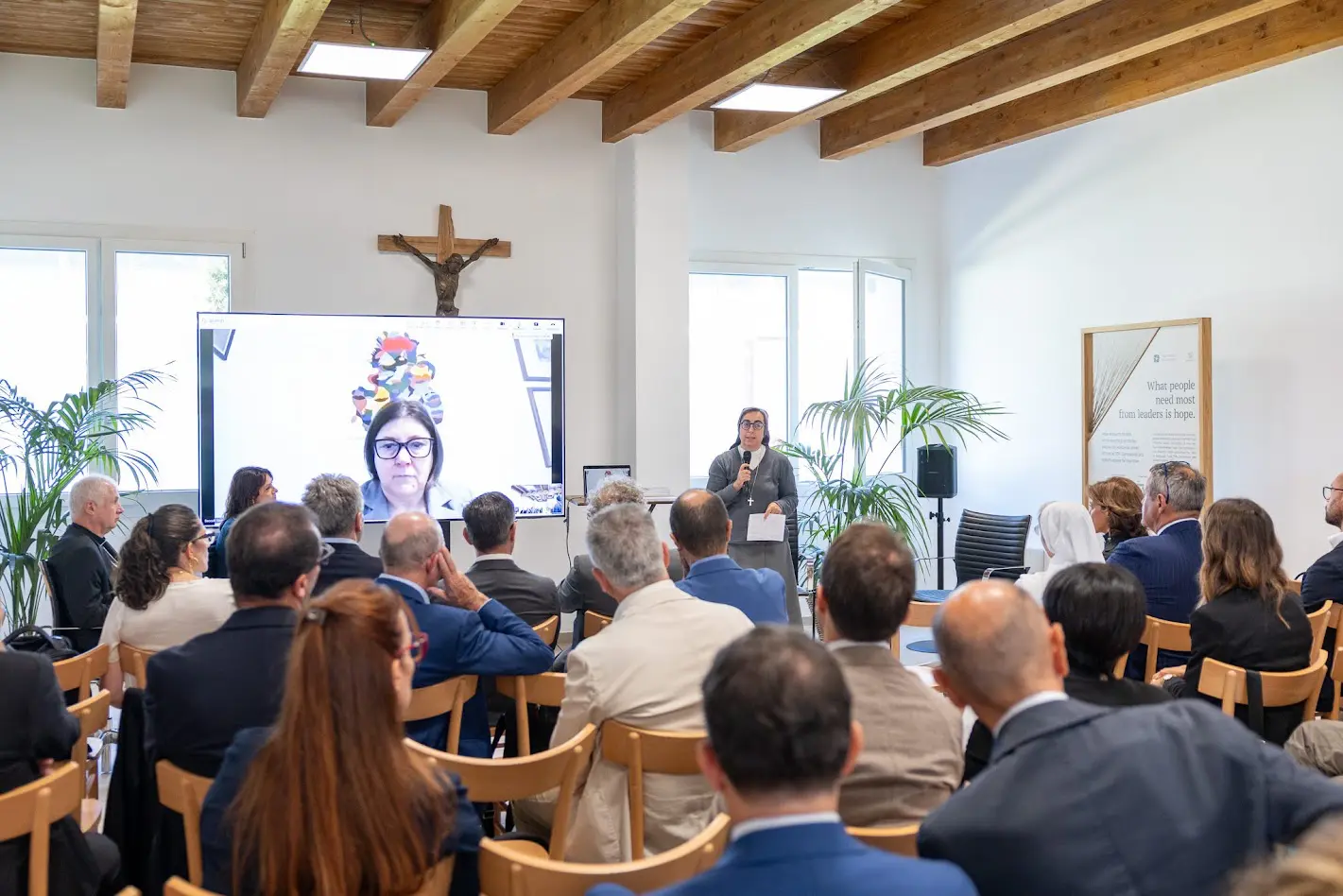
ROMA (ITALPRESS) – A 360° view of the phenomenon of Renewable Energy Communities, thanks to the contribution of six faculties of the Catholic University of the Sacred Heart, with a series of results that can be spent operationally in a booming sector, between the promotion of renewable sources and the benefits for communities. “CER-CARE – Renewable Energy Community between Care and Research: Approaches and tools for Resilience and Equity” is the theme of research within the framework of the project of particular interest to the University (financing line D3.2 2022). The study was presented during the event that took place on Wednesday, September 16 in Borgo Laudato Si’ of Castel Gandolfo.
“Presenting this project – said the director of the Catholic University of the Sacred Heart Elena Beccalli, connected by Milan – is a concrete demonstration of our mission to be a research university, capable of generating a profitable dialogue between generations and disciplines. In this context, projects of particular interest for the University, supported with internal resources, aim to investigate the great issues of our time, such as the impacts of the climate crisis and the contrast to inequalities. This is precisely the CER-CARE project dedicated to analyzing, in the last three years, the nature and impact of the Renewable Energy Communities, such as tools of real social innovation, as well as technological, in response to energy inequalities.”.
According to Sister Alessandra Smerilli, Prefect of the Dicastery for the Integral Human Development Service, “ integral ecology is not only taking care of the planet and nature: it is the care of relations with others, with creation, but also with ourselves and with God. This means ‘integral’. It is important to put together research and professionalism with the look that makes us see the world as a set of relationships that we must build and preserve.” For Professor Alessandra Vischi, head of the CER project, “one of the most significant elements of these three years of research was the interdisciplinary, interfaculty and intersect work that allowed to put in dialogue different knowledge, skills and languages, in the perspective of a reasearch university. The synergy between different faculties has represented an added value for university research increasingly based on the integration of knowledge, to address contemporary challenges in line with identity values and the mission of the University.”.
“It is an honor for the Catholic University of the Sacred Heart to interact with this reality of the Laudato village, with which he shares intent and purpose, especially through the experience of the Alta Scuola per l’Ambiente, born even before the publication of the Laudato si’,” commented Monsignor Claudio Giuliodori, general ecclesiastical assistant of the University. “Borgo Laudato It shows that energy transition is not only a technological necessity, but an opportunity to rethink our relationship with the environment and with local communities. It is from this vision that the model of a real ‘positive energy strategy’ is born, in which engineering and innovation serve the community, environmental protection and future generations,” said Antonino Errigo, Secretary General Laudato High Formation Centre.
The CER-CARE project is a three-year work that involved six different working groups organised around the Faculty of Educational Sciences, Mathematical, Physical and Natural Sciences, Banking, Financial and Insurance Sciences, Political and Social Sciences, Agricultural, Food and Environmental Sciences, Economics and Jurisprudence. The research project has highlighted that, despite having a strong inclusive potential, the CERs tend to develop mainly in contexts already equipped with economic resources, technical skills, social capital and efficient administrations and as precisely the most fragile areas, where the benefits would be more necessary, they encounter greater obstacles to the spread of CERs. According to researchers of the Faculty of Mathematical, Physical and Natural Sciences, they become so fundamental not so much economic incentives, as well as targeted public policies, support for local authorities and organizational models capable of involving vulnerable citizens and families.
Equally necessary for the functioning of a CER, as the Faculty of Education explains, are charismatic leadership, informed citizens, sense of responsibility and ability to cooperate: formation, in this perspective, plays a primary role. Among the results of the project, from the financial point of view, the Faculty of Banking, Financial and Insurance Sciences examined how to structure the contract between CER and energy service companies (ESCo), to encourage the operator’s commitment, to share risk and preserve the social aims of the community.
The aim is to identify contractual conditions and policy interventions aimed at improving the financial sustainability of CER, without compromising its social function. In legal terms, the research has highlighted some critical aspects of the current framework that can affect the certainty of tax treatment and, consequently, the organizational choices of operators. In the study of the Faculty of Economics and Jurisprudence it emerged also how the CERs should balance economic and social goals, generating possible decision-making tensions. This resulted in the identification of a meta-requisite design to manage the trade-off between efficiency and inclusion and the definition of principles for the development of dashboards capable of supporting transparent decisions through ad hoc simulations, data traceability and multidimensional impact indicators.
The research has also allowed the development, thanks to the contribution of the faculty of Political and Social Sciences, of the guidelines, an operating booklet, containing the regulatory, organizational and process solutions more adequate than the different models of CER and the different objectives pursued. The research group of the faculty of Agricultural, Food and Environmental Sciences, finally, has created a solid “energy bridge” between the Cer promoted by the Catholic University of the Sacred Heart and EDUCatt with the project eXnovo, the social cooperative L’Orto Botanico, an initiative of social agriculture born within the Casa Circondariale of Piacenza, with a mutual advantage: on the one hand the CER could have achieved a further guarantee of economic This experience has given the opportunity to demonstrate how a renewable energy community can take on a strong social connotation and become a concrete instrument of solidarity.
– Photo press office Catholic University –
(ITALPRESS).
