

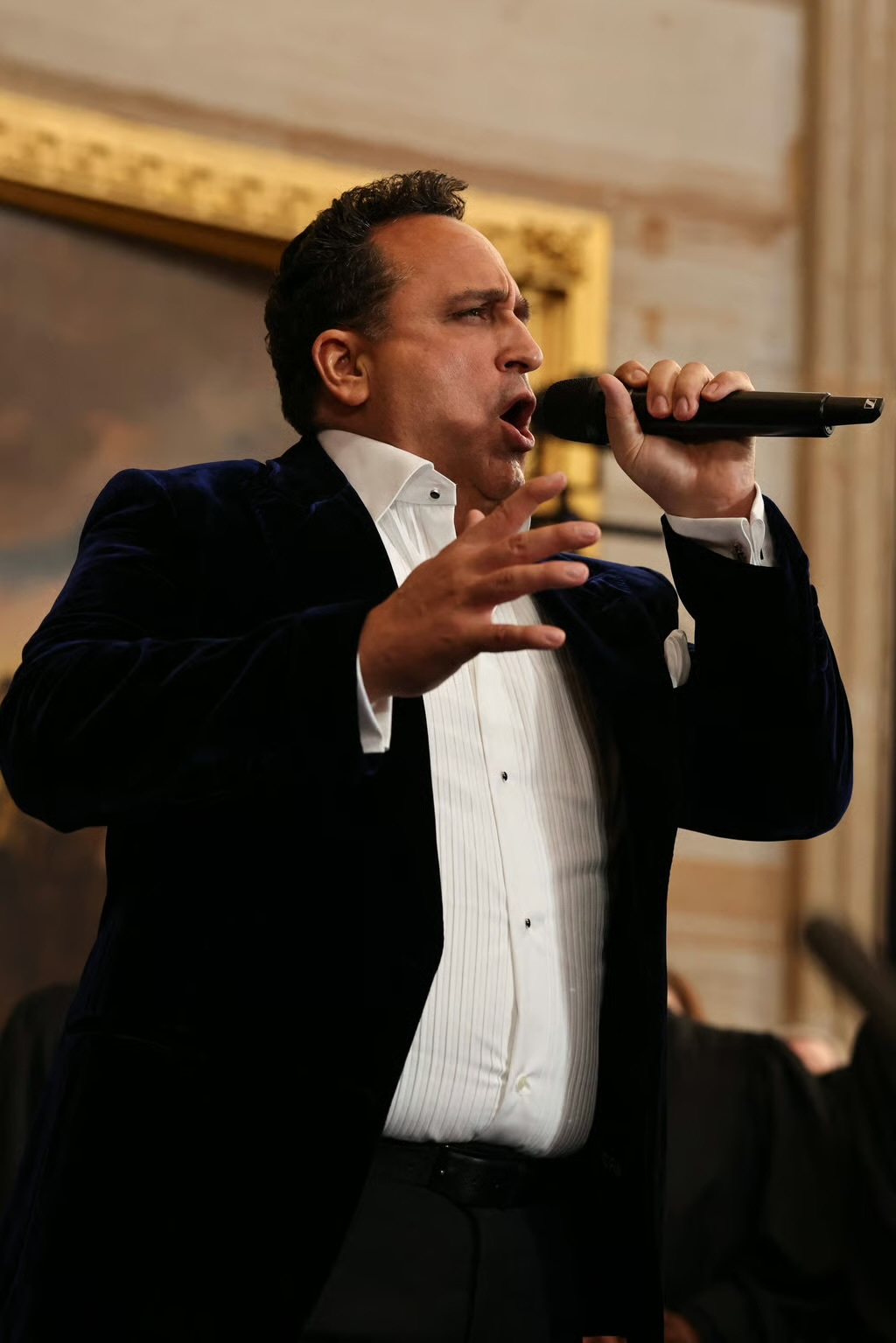
Christopher Macchio, an Italian-American tenor from Holbrook, Long Island, is renowned for his powerful and versatile voice, effortlessly moving from classical repertoire to modern crossover. A graduate of the Manhattan School of Music, he has built an international career both as a soloist and as a member of the New York Tenors, performing on prestigious stages such as Carnegie Hall and Lincoln Center. He has released acclaimed albums, including Dolci Momenti and O Holy Night, and has expanded his fame through television appearances and collaborations with prominent artists in the films Don Q (2024) and Cabrini (2025). In 2025, Macchio had the honor of singing the United States national anthem at Donald Trump’s presidential inauguration, bringing his voice to a global audience.
Macchio unites opera and contemporary crossover naturally, treating them as complementary forms of expression. “I do not see opera and contemporary performance as opposites,” he explains. “Each has its own language, its own beauty, and its own way to reach the listener.” In his view, the boundaries that often separate classical and modern music are more a matter of perception than reality, allowing him to bridge genres while staying true to his artistic vision.
Macchio’s training is rooted in classical discipline, which he considers essential for building a strong foundation. “Opera represents the most refined form of vocal technique,” he affirms, emphasizing that mastery of the classical tradition allows him to explore contemporary genres with confidence and depth. Yet he is quick to add that technique alone is never the ultimate goal. “At the end of the day, it is not about the notes or the perfect sound,” he says. “It is about creating a response in the listener, touching them in a way that goes beyond technique. Communication is always the center, not the categories we impose.” For Macchio, music is about connection between artist and audience, past and present, and different musical worlds.
Today, his work is primarily focused on crossover, blending elements of opera with contemporary styles in innovative ways. He avoids rigid definitions, preferring to let the music guide the interpretation rather than the other way around. “Sometimes a more modern style is more accessible, even more effective depending on the context,” he observes. Rather than adhering to a single genre, he adapts continuously, moving between styles as fluidly as a dancer shifts steps. “It is like driving a Formula 1 car: you are on the same track, but you keep shifting gears,” he explains, drawing an analogy to the careful balance of precision and speed required in both music and racing. He considers this adaptability a rare and valuable skill. “I feel fortunate to have this flexibility, because not everyone can move easily between different musical languages. It opens doors to collaboration, experimentation, and new ways of expressing emotions.”
Macchio’s journey into music was neither planned nor gradual. At fifteen, he had not yet considered singing as a possible career or even a serious pursuit. His first encounter with his own voice happened almost by chance, and with initial reluctance. “I did not want to attract attention,” he recalls with a hint of a smile. “When the teacher asked me to sing in front of the class, I refused outright.” It was only after remaining alone in the classroom with the teacher that he finally agreed to try. The reaction was immediate and striking. “He was shocked,” Macchio recounts. “He told me I had a gift and an obligation to share it. That moment changed everything for me. It was the first time I understood that my voice could have a purpose beyond myself.”
Soon after, he auditioned for a prestigious summer program, an experience that initially felt daunting. “During the audition they showed no reaction,” he recalls. “I walked out thinking I had failed completely.” The following day brought a remarkable surprise: “They called saying they were shocked,” he explains. “What struck them was not just the quality of my voice, but that I had only been singing for a few months. It affirmed that I was on the right path.” A subsequent evaluation by a highly experienced musician confirmed the impression. “He told me my voice was world-class and completely natural. In that moment I understood that music could be more than a passion; it could become a serious vocation.” This early recognition laid the foundation for a career defined by both technical excellence and emotional authenticity.
Macchio’s connection with traditional and patriotic repertoire further shapes his artistic identity. While he embraces contemporary technologies and media to communicate with audiences, he remains deeply rooted in enduring principles. “On a practical level, I love technology and modern media,” he says, “but I have always believed that there are fundamental values that should not change. Music is a vessel to express those values, not just to entertain.” Patriotic and traditional pieces, in his view, represent continuity and a link to cultural heritage. “They reflect the foundations of our civilization,” he explains. “Bringing them to the stage is not simply a stylistic choice; it is a conscious act of giving voice to the system of values that shaped us.” This connection gives his performances a sense of purpose and gravitas that resonates with audiences across generations.
Managing the balance between emotional intensity and technical control is one of the central challenges of his work. “There is a fine line,” he admits, “between letting yourself be carried away by the music and maintaining the structure that technique provides. I feel a responsibility to both.” He acknowledges that this tension can make it difficult to fully abandon oneself to the performance, especially in classical singing where precision is paramount. “In genres like jazz or blues, there is more room for spontaneity and imperfection,” he observes. “Classical music requires a different kind of discipline, but the goal is the same: to create an immersive experience for the listener.” Audience reactions suggest that he succeeds, with performances often perceived as both controlled and deeply moving.
Despite receiving recognition early on, Macchio has maintained an approach to his career that is far from fame-seeking. “It has never been about attention or success,” he states firmly. “From the beginning, I understood that this was a gift, and that it carried a responsibility. That awareness has guided my choices and focus.” Rather than focusing on personal acclaim, he prioritizes the impact of his work on others. “I want to move people. I want to touch something deeper, to remind them of the beauty and nobility of being human. That is the measure of success for me.” In a cultural landscape that he sometimes sees as fragmented or distracted, his intention remains resolute. “If my music succeeds in elevating people, even only in part, then I have done something meaningful. That is what drives me every day.”
Christopher Macchio’s journey demonstrates that the greatest artistry lies not in the performance itself, but in the connections it creates, the stories it tells, and the values it conveys.